
Supreme Court Caveat Filing Services Since 2014
Legal Service India started its Supreme Court Caveat Filing service in 2014. From 2014 to April 2026, we have filed 32,676 caveats in the Supreme Court of India. Our service is designed for advocates and litigants who have succeeded before a High Court and want to take a timely precaution in case the unsuccessful party approaches the Supreme Court.
We understand the practical difficulty: High Courts and their benches are spread across India, while the Supreme Court is in New Delhi. Lawyers and clients should not have to make a journey to Delhi merely to arrange caveat filing. Contact us from your city; we coordinate the filing process with the required Supreme Court Advocate-on-Record (AOR).
Our focus is to make the process quick, cost-effective and efficient, with a target of completing our filing-side work within 24 hours after receiving complete instructions and documents, subject to AOR review and the Supreme Court Registry's requirements.
Supreme Court caveats are subject to the applicable Supreme Court Rules and filing requirements. Filing does not guarantee a particular judicial outcome.
What Is a Caveat?
A caveat is a legal notice filed by a person who apprehends that a court may pass an order in a matter affecting their interests without first hearing them. The caveator asks the court to give notice of the relevant application and an opportunity to be heard in accordance with the applicable law and procedure.
In the Supreme Court of India, caveat filing is subject to the Court’s Rules and applicable filing practice. The original material on this page states that a Supreme Court caveat is ordinarily filed through an Advocate-on-Record (AOR), except where a person is permitted to appear in person.
Why Supreme Court Caveat Filing Requires an Advocate-on-Record
Supreme Court practice is different from practice before a High Court or a district court. An advocate enrolled with a State Bar Council is not automatically an Advocate-on-Record of the Supreme Court. Under the Supreme Court Rules, an Advocate-on-Record is authorised to act for a party and take procedural steps in the matter. An advocate who is not an AOR cannot independently act for a party before the Supreme Court, although the Rules permit an advocate to appear and plead when instructed by the AOR or when the Court permits.
For a caveat represented through an advocate, the required AOR involvement and vakalatnama must be in place. The Rules also contemplate a party appearing in person in accordance with the applicable procedure. Legal Service India assists lawyers and clients by coordinating the caveat filing with the appropriate AOR. If you are an advocate practising in any High Court, you can approach us on behalf of your client; you do not need to travel to Delhi to coordinate the process.
Won Your Case in the High Court? Consider Filing a Caveat in the Supreme Court
A favourable judgment or order from a High Court may not always end the dispute. The unsuccessful party may consider filing a Special Leave Petition, appeal or another proceeding before the Supreme Court and may also seek interim relief. In an appropriate case, the successful party should consider lodging a caveat so that the Court and the other side are alerted to the caveator's request for notice.
Without a caveat, an application may in some circumstances be placed before the Court before the successful party has received notice or an opportunity to respond. This can be particularly consequential where urgent interim relief is sought. A caveat is not a guarantee against an adverse order, nor does it prevent the other side from filing an appeal; it is a procedural step intended to protect the caveator's opportunity to be heard in the matter covered by it.
Every State has a High Court, and some High Courts have benches in different locations. Legal Service India offers a central point of coordination for lawyers and clients across India who need assistance with caveat filing in the Supreme Court at New Delhi.
Why Lawyers and Clients Choose Legal Service India
- Service since 2014: We have been providing Supreme Court caveat filing assistance since 2014.
- 32,676 caveats filed: Our stated filing record from 2014 through April 2026.
- Nationwide coordination: Lawyers and clients can approach us from any State or High Court location.
- No need to travel to Delhi: The process can be coordinated remotely, subject to the documents and formalities required.
- Quick turnaround: We aim to complete the filing-side process within 24 hours after receiving complete instructions and documents, subject to AOR review and Registry processing.
- Cost-effective and efficient: We focus on a practical, streamlined process and communicate the applicable charges before proceeding.
- Renewal assistance: We can assist with a fresh caveat when renewal or re-lodging is required under the applicable rules.
The filing figure and service history above are supplied by Legal Service India. The 24-hour period is a service target, not a guarantee of Registry acceptance, registration or listing.
How to File a Caveat in the Supreme Court of India
Whether you are the successful party in a High Court matter, the advocate handling the case, or a client seeking to protect your position, you can contact Legal Service India remotely. We will review the basic details, explain the information and documents required, and coordinate the filing through the appropriate AOR.
Receive the procedure
We will respond with the filing procedure and information required for your matter.
Provide the documents
Submit the required information, documents and applicable fees as advised.
Filing and registration details
After the filing requirements are completed, the caveat is processed for filing. The registration details are shared when available.
Verify the filing
Use the registration details to check the filing status through the official Supreme Court channels.
Our target is to complete the filing-side work within 24 hours of receiving complete instructions and documents. This is not a guarantee of Registry acceptance or registration within 24 hours; scrutiny, defects, court requirements and Registry processing are outside our control.
Benefits of Filing a Caveat
- Alerts the court that the caveator claims a right to be heard in the anticipated proceeding.
- Helps the caveator receive notice of an application covered by the caveat.
- Provides an opportunity to place submissions before the court, subject to the applicable procedure.
- May reduce the risk of an order being considered without the caveator having notice.
- Allows an interested person to take a precautionary step before the expected application is heard.
When Should a Caveat Be Filed?
A caveat may be appropriate when a person has reason to believe that an application or proceeding affecting their interests is likely to be filed. For example, a person may consider a caveat after a lower court judgment if they reasonably apprehend that the opposing party may approach an appellate court for interim relief. Timing matters: seek advice promptly so that the caveat can be lodged before the anticipated application is taken up.
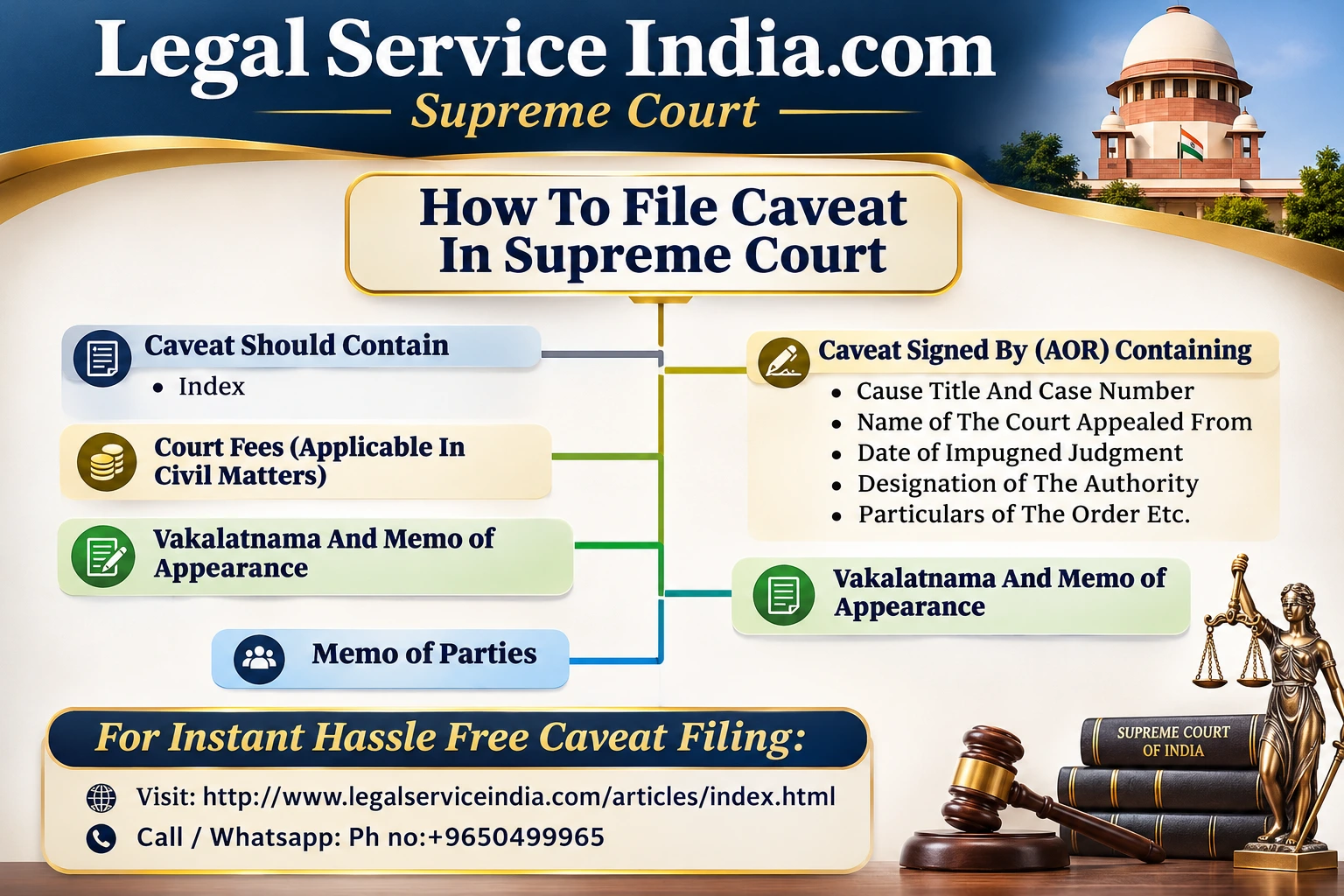
Documents Required to File a Caveat
The precise documents depend on the court, the nature of the proceeding and the filing requirements. The source material identifies the following as documents or particulars that may be required:
- Index of the filing papers.
- Caveat application prepared and signed in the manner required by the applicable rules, including by an AOR where required.
- Cause title and case number, where available.
- Details of the court appealed from and the date and particulars of the impugned judgment or order.
- Court fees, where applicable.
- Vakalatnama and memo of appearance, as applicable.
- Memo of parties and relevant party particulars.
- For a person seeking to appear in person: the required permission/application, affidavit, applicable court-fee material and valid identity proof, as directed by the court.
Essential Particulars for a Caveat Petition
- Name of the court in which the caveat is to be lodged.
- Suit, petition or appeal number, if already assigned.
- Name and contact details of the caveator.
- Brief details of the expected suit, petition or appeal.
- Name of the likely applicant, plaintiff or appellant, where known.
- Relevant judgment, order or proceeding details, where available.
Where Can a Caveat Be Filed?
Section 148A of the Code of Civil Procedure, 1908 provides for lodging a caveat in civil proceedings before a court. The appropriate court and filing procedure depend on the proceeding that is anticipated. A caveat should be lodged in the court where the relevant application is expected to be made, subject to the applicable procedural rules.
Section 148A of the Code of Civil Procedure, 1908
The statutory basis for caveats in civil proceedings is Section 148A of the Code of Civil Procedure, 1908 (CPC). Broadly, the provision allows a person who claims a right to appear before a court in a suit or proceeding that has been, or is about to be, instituted to lodge a caveat.
The section also sets out duties concerning notice to the caveator and the applicant. Under Section 148A(5), a caveat generally remains in force for 90 days from the date of lodging, unless the application referred to in the caveat is made within that period. If the anticipated application is not made within the period, a fresh caveat may be necessary.
Can a Non-Party to a Suit File a Caveat?
The original material refers to the Supreme Court’s order dated 28 June 2021 in SLP (C) No. 12158 of 2020. It records that a caveator may be entitled to notice of the lodging of an SLP, but filing a caveat does not, by itself, make that caveator a party to the proceedings. Whether a person has the requisite right to lodge a caveat depends on their claimed interest and the applicable law.
Important Decisions Discussing Caveats
- Nirmal Chandra Dutta v. Girindra Narayan Roy (AIR 1978 Cal 492): The source material cites this decision for the understanding of a caveat as a caution to the court and the importance of notifying the caveator.
- Kattil Vayalil Parkkum Koiloth v. Mannil Paadikayil Kadeesa Umma (AIR 1991 Ker 411): The source material cites this decision in connection with the interest required to lodge a caveat.
These references should be read alongside the statutory text and the current procedural rules applicable to the court and proceeding concerned. For current filing guidance, consult the Supreme Court of India e-Filing FAQs and the official Supreme Court website.
Important Caveats Articles
Watch: Caveat Filing in the Supreme Court
Frequently Asked Questions About Caveat Filing
What is the validity of a caveat?
Under Section 148A(5) CPC, a caveat generally remains in force for 90 days from the date it is lodged, unless the anticipated application is made within that period.
Can any advocate file a caveat in the Supreme Court?
No. An advocate enrolled with a State Bar Council is not automatically an Advocate-on-Record. Under the Supreme Court Rules, an AOR is authorised to act for a party. A non-AOR advocate may appear and plead when instructed by the AOR or permitted by the Court, but cannot independently act for a party. A party-in-person route is subject to the Court's applicable procedure.
Can a lawyer from another State arrange Supreme Court caveat filing?
Yes. A lawyer practising before a High Court can contact Legal Service India on behalf of the client. We coordinate the Supreme Court filing process with the required AOR, so the lawyer and client do not need to travel to Delhi merely to arrange filing.
How long does Legal Service India take to file a caveat?
Our target is to complete the filing-side work within 24 hours after receiving complete instructions and documents. The actual filing and registration timeline depends on AOR review, completeness of papers, court requirements and Registry processing.
Can a Supreme Court caveat be renewed?
Under the applicable Supreme Court Rules, a caveat ordinarily remains in force for 90 days unless the petition or application is made within that period. If the anticipated proceeding is not filed within the validity period, a fresh caveat may be required. Contact us in good time for renewal or re-lodging assistance.
Does filing a caveat prevent the other side from filing a case?
No. A caveat does not prevent another person from instituting proceedings. Its purpose is to request notice and an opportunity to be heard in the application covered by the caveat, subject to law and procedure.
Does a caveat guarantee that no order will be passed against me?
No. A caveat is not a guarantee of the result. It is a procedural safeguard intended to provide notice and an opportunity to be heard where the law applies.
What details should I send for a caveat filing enquiry?
Share the court name, case or appeal number if available, details of the order or judgment, the parties’ names and a brief explanation of the anticipated application. Do not email original or sensitive documents until the filing team explains the secure submission process.
How do I contact Legal Service India for caveat filing?
Call 9650499965 or email [email protected] with the subject “Caveat Filing Enquiry”.
Need to File a Caveat in the Supreme Court? Contact Us Today
Whether you are a lawyer or a litigant who has succeeded before a High Court, contact Legal Service India for quick, cost-effective and efficient Supreme Court caveat filing assistance. Service since 2014, with 32,676 caveats filed through April 2026.
General information only: This page is intended for general legal awareness and does not constitute legal advice. Caveat eligibility, drafting, service of notice, filing requirements and the effect of a caveat depend on the facts and the current rules of the relevant court. Obtain advice on your specific matter before taking action.