


Law -
Copyright - Copyright Registration
Copyright Registration in India
Register your Copyright Online Copyright your Book, Song, Video, Software, Film Script, Designs, LyricsWe have accomplished over 1161324 Copyright Registration In India as of September 2026
Copyright Registration Process and Procedure in India: A Complete Legal Guide
Creating something original is often the result of months or even years of imagination, skill, research and hard work. A book, song, photograph, software programme, film, painting, website content or other creative work may have substantial commercial value.
But there is an important distinction that every creator should understand:
Copyright protection and copyright registration are not the same thing.
Under Indian law, copyright generally comes into existence automatically when an original work protected by the Copyright Act, 1957 is created. Registration is not a compulsory condition for the existence or enforcement of copyright. However, Copyright Registration can provide valuable documentary evidence of the particulars entered in the Register of Copyrights and may become extremely useful when ownership, authorship or other particulars are disputed. Section 48 expressly provides that the Register of Copyrights is prima facie evidence of the particulars entered in it.
That is why understanding the Copyright Registration Process and Procedure is important for authors, artists, musicians, software developers, filmmakers, businesses, publishers and other creators.
What Is Copyright Registration?
Copyright registration is the process by which the particulars of a copyright work are entered in the Register of Copyrights maintained by the Copyright Office.
The Copyright Act, 1957 provides a statutory mechanism for registration. Section 44 permits registration of copyright, while Section 45 deals with entering particulars of copyright in the Register. The Copyright Rules, 2013 prescribe the procedural requirements, including the use of Form XIV for an application for registration.
It is important, however, not to misunderstand the legal effect of registration.
Registration does not magically create copyright in a work that is otherwise not copyrightable. Nor does a registration certificate prevent a court from examining questions such as originality, authorship, ownership or subsistence of copyright.
The Delhi High Court has also emphasised the evidentiary significance of registration and Section 48, while recognising that registration does not automatically determine every underlying copyright dispute.

Thank You For Your Trust In Us
File Your Copyright - Right Now!
Call us at: 9891244487 / or email at: [email protected]
Copyright Registration vs Copyright Protection
A simple way to understand the distinction is:
| Copyright Protection | Copyright Registration |
|---|---|
| Generally arises automatically when an eligible original work is created | Involves filing an application with the Copyright Office |
| Does not ordinarily depend upon registration | Is an optional statutory registration mechanism |
| Protects qualifying original expression under the Act | Creates an official record of the particulars registered |
| Can exist without registration | Provides useful documentary and evidentiary value |
| Registration is not the source of the copyright | Section 48 gives the Register prima facie evidentiary value |
This distinction is fundamental to understanding the Copyright Registration Process and Procedure in India.
Why Should You Register Copyright?
If registration is not compulsory, a natural question arises:
Why should a creator register copyright at all?
The answer lies primarily in evidence and documentation.
A copyright dispute may arise years after a work was created. By that time, emails may have been deleted, files may have been modified, contracts may be difficult to locate and memories may become unreliable.
A properly maintained copyright registration record can provide important documentary evidence concerning the work and the particulars entered in the Register.
Section 48 of the Copyright Act provides that the Register of Copyrights is prima facie evidence of the particulars entered therein. Certified copies or extracts from the Register are also admissible in court without requiring production of the original Register.
Therefore, registration can be particularly useful where a creator anticipates:
- commercial exploitation of the work;
- licensing or assignment of copyright;
- collaboration with publishers, producers or businesses;
- disputes concerning authorship or ownership;
- unauthorised copying;
- commercial infringement;
- licensing negotiations; or
- future litigation concerning the work.
Registration Is Evidence, Not an Absolute Guarantee
One should avoid describing a copyright certificate as a �fool-proof stamp of ownership.�
That would be legally too broad.
Registration has evidentiary significance, but a court can still examine whether copyright actually subsists in the work, whether the work is original, who created it, whether rights were assigned, and other relevant questions.
The legal position has been repeatedly recognised by Indian courts: copyright registration is not a substitute for proving the underlying legal requirements where those matters are genuinely disputed.
What Works Can Be Protected by Copyright in India?
Section 13 of the Copyright Act recognises copyright in certain classes of works, subject to the requirements of the Act.
Broadly, these include:
1. Literary Works
Literary works include books, articles, manuscripts, written material and other works falling within the statutory definition.
Importantly, computer programmes and computer databases can also fall within the literary-work category where the statutory requirements are satisfied.
2. Dramatic Works
Dramatic works are separately recognised under the Act and may include works intended for performance.
3. Musical Works
Musical works include musical compositions. The legal concept of a musical work should be distinguished from a sound recording embodying that music.
4. Artistic Works
Artistic works can include:
- paintings;
- drawings;
- photographs;
- sculptures;
- maps;
- charts;
- diagrams;
- architectural works; and
- works of artistic craftsmanship.
5. Cinematograph Films
Cinematograph films constitute a separate class of copyright-protected work.
This may include films and other audiovisual works falling within the statutory definition.
6. Sound Recordings
Sound recordings constitute another distinct category of copyright work.
A single commercial song, for example, may involve several different copyright interests, including the underlying musical work, lyrics and sound recording.
What Does Copyright Actually Protect?
This is one of the most important questions for creators.
Copyright protects original expression, not every idea, concept, thought or general subject matter.
For example, the idea of writing a book about artificial intelligence is not, by itself, the same thing as copyright protection over the particular original text written by an author.
Similarly, the idea for a film may not receive copyright protection merely because somebody thought of it first. The legal protection depends upon the nature of the work and the original expression embodied in it.
This distinction becomes particularly important in disputes involving:
- business ideas;
- film concepts;
- website concepts;
- software functionality;
- advertising concepts;
- educational formats; and
- general themes or subjects.
The registration of a work therefore should not be understood as automatically granting a monopoly over an underlying idea.
Copyright Registration Process and Procedure in India
The Copyright Office presently provides an online filing system through which applicants can submit copyright registration applications and track their applications. The official portal provides facilities for e-filing, registration through Form XIV, status tracking, deficiency information and other copyright-related services.
The broad Copyright Registration Process and Procedure can be understood in the following stages.
Step 1: Identify the Correct Category of Work
Before filing an application, determine the category into which the work falls.
For example:
- book → literary work;
- software → literary work/computer programme;
- painting → artistic work;
- photograph → artistic work;
- song composition → musical work;
- recorded music → sound recording;
- film → cinematograph film.
Correct classification is important because the Copyright Office requires the applicant to provide particulars appropriate to the work being registered.
Step 2: Collect the Relevant Documents
The applicant should keep the work and supporting documents ready before beginning the online application.
Depending upon the nature of the work and the ownership structure, documents may include:
- copy of the work;
- details of the author;
- details of the copyright owner;
- authorisation documents;
- assignment documents, where applicable;
- No Objection Certificate where required;
- power of attorney, where applicable;
- identity and address details;
- supporting declarations; and
- other documents required by the Copyright Office.
The precise documentation can vary according to the nature of the work and the applicant's circumstances.
Step 3: Create an Account on the Copyright Office Portal
The official Copyright Office portal provides an online registration facility.
Applicants can create/login to their account and access the copyright registration module. The Copyright Office's current instructions require the applicant to log in and select the online copyright registration facility.
Step 4: Complete Form XIV
Under Rule 70 of the Copyright Rules, 2013, an application for registration of copyright is made in Form XIV.
The Rules also provide that an application is ordinarily made in respect of one work and must be accompanied by the prescribed fee.
The information supplied should therefore be carefully checked before submission.
Errors concerning:
- authorship;
- ownership;
- title of the work;
- publication details;
- assignment;
- applicant details; or
- the classification of the work
can create avoidable complications later.
Step 5: Upload the Work and Supporting Documents
The Copyright Office has facilities for online submission and uploading of relevant works and documents.
The Office has specifically provided for online uploading of literary, dramatic and artistic works and related documents.
For computer programmes, the Copyright Rules prescribe specific requirements concerning submission of source/object code and related material.
Applicants should therefore follow the document and upload requirements applicable to their particular category of work rather than assuming that the same documents are required for every type of copyright application.
Step 6: Pay the Prescribed Fee
The application must be accompanied by the prescribed fee applicable to the relevant category of work.
The fee structure is contained in the applicable Schedule to the Copyright Rules and applicants should verify the current fee applicable to their work before filing.
Step 7: Application Receives a Diary Number
After submission, the application is assigned a diary/application reference number.
This number becomes important for tracking the progress of the application.
The Copyright Office currently provides an online facility for checking application status by diary number.
Step 8: The 30-Day Objection Period
This is an important part of the Copyright Registration Process and Procedure and is frequently misunderstood.
Under Rule 70, the registration process includes a period during which objections may be raised by persons claiming an interest in the subject matter or disputing the applicant's rights.
The Rules contemplate a 30-day period following receipt of the application for objections. A 2026 Calcutta High Court decision also recently considered the operation of Rule 70(9) and Rule 70(10), including the significance of the 30-day period and the Registrar's satisfaction regarding the correctness of the particulars.
The 30-day period should therefore not be described as an automatic guarantee that registration will be granted after exactly 30 days.
If an objection is received, the matter may require further examination or hearing.
Step 9: Examination by the Copyright Office
After the applicable procedural stage, the application may be examined by the Copyright Office.
The Registrar may examine:
- whether the application is complete;
- whether the particulars supplied are satisfactory;
- whether the prescribed documents have been furnished;
- whether objections have been received;
- whether clarification or additional documents are required; and
- whether the statutory requirements for registration have been satisfied.
The Copyright Office's current online system also provides facilities relating to deficiency in applications and hearings.
Step 10: Hearing, If Required
If an objection or other issue requires determination, the applicant may be called upon to respond.
The Copyright Office also provides a mechanism for hearings, including video-conferencing facilities in appropriate matters. The Office has previously issued a public notice providing for video conferencing as an alternative mode of hearing in matters listed for hearing under Rule 70.
This makes it particularly important for applicants to monitor their application status and communications from the Copyright Office.
Step 11: Registration and Entry in the Register
If the application satisfies the applicable requirements, the particulars of the work may be entered in the Register of Copyrights.
The Register is maintained in different parts corresponding to categories such as literary works, musical works, artistic works, cinematograph films, sound recordings and computer programmes/databases.
The registration provides an official record of the particulars entered.
Under Section 48, those particulars carry prima facie evidentiary value.
Does Copyright Registration Give You Exclusive Rights?
This question deserves a clear answer.
No�not in the sense that registration itself creates the exclusive copyright.
The Copyright Act grants substantive rights to the owner of copyright in a qualifying work. Registration is a separate statutory mechanism for recording particulars of the copyright.
Copyright acquisition in India is generally automatic and does not depend upon completing the registration procedure.
The practical value of registration is therefore principally evidentiary and documentary.
This distinction becomes extremely important in copyright litigation.
A registration certificate may strengthen the evidentiary position of the registered particulars, but it does not prevent the opposing party from challenging matters such as originality, authorship or ownership.
Does Copyright Registration Guarantee Speedy Justice?
It would be incorrect to say that copyright registration guarantees speedy justice.
Registration cannot guarantee:
- a speedy trial;
- an injunction;
- damages;
- a finding of infringement;
- victory in litigation; or
- automatic recognition of ownership in every dispute.
What registration can do is provide useful documentary evidence concerning the particulars entered in the Register.
The courts remain responsible for determining disputes concerning copyright infringement, ownership, originality and other legal issues.
That is a far more accurate and legally defensible way of explaining the benefit of registration.
Why Early Copyright Registration Can Still Be a Sensible Legal Strategy
Although registration is not compulsory, creators should consider the practical advantages of establishing a strong documentary trail around their work.
For commercially valuable works, it is sensible to preserve:
- dated drafts;
- original source files;
- correspondence;
- contracts;
- assignment deeds;
- invoices;
- publication records;
- metadata;
- development records;
- emails;
- licensing agreements; and
- copyright registration records, where registration is undertaken.
In a dispute, the strength of the case may depend not on one document alone but on the overall chain of evidence demonstrating creation, authorship, ownership and subsequent dealings with the work.
The Role of the Registrar of Copyrights
The Copyright Office is not merely a place where certificates are issued.
The Copyright Office maintains the Register of Copyrights and performs various administrative and statutory functions concerning copyright registration and related matters.
The official Copyright Office currently provides facilities including:
- e-filing of copyright applications;
- registration through Form XIV;
- change in particulars through Form XV;
- application-status tracking;
- deficiency information;
- hearings;
- e-register access; and
- other copyright-related services.
The Registrar's role therefore forms an important part of the statutory copyright-registration framework.
Copyright Registration and Modern Digital Works
The importance of copyright registration has increased with the rapid growth of digital content.
Today, valuable copyright works may include:
- YouTube videos;
- podcasts;
- photographs;
- digital illustrations;
- website content;
- mobile applications;
- software;
- databases;
- online courses;
- digital books;
- advertising creatives;
- music recordings;
- social-media content; and
- other forms of digital expression.
But the digital nature of a work does not eliminate the need to establish who created it and who owns the relevant rights.
For businesses and creators operating online, copyright strategy should therefore ideally include both substantive copyright protection and careful evidence preservation.
Copyright Registration: The Practical Legal Lesson
The biggest misconception is that copyright registration is the process through which copyright itself is born.
That is not the correct way to understand Indian copyright law.
A better way to put it is:
Copyright generally arises from the creation of a qualifying original work; registration creates an official record that can have significant evidentiary value.
That distinction can become decisive when a copyright dispute reaches court.
Registration should therefore be viewed not as a magical shield against infringement, but as one important component of a broader intellectual-property protection strategy.
Frequently Asked Questions on Copyright Registration Process and Procedure
Is Copyright Registration Compulsory in India?
No. Copyright registration is not generally a prerequisite for copyright protection. Copyright can arise automatically in an eligible original work.
What Form Is Used for Copyright Registration?
Applications for registration are made in Form XIV under Rule 70 of the Copyright Rules, 2013.
Can Copyright Be Registered Online?
Yes. The Copyright Office provides an online e-filing facility for copyright applications.
How Long Is the Objection Period?
The Rules provide a 30-day period for objections following receipt of the application, subject to the operation of the relevant provisions of Rule 70.
Does Copyright Registration Prove Ownership Conclusively?
No. Registration provides prima facie evidentiary value for the particulars entered in the Register under Section 48. It does not conclusively prevent a court from examining underlying questions such as authorship, originality or ownership.
Can an Unpublished Work Be Registered?
Yes. The Copyright Rules specifically contemplate registration of unpublished works and prescribe requirements concerning copies of the work.
Can Software Be Registered Under Copyright Law?
Yes. Computer programmes fall within the statutory copyright framework and are treated within the literary-work category. The Rules prescribe specific requirements concerning source/object code for computer-programme applications.
What Happens If Someone Objects to My Application?
The application may require further examination and, where necessary, a hearing or response to the objection. The Copyright Office maintains facilities for application hearings and related orders.
The Copyright Registration Process and Procedure in India is relatively straightforward in concept but can become legally complicated where questions of authorship, ownership, originality, assignments or objections arise.
The most important principle for every creator to remember is this:
Copyright registration does not create the copyright; it creates an official record of the particulars of the work and can provide valuable prima facie evidence under Section 48 of the Copyright Act.
For a creator, therefore, the sensible approach is not merely to ask, �Should I register my copyright?�
The better questions are:
- Who owns the copyright?
- Who created the work?
- What exactly has been created?
- What evidence establishes its creation and ownership?
- Have rights been assigned or licensed?
- And, if a dispute arises, can those facts be proved?
A well-prepared copyright registration application, supported by proper documentation and a clear chain of title, can become an important part of that legal strategy.
Object of Copyright Registration
The object of copyright law is to encourage authors composers and artists to create original works by rewarding them with the exclusive right for a limited period to reproduce the works for the benefit of the public. On the expiry of the term copyright the works belong to the public domain and anyone may reproduce them without permission. The exclusive right given to tho author is a negative right that is to say, a right to prevent others from copying or reproducing the work.Copyright like patent right, is a monopoly restraining the public from doing that which, apart from the monopoly, it would be perfectly lawful for them to do. The monopoly is itself right and just, and is granted for the purpose of preventing persons from unfairly availing themselves of the work of others, whether that work be scientific, literary or artistic. The protection of authors, whether inventions, works of art, or of literary compositions, is the object to be attained by all patent and copyright laws. The Acts are to be construed with reference to this purpose. On the other hand, care must always be taken not to allow them to be made the instruments of oppression and extortion.
Can a Registered Copyright Be Cancelled in India?
Yes, Many creators, designers, authors, and businesses believe that once a copyright is registered, it becomes permanent and untouchable. This belief is widespread but legally incorrect. Under Indian law, copyright registration is not absolute. Even after a work is registered with the Copyright Office, the entry in the register can be challenged, corrected, or even removed by a court if it was wrongly granted.
Why Copyright Registration in India Should Be Done Through an Experienced Copyright Lawyer?
Avoid objections and delays and in some cases future Cancellation of a Registered Copyright.When copyrighting, let an experienced copyright lawyer handle your application correctly the first time. learn more
1161324 Copyright Registered in India as of 17/09/2026
Thank You For Your Trust In Us
File Your Copyright - Right Now!
Call us at: 9891244487 / or email at: [email protected]
Copyright Your Creative Work Today and Be Protected Under the Indian Copyright Laws
We offer Copyright Registration ServicesRight from your Desktop.
Why Lawyer's Expert Knowledge is Key to Filing a Full proof Copyright Registration? Think copyright registration is just filling out a form? Think again. A survey Report shows 70-75% of Registered Copyright Certificate Holders are Struggling to get quick Justice, due to weak Copyright Filing Without expert legal guidance, your work could be left vulnerable. With a lawyer's expertise, your rights become bullet-proof. Your ideas deserve protection as strong as your creativity.
Don't risk loopholes or rejection-secure your legacy the right way. Read why a lawyer's expertise is ESSENTIAL for copyright registration in India:
Latest Updates in Copyright Registration in India (2026)
AI-Generated Content � Legal Position Emerging
Works created purely by AI are NOT eligible for copyright (no human authorship). However, AI-assisted works with human creativity ARE protectable.
| Type of Work | Copyright Eligibility |
|---|---|
| Purely AI-generated | Not Eligible |
| AI-assisted with human creativity | Eligible |
Common Reasons for Rejection
Common Reasons for Copyright Application Rejection in India:
- Wrong category selection
- Missing NOC
- Similar existing work
- Incomplete documents
- AI-only content (no human input)
| Reason | Impact |
|---|---|
| Wrong category selection | Application mismatch and rejection |
| Missing NOC | Ownership disputes |
| Similar existing work | Lack of originality |
| Incomplete documents | Processing delays or rejection |
| AI-only content | No legal recognition |
Why Copyright is Important for YouTubers & Bloggers
Copyright Registration for YouTubers, Bloggers and Website Owners
Content:
- Protects:
- YouTube videos
- Website articles
- Online courses
- Prevents:
- Content scraping
- Re-uploading
- Monetization theft
| Protection Area | Benefit |
|---|---|
| YouTube Videos | Prevents unauthorized reuse |
| Website Articles | Stops plagiarism and copying |
| Online Courses | Secures educational content |
Latest Copyright Judgments in India (2022�2025)
Include:
1. Tips Industries Ltd. v. Wynk Music Ltd. (2022)
- Streaming requires proper licensing.
- Important for OTT & digital platforms.
2. Amazon v. Amway (Delhi HC � digital IP relevance)
- Strengthened protection of online content.
3. Google LLC v. DRS Logistics (Delhi HC, 2023)
- Intermediary liability & online infringement issues.
Why Choose Legal service India To Prepare and File Your Indian Copyright Office Application?
- Legal service India was designed by copyright attorneys to offer
creative people complete yet affordable copyright protection services -
right from the comfort of your home saving you unnecessary time, energy and
thousands of rupees in legal fees.
- Legal service India professionally drafts and prepares the correct
Indian Copyright Office form and provides a money-back guarantee that your
copyright will be accepted by the Registrar of Copyright Office
- Legal service India Specializes in Copyrighting:
Books / E-Books / Manuscripts, Song Lyrics / Written Music, Recorded Music / Songs, Poetry, Screenplays / Stage Plays, Short Stories, Websites / Software, Video / Films, Photography
- WE also do Copyright Hearing in case of Discrepancy Clearance, all we
require is a power of attorney from you and the reasons for denial copyright
registration, we will ensure that your copyright is approved, by our
arguments support by case laws and copyright research which we will conduct
on your matter.
Copyright Registration Gives The following kind of Copyright Protection Under The Copyright Laws?
Registering your work with the Registrar of Copyright Office is basically a copyright protection insurance policy. Copyright protection arises automatically the moment the author fixes the work in a tangible form (i.e. when a writer writes her story), without the author having to do anything.So why register for copyright protection if you're work is automatically protected?
Here are four important reasons why filing for copyright protection with the Registrar of Copyright Office is important:- Copyright Registration establishes a public record of your copyright and puts everyone in the world on notice that you have sought and claim copyright protection under the Copyright laws.
- You cannot Sue anyone for copyright infringement until you have filed for copyright protection with the Registrar of Copyright Office.
- No award for statutory damages or attorneys fees will be made for any infringement of a copyright in an unpublished work which occurs prior to the submission of the copyright registration documents. The same holds true for published works, unless the copyright registration is made within three months after the first publication.
- If the registration of your work is done within five years from its creation, it is considered Prima Facie Evidence in court. Prima facie evidence means that if you ever went to court, proof of the copyright registration with the Registrar of Copyright Office would be sufficient evidence of your ownership of the copyrighted material.
The only way for another party to win would be for them to present evidence showing:
- That they had a pre-existing copyright claim to the work.
- That you permitted them to use your work.
- That you didn't actually create the work.
- That you stole it from them.
If you are serious about protecting your work, obtaining copyright protection
under the copyright laws is a smart and necessary step to take.
Copyright guarantees protection from Government of India to your priceless
creative work.
Documents required for copyright registration in India:
Primary duty of Copyright Registrar is to serve as a guarantor of your Creative Ownership, thus the requirement is your creative work and certain papers requiring your signature, as well as Notary Declaration in case of Sound Recording and Cinematography.Is A Copyright In India Recognized Worldwide?
Copyright in India is recognized virtually worldwide under the Berne Convention and the applicable law of its member nations.Click on the link Berne Convention to see the list of countries where your copyright stands valid when registered in India
Also check Copyright Registration procedure in India and Copyright law in India
Note* Copyright Certificate issued by Government of India
Click here to see a Copyright Certificate

Copyright Registration Gives the Copyright Holder the following Rights:
- The Right to Copy or reproduce The Creative work.
- The right to be credited for the Creative work.
- Also the Right to determine who may adapt the work to other forms. i.e a book to a film
- The right to decide who may perform the work
- And Most importantly who may financially benefit from it.
Copyright in India: Comprehensive FAQ Guide for Creators, Artists, Writers And Digital Content Owners: Comprehensive Copyright Guide for Indian Creators: Registration, Protection, Rights And Infringement Remedies
Supreme court Guidelines on Copyright Registration of Sound Recording and Cinematography
In case you want to copyright a Video, Film or an Audio Recording track i.e song, we request you to have an agreement with all the people involved in the making of it to give an NOC in the very beginning before you avail their services, that they will not have any Objection to you copyrighting the creative work in your favour. This has become imperative now after the latest Supreme court Guidelines on Sound Recording and Cinematography Copyright Registration. Most of the filmmakers in India are facing an uphill task in getting their film copyrighted due to this latest inclusion, kindly ensure that you do not fall in this trap. If you do not have any idea on this how to execute it do let us know we can do it for you at a minimal fee.- Copyright Registration Under the Copyright Act of 1957 serves as a Prime Facie Evidence in all courts in India, without further proof or
production of the original.
- Good news for all waiting for their copyright certificate, the copyright
office has now expedited their services hence now Copyright certificate is
issued within 6 months.
- Choreography can also be copyrighted when reduced to writing as a
Dramatic work, in the
following way:
- Shorthand notation of Benesh
- The longer more academic and elaborate Laban system and
- Choreographer's own invented system
Click here to see a
Copyright Certificate / Click here to see the entire
Copyright Registration Process
How to File a
Copyright Infringement Case in India
- The Entire Court Procedure To File A Copyright Infringement Case In India
- How To Institute The Suit,
- Who Should Be Parties To Suit,
- What Should The Pleadings Contain,
- What Should The Plaint Contain,
- How Is The Written Statement of Defense To Be,
- Discovery And Interrogatories,
- Inspection of Documents Referred To In Pleadings Or Affidavits,
- How Is The Verification of Plaint Done,
- What The Plaintiff Has To Establish,
- What The Plaint Should Contain,
- Plaint Should Also Contain Prayers
We have given Complete details on Copyright Registration following topics are dealt in exclusively namely:
Copyright Registration Process and Procedure
Email us at [email protected] stating what exactly do you want to copyright we will send the entire procedure along with the fee.
-
Copyright Registration Process Flowchart
Time for Processing Application
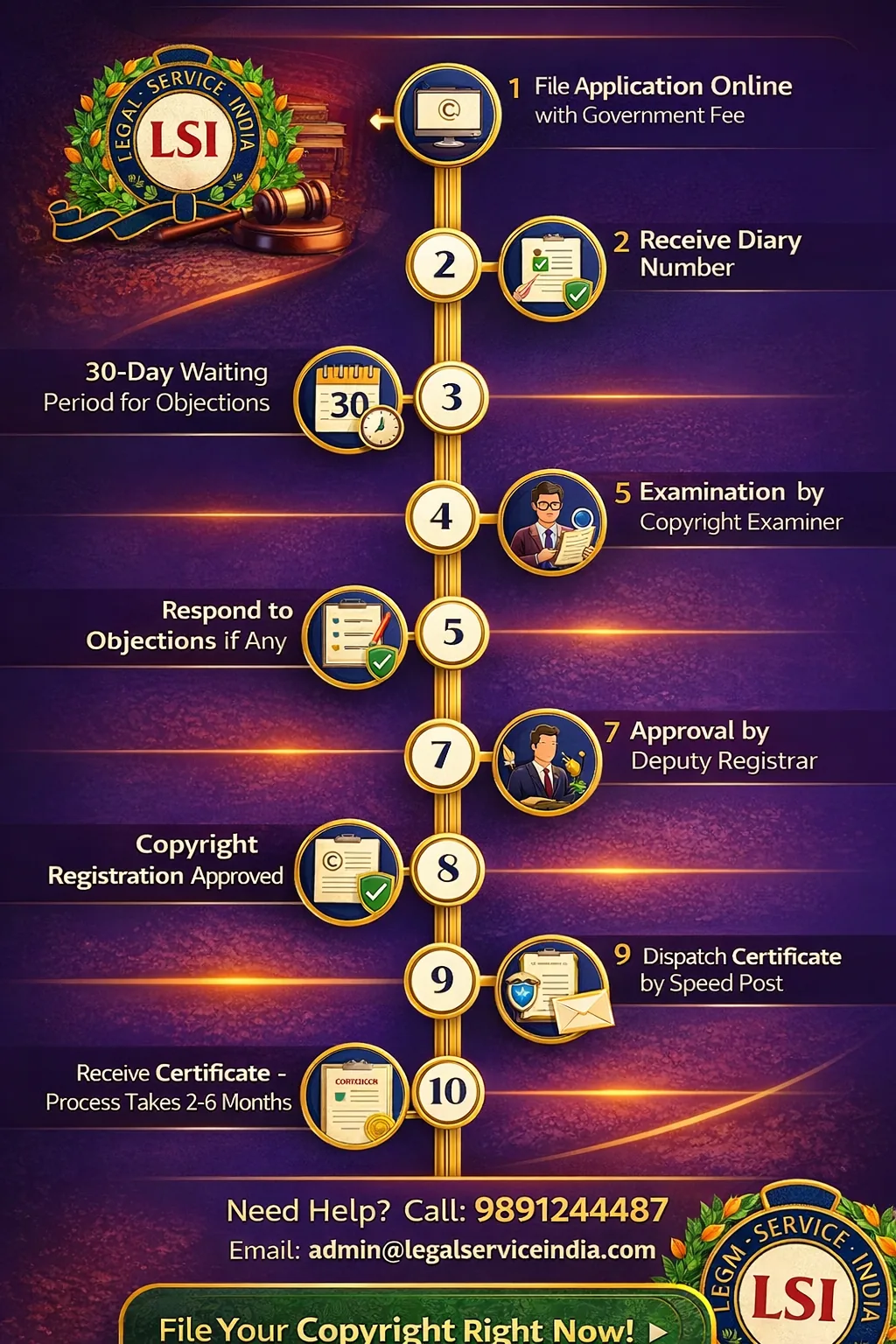
From the date of submission to certification it has its own time duration.- First 30 days is the cooling period, during this period if anyone wants to make an objection can do so
- If Non makes an Objection than it goes in the process of scrutiny
- If there is errors or suspicion in the application it will get into Objection
- If no Objection is found it goes into Copyright Registration Clearance.
- A permanent Copyright Registration no is assigned
- Finally after nearly six months You will receive the Certificate via
Indian Postal
Scope and Extent of Copyright Registration
These Days the Copyright Law has become Global India being a member of Berne Convention has Made the validity of your certificate to over 195 countries, Check the link to see the list of countries where it is valid.
How To copyright a work in India
We Offer the Services to Copyright Registration in India, being experts in Copyright Infringement matters in Court we exactly know how a Copyright needs to be Registered so that, If your creative work is copied or stolen, our method of Submission is so perfect that the Hon'ble court will not hesitate to give you Lightning speed judgment in your favour. Our Huge experience in this field gives us the edge over others. Our Clients have experienced this time and again when the real test of Copyright Registration is tested in the Court of law.
How to copyright a song in India?
A Song contains a bundle of additional copyrights involved i.e Song has Musicians, Lyricist, Singer, Sound Recorder, Composer and Producer, in most cases each aspect is done by various individuals, it is their sum total contribution, that leads to the creation of an audio recorded Song, hence to register such a creative work, NOC from each has to be obtained, only than can a Song be copyrighted, If even a single one of those involved rejects to give NOC copyright registration for a song will fail.Additional Rules to Follow for Copyright Registration of an Audio song and Video file:
It is mandatory to get No Objection Certificate from each and every person involved in the making of the video or audio song, if even one person involved in the creation of the song or film refuses to give NOC than the Copyright office will disregard your Copyright application and dump it as OBJECTION.
Protection of copyright in Film, Script, Translation and Dubbing-
A script is a written text of a movie. Therefore, it is different from story and the screenplay though there is an element of overlapping. Similarly, the dubbing is different from translation. A film with a sound track with a different A dubbing is meant to provide a film with a sound track with a different language from the original. In dubbing, what what is important is the lip movement. Thus no Verbatim translation is possible in an activity of dubbing.
Under the Copyright Act of 1957, both a literary work and a cinematograph film would come under its purview thus, entitled for protection. They both operate on different fields. They are not meant to be seen in conflict with each other. A copyright of cinematograph film shall not affect the separate copyright of a work, which forms part of it.
Literary work is distinct from dramatic work:
Broadly speaking, a dramatic work may also come within the purview of the literary work being a part of dramatic literature. However, provisions of the Act make a distinction between the literary work and dramatic work. Keeping in view the statutory provisions, there cannot be any doubt whatsoever that copyright in respect of performance of dance would not come within the purview of the literary work but would come within the purview of the definition of dramatic work.
Originality of Literary Work mean as Par Copyright Registration Law in India
Originality in work Relates to the expression of thought.-S.2(o) of the Copyright Act, is an inclusive definition and, therefore, not exhaustive.
Its literary work includes tables and compilations Dissertation is, therefore, prima facie literary work.
The Creative Literary Work Original does not necessarily mean that the Creative work must be the expression of original or invented thought. The Indian Copyright Act is not concerned with the origin of ideas, rather with the expression of thoughts and in the case of "literary work" with the expression of thoughts in print or writing.
The originality means here relates to the expression of the thought but the Act does not require that the expression must be in an original or novel form, but that the Creative work must not be copied from another person's Creative work that it should originate from the author. See University of London Press Ltd. v/s University Tutorial Press Limited, (2000-2020) 2 Ch 601.
Thus it is well settled that the originality in work relates to the expression of thought. Much depends on the skill, labour knowledge and the capacity to digest and utilize the raw materials contributed by the others in imparting to the product the quality and the character which those materials did not possess and which differentiate the product from the materials used.
It is always possible to arrive at the same result from independent sources. The compiler of work in which absolute originality is of necessity excluded is entitled, without exposing himself to a charge of piracy, to make use of preceding work upon the subject, where he bestows such mental labour upon what he has taken, and subjects it to such revision and correction as to produce an original result.
The question whether there has been an infringement of copy right depends whether a colourable imitation has been made.
Effect of Copyright Registration:
The intention behind the enactment of the section was not to make registration compulsory or mandatory for the purpose of enforcement of copyright. It provided an option. It was, therefore, not obligatory for an author to get the copyright registered under Section 44 for the purpose of acquiring rights conferred by it.The registration Establishes that the person shown is the actual author of the creative work. The presumption is not conclusive but where contrary evidence is not forthcoming, it is not necessary to render further proof to show that the copyright vested in the person mentioned in the register. Section 48 of the Copyright Act provides that the registration of copyright shall be prima facie evidence of the particulars entered therein.
Documents purporting to be copies of the register certified by the Registrar of copyright and sealed with the seal of the copyright office shall be admissible in evidence in all courts without further proof or production of the original. If the Legislature intended to make the requirement of registration mandatory, the
Language of Section 44 would have been different. There is no provision in the Act depriving an author of the rights conferred by this Act on account of non-registration of the copyright.
The only effect of registration is what is stated in Section 48, namely, that it shall be prima facie evidence of the particulars entered in the register. There is no indication in any of the provisions of the Act, read individually or as a whole, to suggest that registration is a condition precedent to subsistence of copyright or acquisition or ownership thereof or relief's for infringement of copyright.
The certificate of registration under the copyright Act will only prima facie show that the particulars mentioned therein are entered in the copyright register. The mere fact that something is entered in the copyright register, does not, as a matter of law, establish that what is registered is in fact and in law copyrightable subject-matter.
This is so because the sine qua non to the existence of copyright, is the expenditure of skill and labour on any work which originated from its author and unless the original work on which skill and Iabour has been expended by its author is produced in court to prima facie show that the work has originated from the author, it cannot be said that there is copyright in the work.
Registration of copyright does not confer any rights copyright exists whether registration is done or not and the registration is merely a piece of evidence as to when a certain author started claiming copyright in the artistic or other work. The definition of the word author and Section 17 lay emphasis on the fact that copyright vest in that person who is the original creator of this work. where it is not possible to be definite as to who was the original creator, the person who got registration earlier is presumed to be the author or original creator of the artistic work.
What Does Producer is The Author of The Film?
Section 2(d)) of the Act includes a producer of a cinematograph film in a definition of an author. Thus, a producer of a cinematograph film is an author entitled for protecting his copyright.How to copyright a website in India?
Only the content of a Website can be copyrighted, Since your Host is your witness in Court.What is Neighbouring Rights?
Copyright consist in not merely the right to reproduction but in the right to works derived from the original works. Rights like the right of public performance, the recording right and the broadcasting right are as important or even more important than the right of reproduction.The right to prevent reproduction of recordings given to the producers of sound recordings and right of public performance of a dramatic or musical work are termed as neighbouring rights under the European Law
How to Display a Copyright Notice:
Copyright Notice in India does not have any strict or standard rule, However the general rule in which it is most commonly used is in this manner:
© Traditions and Modernity in Khasi Society, 2018-2026
However these days even the Diary now is also mentioned to clearly state that a particular book is registered by Ministry of human Resources. Govt of India
Example: © Traditions and modernity in Khasi Society, 2000-2001, Diary no: xxxx/xxxx-Co/L (this option is preferred as this clearly shuns away copyright violation)
Most publications, also mentions the following:
No part of this publication may be reproduced or stored in a retrieval system in any form or by any means without the prior written permission of the copyright owner.
Highest no of copyright registered between 2018-2024, mentioned below the 5 top cities these are numbers we at legal service India have registered based on our static's:
- Mumbai - Most creative city in India as per copyright registration in the year 2019-2020, jumped up from third place in the previous year
- Hyderabad - Second Most creative city in India as per copyright registration, was in the no 1 position last year.
- Chennai- In the Third position up by one position since last year
- Bangalore - Now to fourth position
- Kolkata - was first on 2018 maintains its fifth position.
- Kerala - Best position was first place in 2017
The Astronomical Figure of Two Lakh Copyrights Registration Has Been Achieved By Legal Service India, Thank You For Your Continued Support And Trust In Us.
Landmark Copyright Law Judgments in India
Landmark Copyright Law Judgments by the Supreme Court of India (Up to 2023)
-
R.G. Anand v. Delux Films (1978)
- Case Name: R.G. Anand v. Delux Films & Others
- Summary: This is one of the most cited cases in Indian copyright law. The Supreme Court laid down principles for determining copyright infringement in cases of adaptation or reproduction of works. The Court held that to prove infringement, the plaintiff must show that the defendant's work is a substantial copy of the original, and mere similarities or inspiration do not amount to infringement unless there is a direct copying of expression.
-
Eastern Book Company v. D.B. Modak (2008)
- Case Name: Eastern Book Company & Others v. D.B. Modak & Another
- Summary: This case dealt with the copyrightability of judicial decisions and headnotes. The Supreme Court held that while the text of judicial decisions is in the public domain, the headnotes, editorial notes, and other additions made by publishers may be protected by copyright if they demonstrate originality and creativity.
-
Entertainment Network (India) Ltd. v. Super Cassette Industries Ltd. (2008)
- Case Name: Entertainment Network (India) Ltd. v. Super Cassette Industries Ltd.
- Summary: This case addressed the issue of compulsory licensing under the Copyright Act, 1957, particularly in the context of radio broadcasting. The Court held that the Copyright Board has the authority to grant compulsory licenses for broadcasting musical works, ensuring a balance between the rights of copyright owners and public interest.
-
Star India Pvt. Ltd. v. Leo Burnett (India) Pvt. Ltd. (2003)
- Case Name: Star India Pvt. Ltd. v. Leo Burnett (India) Pvt. Ltd.
- Summary: This case dealt with the concept of "substantial copying" in copyright law. The Court held that even if a small portion of a work is copied, it may still amount to infringement if the copied portion is qualitatively significant.
-
The Chancellor, Masters & Scholars of the University of Oxford v. Rameshwari Photocopy Services (2016)
- Case Name: The Chancellor, Masters & Scholars of the University of Oxford v. Rameshwari Photocopy Services & Others
- Summary: Commonly known as the "Delhi University Photocopy Case," this judgment addressed the issue of fair use in educational contexts. The Delhi High Court ruled that photocopying portions of textbooks for educational purposes falls under the fair use exception under Section 52(1)(i) of the Copyright Act, 1957. The Supreme Court later upheld this decision, emphasizing the importance of access to education.
-
Ips Industries Ltd. v. Wynk Music Ltd. (2022)
- Case Name: Tips Industries Ltd. v. Wynk Music Ltd. & Another
- Summary: This case dealt with the interpretation of statutory licensing under Section 31D of the Copyright Act, 1957, in the context of streaming platforms. The Bombay High Court ruled that streaming services must obtain proper licenses from copyright owners before making music available to users. The case highlighted the challenges of applying traditional copyright laws to digital platforms.
-
Super Cassettes Industries Ltd. v. Hamar Television Network Pvt. Ltd. (2012)
- Case Name: Super Cassettes Industries Ltd. v. Hamar Television Network Pvt. Ltd.
- Summary: This case addressed the issue of infringement through re-broadcasting of copyrighted content. The Supreme Court held that re-broadcasting without permission constitutes copyright infringement, even if the original broadcast was licensed.
-
Indian Performing Right Society Ltd. v. Sanjay Dalia (2015)
- Case Name: Indian Performing Right Society Ltd. v. Sanjay Dalia & Another
- Summary: This case dealt with the jurisdiction of courts in copyright infringement cases. The Supreme Court held that a suit for copyright infringement can only be filed in the jurisdiction where the plaintiff resides or carries on business, or where the cause of action arises, thereby limiting forum shopping.
Frequently Asked Questions (FAQs) on Copyright Registration in India
1. Is copyright registration compulsory in India?
No. Copyright protection arises automatically once an original work is created and fixed in a tangible form. However, registration provides strong legal evidence of ownership and is extremely helpful in enforcement and litigation.
2. Who can apply for copyright registration?
The author, creator, copyright owner, or an authorized agent/advocate can apply. In case of joint works, all authors or their authorized representative may apply.
3. Where is copyright registered in India?
Applications are filed with the Copyright Office of India, which functions under the Ministry of Commerce and Industry.
4. What types of works are eligible for registration?
Copyright can be registered for:
- Literary works (books, articles, blogs, scripts)
- Artistic works (paintings, drawings, photographs)
- Musical works and sound recordings
- Cinematograph films
- Computer software, source code, and databases
5. Can a website or blog be copyrighted?
Yes. Website content such as text, images, graphics, and original layout can be protected as literary and artistic works. Registration strengthens your claim in case of copying or plagiarism.
6. How long does copyright protection last in India?
For most works, copyright lasts for the lifetime of the author plus 60 years after their death. For films, sound recordings, and government works, different durations apply.
7. How much time does copyright registration take?
If no objections are raised, registration usually takes 2 to 6 months. If objections are filed, the process may take longer depending on hearings and responses.
8. What happens if someone copies my work before registration?
You still have copyright protection, but proving ownership becomes harder. Registration acts as prima facie evidence, making enforcement faster and more effective.
9. Is Indian copyright valid internationally?
Yes. India is a signatory to the Berne Convention, meaning Indian copyright is recognized in most countries worldwide.
10. Can I sell or license my copyrighted work?
Absolutely. Copyright is a transferable and licensable right. Registered works often carry higher commercial and licensing value.
Copyright Registration Checklist (India)
Use this practical checklist before filing your application:
Before Applying
✔ Ensure the work is original and unpublished (or clearly
mark if published)
✔ Confirm authorship and ownership details
✔ Decide whether you are filing personally or through an agent
Documents to Keep Ready
✔ Completed application form
✔ Copy of the work (PDF, audio file, video, or source code extract)
✔ Applicant's ID and address proof
✔ No-objection certificate (if required)
✔ Power of Attorney (if filed through an advocate/agent)
During Filing
✔ Correct category selected (literary, artistic, software, etc.)
✔ Government fee paid as per work type
✔ Diary number safely recorded
Post-Filing
✔ Track objection period (30 days)
✔ Respond promptly to any objections or examination reports
✔ Preserve the copyright certificate after approval
Why Copyright Registration Matters in the Digital Age
In an era of AI content, instant copying, and online plagiarism, copyright registration is no longer optional for serious creators. Bloggers, legal writers, educators, YouTubers, and software developers face daily risks of content misuse. Registration provides a legal shield, enhances credibility, and supports monetization through licensing and enforcement.
Copyright Law Articles:
Copyright law is a vast subject it is not just merely about Registration of Creative work and attaining a Certificate, it involves a huge study and evolution of Laws related to Creative works value and maintainability of Individual rights over his/her Intellectual Property, those various aspect of Copyright law is mentioned in these numerable articles mentioned below. Please go through them to increase your knowledge on Copyright law:- Latest Copyright Articles
- Illustrations of Literary Works That Cannot Be Registered Under Copyright Law in India
- Impact Of Digital Technology On Copyright Law
- Compulsory Licensing in Copyright
- Copyright In E-Publishing And The Development In Indian Copyright Law
- Copyright Infringement and Protection in India
- New Copyright Amendment Rules, 2021: An Overview
- FAQ on Copyright Registration
- How do you Register your Creative work with the Copyright Office in India - Registration of Copyright
- Procedure and Guidelines to Obtain Statutory Licence For Cover Versions of Songs as par Copyright Laws
- Copyright Office and Registrar of Copyright
- Scenes affaire in India
- Copyright Societies
- Copyright Laws in India
- Copyright protection in literary work, Book, scripts, screenplay, novels, lyrics
- Infringement of Copyright
- What cannot be copyrighted in India
- Copyright Protection on Reports of Judicial Proceedings
- Copyright Protection on historical book
- Copyright Amendment Bill 2012
- Tips To Hire A Copyright Lawyer In India
- Remix culture: Impact on Copyright owner of musical works
- The Copyright Act (Amendment) Bill, 2012 - artistes entitled to lifelong Royalty
- Intellectual Property and Traditional knowledge
- Registration and filing of Copyrights in India
- The Rights protected by Copyright Law
- Copyright Law in India
- Copyright Infringement through internet
- Copyright Judgments in India
- Challenges of Copyright And Cyber Space
- Cyberspace A Two Edged Sword For Copyright
- The Doctrine of First Sale in Indian Copyright Law
- Copyright Registration in India
- Guidelines For Implementation of Section 209 IPC In IPR Matters
- Statutory Licence for Broadcasting or Literary And Musical Works And Sound Recording
- Strengthening Consumer Protection Against Abuse of Intellectual Property Rights
 100% MONEY-BACK GUARANTEE!!
We GUARANTEE that your copyright application will be accepted
by the Registrar Copyright Office or we refund 100% of your money.
- Register Your Creative Work
- Prevent Theft