





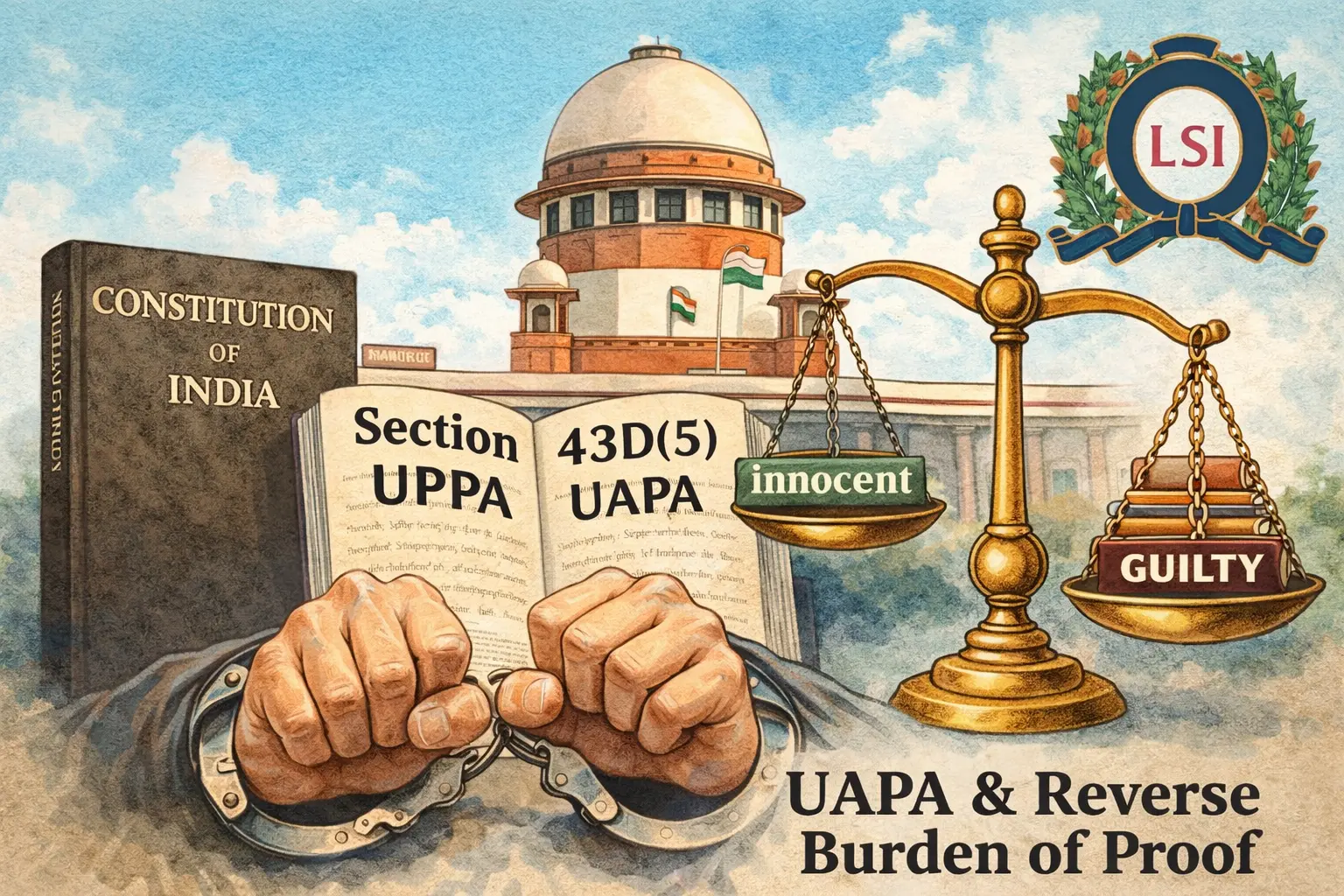
Introduction – The Legal Context of UAPA and Reverse Burden of Proof
The Unlawful Activities Prevention Act, 1967 (UAPA) stands as one of India’s most stringent legislative instruments designed to combat terrorism, unlawful activities, and threats to national security. Enacted during a period when the nation faced significant internal and external security challenges, the UAPA has undergone multiple amendments to strengthen its provisions and expand its scope. The Act empowers law enforcement agencies with extraordinary powers to investigate, detain, and prosecute individuals suspected of engaging in activities that threaten the sovereignty, integrity, and security of India.
One of the most contentious aspects of the UAPA is the concept of “reverse burden of proof” enshrined in Section 43D(5) of the Act. Unlike ordinary criminal proceedings where the prosecution bears the burden of proving guilt beyond reasonable doubt, the UAPA shifts this burden onto the accused in certain circumstances. This means that once the prosecution establishes prima facie evidence of the accused’s involvement in unlawful activities, the accused must prove their innocence to secure bail or acquittal. This inversion of the fundamental principle of criminal jurisprudence—”innocent until proven guilty”—has sparked intense debates among legal scholars, human rights activists, and practitioners about its compatibility with constitutional guarantees.
The reverse burden of proof mechanism is not unique to UAPA; it exists in other special legislations such as the Prevention of Money Laundering Act (PMLA), the Narcotic Drugs and Psychotropic Substances Act (NDPS), and various anti-corruption laws. However, the application of this principle in UAPA cases raises particularly acute concerns because of the nature of offences involved, the severity of punishments prescribed, and the prolonged periods of incarceration that accused persons often face before trial.
Article 21 of the Indian Constitution guarantees the right to life and personal liberty, which has been expansively interpreted by the Supreme Court to include the right to a speedy trial, the right to legal aid, and the right to live with human dignity. The tension between these constitutional guarantees and the stringent provisions of UAPA creates a complex legal landscape where courts must carefully balance individual rights against collective security interests. The challenge becomes even more pronounced when systemic delays in the criminal justice system result in accused persons spending years in custody without trial, effectively serving sentences before being convicted.
The recent Supreme Court judgment in Central Bureau of Investigation v. Dayamoy Mahato represents a watershed moment in addressing these concerns. The Court not only examined the specific facts of the case involving the tragic Jnaneshwari Express derailment but also took a broader view of the systemic issues plaguing the administration of justice in UAPA cases. By issuing comprehensive directives to all High Courts and trial courts across the country, the Supreme Court has attempted to create a framework that ensures both effective prosecution of serious offences against the State and protection of the fundamental rights of accused persons.
This judgment is significant because it acknowledges the inherent difficulties faced by undertrials in rebutting the presumption of guilt, particularly when they are socio-economically disadvantaged and lack access to adequate legal representation, investigative resources, and expert assistance. The Court’s recognition that “a constitutional democracy does not legitimise burdens by simply declaring them; it must ensure that those burdened are meaningfully equipped to bear them” reflects a mature understanding of the practical realities of criminal justice administration in India.
The legal context of this case must also be understood against the backdrop of India’s federal structure, where law and order is primarily a state subject, but national security concerns necessitate central legislation and coordination. The UAPA cases often involve complex investigations spanning multiple states, requiring coordination between central agencies like the CBI, NIA, and state police forces. The designation of special courts, appointment of special prosecutors, and allocation of adequate resources become critical factors in ensuring timely justice.
Furthermore, the judgment comes at a time when the National Crime Records Bureau’s Crimes in India Report, 2023 reveals staggering numbers—394,919 cases pending for trial and 479,420 cases pending for investigation under UAPA. These statistics underscore the magnitude of the problem and the urgent need for systemic reforms. The Supreme Court’s intervention through this judgment represents a judicial acknowledgment that procedural safeguards and institutional mechanisms must be strengthened to prevent the reverse burden of proof from becoming an instrument of indefinite detention without trial.
Case Background – The Jnaneshwari Express Tragedy and Legal Proceedings
The case that led to this landmark Supreme Court judgment arose from one of the most devastating acts of sabotage in Indian railway history—the derailment of the Jnaneshwari Express on May 28, 2010. The incident occurred between Khemasuli and Sardiha railway stations in the Jhargram area of West Bengal, a region that had been experiencing significant Maoist insurgency activities. The derailment resulted in the tragic loss of 148 lives and injuries to 170 persons, making it one of the deadliest railway accidents in recent Indian history.
The factual matrix of the case reveals a calculated and premeditated act of terrorism aimed at pressurizing the government and creating widespread terror. According to the investigation conducted by the Central Bureau of Investigation (CBI), the accused persons were allegedly motivated by the deployment of a joint force comprising State Police and Central Paramilitary Forces in the jurisdiction of Jhargram Police Station. This deployment was part of the government’s efforts to combat the Maoist capture of Rasua village and surrounding areas, which had become strongholds of left-wing extremism.
The modus operandi of the crime, as revealed during investigation, involved the deliberate removal of pandral clips from the railway tracks near Rajabandh. These clips are critical components that hold the rails in place, and their removal was designed to cause the derailment of any passing train. The accused persons allegedly acted with common intention and in furtherance of a criminal conspiracy, fully aware that their actions would cause grievous hurt and death to passengers traveling on the train. The timing and location of the sabotage were carefully chosen to maximize impact and casualties.
When the Jnaneshwari Express passed over the sabotaged section of track, it derailed catastrophically. The tragedy was compounded when the derailed coaches collided with an oncoming goods train traveling in the opposite direction, resulting in massive destruction and loss of life. The collision caused extensive damage to railway property, with the government estimating losses of approximately 25 crores, apart from the incalculable human cost of lives lost and families destroyed.
An FIR was registered on June 9, 2010, against unknown persons, and the investigation was subsequently taken over by the CBI given the gravity of the offence and its implications for national security. The investigation led to the identification and arrest of multiple accused persons, including Dayamoy Mahato and others who were allegedly associated with Maoist organizations operating in the region. The chargesheet filed by the CBI was comprehensive, invoking multiple provisions of the Indian Penal Code, 1860 (IPC), the Indian Railways Act, 1989, and the UAPA.
The charges framed against the accused persons included Section 120B IPC (criminal conspiracy), Section 302 IPC (murder), Section 307 IPC (attempt to murder), Sections 323, 325, and 326 IPC (various degrees of hurt and grievous hurt), Section 440 IPC (mischief committed after preparation made for causing death or hurt), and Section 212 IPC (harbouring offenders). Additionally, Sections 150 and 151 of the Indian Railways Act, 1989, were invoked for offences relating to malicious acts endangering the safety of persons traveling by railway. Most significantly, Sections 16 and 18 of the UAPA were applied, charging the accused with terrorist acts and conspiracy to commit terrorist acts.
The trial commenced in the designated special court, but as is often the case with complex criminal prosecutions involving multiple accused and voluminous evidence, the proceedings faced significant delays. Years passed without substantial progress in the trial, and the accused persons remained in custody. Eventually, six of the accused persons approached the Calcutta High Court seeking bail, arguing that they had been incarcerated for an extended period without trial and that their continued detention violated their fundamental rights under Article 21 of the Constitution.
The Calcutta High Court, after considering the submissions made by both parties and examining the materials on record, granted bail to the six accused persons. The High Court’s decision was based on several factors, including the prolonged period of incarceration without trial, the fact that the investigation had been completed and chargesheet filed, and the principle that bail, not jail, should be the rule even in serious offences when the trial is unlikely to conclude in the near future. The High Court also took into account the fact that the accused persons had been cooperating with the investigation and trial process.
The CBI, aggrieved by the High Court’s decision to grant bail, filed criminal appeals before the Supreme Court. The CBI’s primary contention was that given the gravity of the offences, the nature of the charges under UAPA, and the reverse burden of proof applicable in such cases, the High Court had erred in granting bail without adequately considering the stringent requirements of Section 43D(5) of the UAPA. The CBI argued that the accused persons had not been able to satisfy the court that there were reasonable grounds for believing that they were not guilty of the offences charged, which is a prerequisite for bail under UAPA.
The matter was heard by a two-judge bench of the Supreme Court comprising Justice Sanjay Karol and Justice N. Kotiswar Singh. The bench was represented by Additional Solicitor General of India K.M. Nataraj and Senior Advocate Shailesh Madiyal appearing for the CBI-Appellant, while AOR N. Sai Vinod and Advocate Archit Krishna represented the respondents-accused persons. The arguments before the Supreme Court ranged from the specific facts of the case to broader questions about the administration of justice in UAPA cases, the practical challenges faced by undertrials in rebutting the presumption of guilt, and the systemic delays that plague the criminal justice system.
The Supreme Court recognized that this case presented an opportunity to address not just the immediate question of whether bail should be granted or cancelled, but also the larger structural and procedural issues that affect the fair and expeditious trial of UAPA cases across the country. The Court took judicial notice of the alarming statistics from the National Crime Records Bureau showing hundreds of thousands of cases pending under UAPA, and decided to use this case as a vehicle for issuing comprehensive directions to improve the administration of justice in such matters.
Court’s Observations – Balancing National Security and Individual Liberty
The Supreme Court’s observations in this case reflect a nuanced and sophisticated understanding of the complex interplay between national security imperatives and constitutional guarantees of personal liberty. The Court began by acknowledging the gravity of the offence and the immense loss of life and property caused by the Jnaneshwari Express derailment. The bench observed that “the loss of lives and public property has been immense and there is grave impact upon the lives of the people connected to those who have died as a consequence or have been injured because of the ulterior motives in carrying out this alleged offence against the State.”
This acknowledgment is significant because it establishes that the Court is not unmindful of the serious nature of terrorist acts and their devastating impact on society. The Court recognized that offences under UAPA “strike at the nation’s security and are an effort to undermine its sovereign authority,” and therefore require heightened scrutiny when considering applications for bail. The Court emphasized that “Courts are duty bound to scrutinise claims for bails in such cases with heightened but fair-minded vigilance,” thereby setting a standard that balances security concerns with fairness.
However, the Court was equally emphatic that Article 21 rights cannot be relegated to a secondary position even in cases involving national security. The bench observed that while protecting the nation’s security is paramount, “that cannot be the sole ground of consideration” when deciding bail applications. The Court stated that “the act of the accused persons must be looked at, on the whole, and all relevant factors must be given due consideration while granting or denying bail.” This holistic approach requires courts to consider not just the nature of the offence, but also factors such as the period of incarceration, the likelihood of trial concluding in reasonable time, the conduct of the accused, and the availability of evidence.
One of the most significant aspects of the Court’s reasoning relates to its observations on the reverse burden of proof and its practical implications for accused persons. The Court noted that “given the nature of the offence involved, that is, offences against the State and society, bail is a slightly difficult relief to obtain and a necessary consequence thereof, an undertrial in custody faces several difficulties in rebutting the presumption drawn by law, against them.” This observation demonstrates the Court’s awareness that the reverse burden of proof is not merely a legal technicality but has profound practical consequences for the accused.
The Court went further to highlight the structural inequalities that the reverse burden of proof creates, particularly for socio-economically disadvantaged accused persons. The bench observed that “an incarcerated accused would have severely limited access to evidence, witnesses and investigative material. This becomes all the more pronounced because the opposite party is the State which has all the means and resources at its disposal.” This observation is crucial because it acknowledges the inherent power imbalance between the State and the individual accused, and recognizes that this imbalance is exacerbated when the accused is in custody and must prove their innocence.
The Court’s observations on the impact of prolonged incarceration on disadvantaged accused persons are particularly noteworthy. The bench stated that “prolonged incarceration in cases where the accused is socio-economically disadvantaged, amplifies the inequalities for it becomes exceedingly difficult to forward legal/financial/expert assistance that is required to dispel the presumption. There is nearly complete dependence on an otherwise overburdened legal-aid system which struggles with delays, inadequate resources and inconsistent quality.” This candid acknowledgment of the shortcomings of the legal aid system and its impact on the ability of accused persons to defend themselves is refreshing and demonstrates judicial realism.
From a critical perspective, these observations represent a significant evolution in judicial thinking about the reverse burden of proof. While earlier judgments have upheld the constitutional validity of reverse burden provisions in special legislations, this judgment goes beyond mere validation to examine the practical consequences of such provisions and the corresponding obligations they create for the State and the judiciary. The Court’s statement that “in these cases, true it is that the burden of proving innocence is on the accused, a burden is also on the Courts to make it possible for them to do so” is particularly significant because it transforms the reverse burden from a purely procedural mechanism into a constitutional obligation that requires active judicial intervention.
The Court articulated a powerful vision of constitutional democracy when it observed that “a constitutional democracy does not legitimise burdens by simply declaring them; it must ensure that those burdened are meaningfully equipped to bear them, even those who are accused of the worst offences imaginable.” This statement reflects a mature understanding that procedural fairness is not just about formal compliance with rules but requires substantive measures to ensure that accused persons have a realistic opportunity to defend themselves. The Court added that “if the State, in spite of all its might presumes guilt, then the same State must also, with the employment of all the resources at its command, create pathways through which the accused can reclaim their innocence.”
The Court’s observations on delay in the criminal justice system are equally significant. The bench noted that “delay is an un-ignorable reality of the Indian criminal adjudication system which on its own raises significant issues, but when this delay is in cases such as the UAPA, where a reverse burden of proof is in place, it acquires a qualitatively different, and more insidious, character.” This observation recognizes that delay in UAPA cases is not just an administrative inconvenience but fundamentally undermines the fairness of the reverse burden mechanism. When accused persons must prove their innocence but are denied the opportunity to do so because of systemic delays, the reverse burden effectively becomes a mechanism for indefinite detention without trial.
The Court was particularly critical of the practice of courts asking accused persons to establish preliminarily, even before trial begins, that they will be able to rebut the presumption against them. The bench observed that “this doctrinal inversion becomes all the more pernicious on account of procedural delays and very liberty of a person becomes hostage to clogged dockets, overworked judges, a lax prosecution, repeated adjournments by members of the bar and much more.” This observation places responsibility not just on the prosecution or the accused, but on the entire justice delivery system including judges, prosecutors, and defense counsel.
The Court emphasized that “institutions of justice must act not as passive observers but as active guarantors of fairness: ensuring real access to counsel, enabling effective preparation of defence, and preventing the presumption from hardening into an irreversible verdict long before the trial ends.” This call for active judicial intervention represents a significant departure from the traditional adversarial model where the court is merely an umpire between two parties. Instead, the Court envisions a more inquisitorial and protective role for judges in UAPA cases, where they must actively ensure that the accused has the means to defend themselves.
The Court concluded its observations with a powerful statement about the moral foundations of democracy: “Ultimately, a democracy is judged not by how it treats the unquestionably innocent, but by how it safeguards the rights of those it suspects. In that moral balance, the justice system must ensure that even under a reverse burden regime, the accused is not abandoned to the weight of presumptive guilt but supported in the pursuit of truth and justice.” This statement reflects a commitment to constitutional values that transcends the immediate facts of the case and provides a philosophical foundation for the practical directions that follow.
In the specific context of the case, the Court held that “interfering with the liberty of the accused, at this stage, particularly when nothing else holds against them, would not be justified.” This conclusion was based on the prolonged period of incarceration, the completion of investigation, and the lack of progress in trial. However, rather than simply dismissing the appeals, the Court used this opportunity to issue comprehensive directions aimed at systemic reform.
Impact – Broader Legal and Practical Implications
The impact of this Supreme Court judgment extends far beyond the immediate parties to the case and has profound implications for the administration of criminal justice in India, particularly in cases involving special legislations with reverse burden of proof provisions. The directions issued by the Court create a framework for systemic reform that addresses multiple dimensions of the problem—judicial administration, resource allocation, legal aid, and procedural efficiency.
One of the most significant impacts of the judgment is the directive to Chief Justices of all High Courts to examine the number of cases pending within their states under laws such as UAPA that pose a reverse burden of proof on the accused. This directive transforms what could have been a case-specific intervention into a nationwide audit of pending cases. By requiring High Courts to take stock of the situation, the Supreme Court has initiated a process of data collection and analysis that is essential for evidence-based policy making and resource allocation. The directive recognizes that without accurate information about the scale and nature of the problem, it is impossible to devise effective solutions.
The Court’s direction to ascertain the number of special courts designated to try UAPA offences, and if special courts have not been designated, the number of sessions courts dealing with such matters, addresses a critical infrastructural deficit. The UAPA contemplates the designation of special courts for speedy trial of offences under the Act, but in practice, many states have not designated sufficient special courts, resulting in these cases being tried by regular sessions courts that are already overburdened with heavy caseloads. The Court’s directive to “take up the matter with the appropriate authority if it is found that they are not sufficient” creates an obligation on High Courts to advocate for additional judicial infrastructure.
The direction to discern whether posting of judicial officers in these courts as well as staffing is sufficient is equally important. Even when special courts exist, they may not function effectively if they lack adequate judicial officers, court staff, stenographers, and other support personnel. The Court’s recognition that inadequate staffing “forecloses a ground for delay and adjournment” demonstrates an understanding of the practical realities of court functioning. By directing that “suitable order for posting be issued expeditiously” if staffing is found insufficient, the Court has created a mechanism for addressing this problem at the administrative level.
The directive that State Legal Services Authorities shall take steps to make each undertrial aware of their right to representation, either by counsel of their own choice or through legal aid counsel, addresses the critical issue of access to justice. Many undertrials, particularly those from socio-economically disadvantaged backgrounds, are not aware of their rights or the procedures for obtaining legal aid. The Court’s direction that for those who choose legal aid, “assignments to their cases to the counsel should be made expeditiously so that the proceedings can start/continue at the earliest” recognizes that delay in assignment of counsel can significantly impede the progress of trial.
The specific directions issued for the trial in the present case have broader implications as a model for how UAPA trials should be conducted. The direction that the trial court shall take stock of the matter and record the status and reasons for delay creates accountability and transparency. The direction that from that day forth, the matter shall be taken up on a day-to-day basis establishes a standard for trial conduct that prioritizes expeditious disposal. The direction that granting of adjournments shall be eschewed unless exceptional circumstances are shown addresses one of the most common causes of delay in criminal trials.
The provision for oversight by an Administrative Judge nominated by the Chief Justice, who shall seek a report every four weeks from the trial judge and ensure compliance with directions, creates a supervisory mechanism that can prevent backsliding and ensure sustained progress. This kind of structured oversight is essential in a system where good intentions often fail to translate into concrete results due to lack of monitoring and accountability.
The Court’s direction that cases pending for more than five years should be prioritized and taken up on a day-to-day basis addresses the most egregious situations where accused persons have been languishing in custody for extended periods. By requiring courts to record detailed orders taking note of previous reasons for adjournment, the Court creates a mechanism for identifying patterns of delay and holding responsible parties accountable. The direction to refrain from granting adjournments on routine requests establishes a presumption against adjournments that shifts the burden onto the party seeking adjournment to justify it.
The direction that High Courts shall periodically seek reports from concerned courts and take up issues confronting them on the administrative side creates a feedback loop that can identify and address systemic problems. This kind of active judicial administration, where High Courts take responsibility for ensuring that trial courts have the resources and support they need to function effectively, represents a significant departure from the traditional hands-off approach to judicial administration.
From a broader legal perspective, this judgment contributes to the evolving jurisprudence on the balance between security and liberty in a constitutional democracy. The Court’s articulation of the principle that imposing a reverse burden of proof creates a corresponding obligation on the State and the judiciary to ensure that accused persons have the means to discharge that burden represents an important doctrinal development. This principle could have implications beyond UAPA cases to other special legislations that impose reverse burdens, such as the PMLA and NDPS Act.
The judgment also has implications for the interpretation and application of Article 21 of the Constitution. By emphasizing that the right to life and personal liberty includes not just formal procedural protections but substantive measures to ensure effective access to justice, the Court has expanded the scope of Article 21 jurisprudence. The statement that “a constitutional democracy does not legitimise burdens by simply declaring them; it must ensure that those burdened are meaningfully equipped to bear them” could be cited in future cases involving other forms of procedural or substantive burdens imposed by law.
The judgment’s impact on legal aid systems could be transformative if properly implemented. By directing State Legal Services Authorities to proactively inform undertrials of their rights and expeditiously assign counsel, the Court has created enforceable obligations that can improve the quality and timeliness of legal aid. However, the effectiveness of these directions will depend on adequate funding and resources for legal aid systems, which remains a challenge in many states.
For the legal profession, particularly lawyers practicing criminal law, this judgment provides important guidance on professional responsibilities in UAPA cases. The Court’s criticism of “repeated adjournments by members of the bar” as a cause of delay serves as a reminder that lawyers have a professional obligation to ensure expeditious disposal of cases, particularly when their clients are in custody. The judgment could lead to stricter enforcement of professional conduct rules regarding adjournments and dilatory tactics.
For investigating agencies like the CBI and NIA, the judgment sends a clear message that while they have extraordinary powers under UAPA, those powers come with corresponding responsibilities to conduct investigations efficiently and present cases for trial expeditiously. The Court’s emphasis on the power imbalance between the State with all its resources and the incarcerated accused with limited means serves as a reminder that investigating agencies must exercise their powers fairly and responsibly.
For accused persons and their families, this judgment provides hope that the justice system recognizes their plight and is taking concrete steps to address systemic problems. The Court’s acknowledgment of the difficulties faced by socio-economically disadvantaged accused in rebutting the presumption of guilt validates their experiences and creates legal grounds for seeking relief. The specific directions for expeditious trial and oversight could lead to faster resolution of cases and earlier release for those who are ultimately acquitted.
For policymakers and legislators, this judgment highlights the need for comprehensive reform of the criminal justice system, particularly in relation to special legislations. While the Court has worked within the existing legislative framework, its observations about the “pernicious” effects of combining reverse burden of proof with systemic delays could inform future legislative reforms. There may be a need to reconsider whether reverse burden provisions are necessary or appropriate in all circumstances, or whether additional safeguards should be built into the legislation to prevent abuse.
The judgment also has implications for judicial education and training. The Court’s emphasis on the need for judges to act as “active guarantors of fairness” rather than “passive observers” suggests that judges handling UAPA cases need specialized training on the unique challenges these cases present and the constitutional obligations they create. Judicial academies and training institutions should incorporate the principles articulated in this judgment into their training programs.
FAQs – Common Questions About UAPA and This Judgment
Q1: What is the Unlawful Activities Prevention Act (UAPA) and why is it controversial?
The Unlawful Activities Prevention Act, 1967 (UAPA) is a special legislation enacted by the Parliament of India to provide for effective prevention of unlawful activities associations and to deal with terrorist activities. The Act defines “unlawful activity” as any action intended to bring about secession of any part of India, or to disrupt the sovereignty and territorial integrity of India, or to cause disaffection against India. Over the years, the Act has been amended multiple times to expand its scope and strengthen its provisions, particularly after the 2008 Mumbai terrorist attacks.
The UAPA is controversial for several reasons. First, it provides for prolonged detention without trial—an accused can be detained for up to 180 days during investigation without chargesheet being filed, which is significantly longer than the period allowed under ordinary criminal law. Second, the Act imposes a reverse burden of proof in Section 43D(5), which means that for granting bail, the court must be satisfied that there are reasonable grounds for believing that the accusation against the accused is prima facie not true. This shifts the burden from the prosecution to prove guilt to the accused to prove innocence, which is contrary to the fundamental principle of criminal jurisprudence.
Third, the UAPA provides for designation of individuals and organizations as “terrorists” or “terrorist organizations” by the central government, and such designation can be challenged only through a limited review process. Fourth, the Act has been criticized for vague and overbroad definitions that can potentially be misused to target political dissent, human rights activists, and marginalized communities. Critics argue that the Act has been used disproportionately against minorities, activists, and political opponents, with very low conviction rates suggesting that many arrests may not be justified. However, supporters of the Act argue that it is necessary to deal with serious threats to national security and that the stringent provisions are justified given the nature of terrorist activities.
Q2: What does “reverse burden of proof” mean and how does it affect bail applications under UAPA?
The concept of “reverse burden of proof” refers to a legal provision that shifts the burden of proving innocence from the prosecution to the accused. In ordinary criminal cases, the prosecution must prove the guilt of the accused beyond reasonable doubt, and the accused is presumed innocent until proven guilty. However, under Section 43D(5) of the UAPA, when an accused person applies for bail, the court must be satisfied that “there are reasonable grounds for believing that the accusation against such person is prima facie not true.” This means the accused must satisfy the court that the accusations are likely false, rather than the prosecution having to prove that the accusations are likely true.
This reverse burden has significant practical implications for bail applications. First, it makes obtaining bail much more difficult in UAPA cases compared to ordinary criminal cases. Even if the accused has been in custody for a long period and the trial is unlikely to conclude soon, the court cannot grant bail unless the accused can demonstrate that the accusations are prima facie not true. Second, it creates an evidentiary challenge for the accused, who may have limited access to evidence and witnesses while in custody. The prosecution, being the investigating agency, has control over most of the evidence, and the accused must somehow demonstrate that this evidence does not support the charges.
Third, the reverse burden operates at the bail stage itself, before the trial has even begun. This means the accused must essentially prove their innocence preliminarily just to secure release pending trial, which can take years to conclude. The Supreme Court in this judgment has recognized that this creates particular hardships for socio-economically disadvantaged accused who lack resources to gather evidence, hire expert witnesses, or conduct independent investigations. The Court has emphasized that when the law imposes such a reverse burden, the State and the judiciary have a corresponding obligation to ensure that the accused has meaningful opportunity to discharge that burden, including through adequate legal representation, access to evidence, and expeditious trial.
Q3: What are the key directions issued by the Supreme Court in this judgment and how will they improve the situation?
The Supreme Court has issued comprehensive directions that operate at multiple levels—national, state, and individual case level. At the national level, the Court has directed the Chief Justices of all High Courts to conduct a systematic examination of UAPA cases pending in their states. This includes ascertaining the total number of pending cases, the number of special courts designated to try such cases, the adequacy of judicial officers and staff, and the availability of prosecutors. This audit will provide data necessary for evidence-based policy making and resource allocation.
The Court has directed that cases should be organized chronologically and taken up from earliest to latest unless otherwise warranted, ensuring that the oldest cases where accused persons have been in custody longest are prioritized. For cases pending for more than five years, trial courts must take stock of the situation, record reasons for previous delays, and take up the matter on a day-to-day basis with minimal adjournments. The Court has also mandated that Administrative Judges nominated by Chief Justices shall seek reports every four weeks from trial judges to ensure compliance with these directions, creating an accountability mechanism.
At the level of legal aid, the Court has directed State Legal Services Authorities to proactively inform each undertrial of their right to representation and expeditiously assign legal aid counsel to those who need it. This addresses the critical problem of accused persons languishing in custody without adequate legal representation. The Court has also directed High Courts to ensure that adequate prosecutors are appointed so that trials are not delayed on that account.
These directions, if properly implemented, will improve the situation in several ways. First, they will reduce the backlog of pending UAPA cases by ensuring expeditious trial. Second, they will ensure that accused persons have access to adequate legal representation to defend themselves. Third, they will create accountability through regular monitoring and reporting. Fourth, they will address infrastructural deficits by requiring High Courts to advocate for additional special courts and resources where needed. Finally, they will prevent the reverse burden of proof from becoming an instrument of indefinite detention by ensuring that accused persons have a realistic opportunity to prove their innocence through expeditious trial.
Conclusion – Future Implications and the Path Forward
The Supreme Court’s judgment in Central Bureau of Investigation v. Dayamoy Mahato represents a significant milestone in the evolution of Indian criminal jurisprudence, particularly in relation to special legislations that impose reverse burdens of proof. The judgment demonstrates that even within the constraints of existing legislation, the judiciary can play a transformative role in ensuring that constitutional values of fairness, dignity, and access to justice are not compromised in the name of national security.
The Court’s articulation of the principle that “a constitutional democracy does not legitimise burdens by simply declaring them; it must ensure that those burdened are meaningfully equipped to bear them” provides a philosophical foundation that extends beyond UAPA cases to the entire criminal justice system. This principle recognizes that procedural fairness is not just about formal compliance with rules but requires substantive measures to address power imbalances and structural inequalities. It acknowledges that when the State, with all its resources and power, presumes guilt, it must also create pathways through which the accused can reclaim their innocence.
Looking forward, the effectiveness of this judgment will depend on its implementation at the ground level. The directions issued by the Court are comprehensive and well-designed, but they require sustained commitment from all stakeholders—High Courts, trial courts, State Legal Services Authorities, investigating agencies, prosecutors, and defense counsel. The success of these directions will be measured not just by compliance reports but by tangible outcomes: reduction in the number of undertrials languishing in custody for years without trial, increase in the rate of case disposal, improvement in the quality of legal representation, and ultimately, greater confidence in the fairness of the criminal justice system.
One potential area of future development is legislative reform. While the Court has worked within the existing legislative framework of UAPA, its observations about the “pernicious” effects of combining reverse burden of proof with systemic delays suggest that there may be a need for Parliament to reconsider whether the current balance between security and liberty is appropriate. Future amendments to UAPA could incorporate additional safeguards such as mandatory time limits for completion of trial, automatic review of cases where accused have been in custody beyond a certain period, or modification of the reverse burden provision to make it less onerous.
Another area for future development is the use of technology to improve case management and reduce delays. Digital case management systems, video conferencing for routine hearings, electronic filing and service of documents, and artificial intelligence-based tools for legal research and case analysis could significantly improve the efficiency of UAPA trials. The Supreme Court’s emphasis on day-to-day hearings and minimal adjournments could be facilitated by technology that reduces the need for physical presence and streamlines procedural requirements.
The judgment also opens up possibilities for similar interventions in other areas of criminal law where systemic problems result in prolonged incarceration without trial. The principles articulated in this judgment—active judicial oversight, prioritization of old cases, mandatory reporting and accountability, proactive legal aid—could be applied to other categories of cases such as those under PMLA, NDPS Act, or even ordinary criminal cases where undertrials have been in custody for extended periods.
From a comparative perspective, this judgment aligns India with international human rights standards that emphasize the right to speedy trial and the presumption of innocence. While the reverse burden of proof under UAPA may be justified as a necessary measure to deal with terrorism, the Court’s insistence that such provisions must be accompanied by effective safeguards ensures that India’s counter-terrorism laws do not violate fundamental principles of justice recognized internationally.
The judgment also contributes to the ongoing debate about the role of the judiciary in a constitutional democracy. By issuing comprehensive directions that go beyond the immediate facts of the case to address systemic problems, the Court has demonstrated that judicial activism, when properly calibrated, can be a force for positive change. The Court has not overstepped its bounds by striking down legislation or usurping executive functions, but has instead used its constitutional authority to ensure that existing laws are implemented in a manner consistent with constitutional values.
For legal practitioners, this judgment provides important precedents and arguments that can be used in future cases involving UAPA and other special legislations. The Court’s observations about the difficulties faced by incarcerated accused in rebutting presumptions of guilt, the impact of delay on the fairness of reverse burden provisions, and the obligation of courts to act as active guarantors of fairness can be cited in bail applications, petitions for speedy trial, and challenges to prolonged detention.
For legal scholars and academics, this judgment provides rich material for analysis and critique. The Court’s attempt to balance security and liberty, its articulation of the obligations created by reverse burden provisions, and its vision of constitutional democracy as requiring substantive rather than merely formal fairness all merit detailed scholarly examination. Future research could examine the implementation of the Court’s directions, their effectiveness in reducing delays and improving outcomes, and the lessons that can be learned for other areas of criminal justice reform.
In conclusion, this judgment represents a hopeful development in Indian criminal jurisprudence. It demonstrates that the judiciary is aware of the systemic problems plaguing the administration of justice in UAPA cases and is willing to take concrete steps to address them. It affirms that even those accused of the most serious crimes against the State are entitled to fair treatment and expeditious trial. Most importantly, it reminds us that “a democracy is judged not by how it treats the unquestionably innocent, but by how it safeguards the rights of those it suspects.” By this standard, the Supreme Court’s judgment represents a significant step toward a more just and humane criminal justice system.
How Claw Legaltech Can Help?
In the complex landscape of UAPA cases and criminal litigation involving special legislations, legal professionals and litigants need sophisticated tools to navigate the intricate procedural requirements, stay updated on legal developments, and manage cases effectively. Claw Legaltech provides a comprehensive suite of AI-powered legal technology solutions specifically designed to address these challenges and empower lawyers, law firms, and individuals involved in criminal litigation.
Legal GPT – AI-Powered Legal Assistance: Claw’s Legal GPT is an advanced artificial intelligence tool specifically trained on Indian legal databases, including judgments, statutes, and legal commentary. For lawyers handling UAPA cases, Legal GPT can draft bail applications incorporating the latest Supreme Court directions from the Dayamoy Mahato judgment, prepare arguments addressing the reverse burden of proof, and provide instant answers to complex legal queries with proper citations. The tool can analyze case facts and suggest relevant precedents, saving hours of manual research time. For accused persons and their families trying to understand their legal rights, Legal GPT can explain complex legal concepts in simple language and provide guidance on available remedies.
AI Case Search and Judgment Database: With access to over 100 crore (1 billion+) rulings from courts and tribunals across India, Claw’s AI Case Search feature enables lawyers to find relevant judgments quickly using natural language queries or specific keywords. For UAPA cases, lawyers can search for precedents on bail applications, interpretation of specific provisions, or procedural issues, and the AI will surface the most relevant judgments with contextual understanding. The Chat with Judgments feature allows users to have conversational interactions with judgment texts, asking specific questions and receiving precise answers with citations, making it easier to extract relevant principles from lengthy judgments like the Dayamoy Mahato case.
Case Management and Tracking Tools: Managing UAPA cases requires meticulous attention to deadlines, hearing dates, and procedural requirements. Claw’s Smart Calendar automatically tracks all hearing dates, filing deadlines, and important events, sending timely reminders to ensure nothing is missed. The Case Alerts feature provides automatic updates whenever there are developments in your cases, including new orders, judgments, or procedural directions. For lawyers handling multiple UAPA cases across different courts, the Client & Case Management system organizes all case files, documents, and case history in one centralized platform, making it easy to access information and track progress. The Pan-India Case Access feature ensures that lawyers can monitor cases across all courts and tribunals in India from a single dashboard.
These technology solutions are particularly valuable in UAPA cases where, as the Supreme Court has recognized, accused persons face significant challenges in rebutting presumptions of guilt and where delays can have devastating consequences. By leveraging Claw Legaltech’s AI-powered tools, legal professionals can work more efficiently, stay better informed, and provide more effective representation to their clients, ultimately contributing to the fairer and more expeditious administration of justice that the Supreme Court has called for in its landmark judgment.
Disclaimer: This blog is for informational purposes only and does not constitute legal advice. For specific legal guidance on UAPA cases or any criminal matter, please consult a qualified legal professional.

