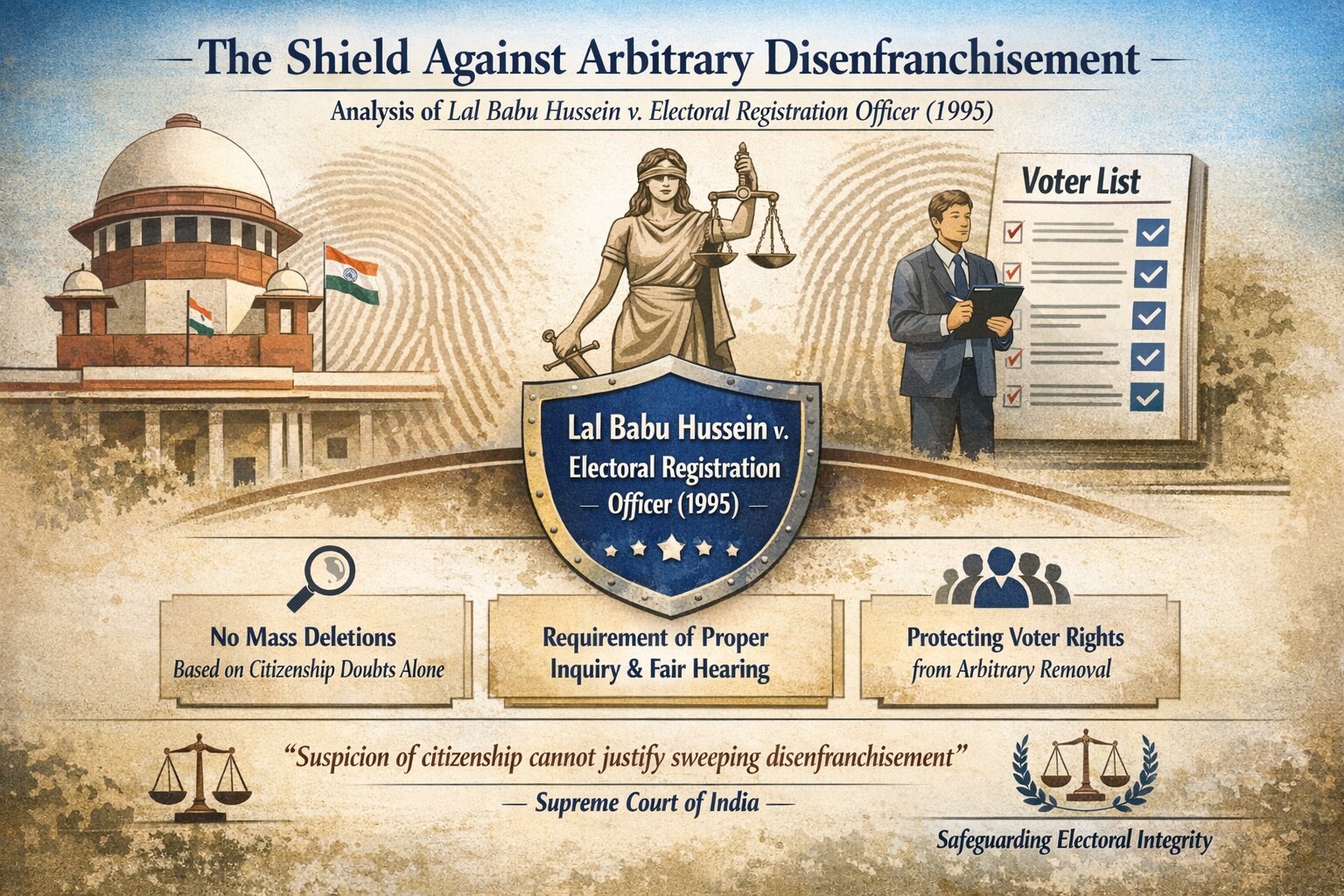
In a representative democracy, the right to be included in the electoral roll is the gateway to political agency. However, the process of maintaining these rolls often intersects with sensitive issues of national identity and citizenship. The Supreme Court’s decision in Lal Babu Hussein v. Electoral Registration Officer addressed a critical question: Can the state use the process of electoral roll revision to summarily strip large groups of people of their voting rights based on suspicion of being “foreigners” without following due process?
Factual Background and Context
The case arose in the mid-1990s in the National Capital Territory of Delhi. The Electoral Registration Officers (EROs) initiated a massive exercise to “cleanse” the electoral rolls of alleged “illegal migrants” from Bangladesh.
The authorities issued mass notices to residents in certain pockets of Delhi, requiring them to produce specific documents to prove their Indian citizenship. Failure to produce these documents—which included birth certificates or land records that many poor or migrant labourers did not possess—resulted in the summary deletion of their names from the voter list.
The petitioners, representing the affected residents, challenged this move as arbitrary, discriminatory, and a violation of the principles of natural justice.
The Core Legal Issues
The Supreme Court was called upon to adjudicate on three primary fronts:
- Jurisdiction of the ERO: Does an Electoral Registration Officer have the power to decide the question of citizenship?
- The Nature of Evidence: Can the ERO mandate a specific set of documents as the only proof of citizenship, ignoring other corroborative evidence?
- Due Process: Does the summary deletion of names without a fair hearing violate the principles of natural justice and Article 21 of the Constitution?
The Judgment of the Supreme Court
The Bench, led by Justice A.M. Ahmadi, delivered a landmark ruling that balanced the state’s interest in maintaining a clean electoral roll with the individual’s right to citizenship.
- Power to Decide Citizenship
The Court held that while the ERO has the primary duty to ensure that only citizens are on the roll (as per Section 16 of the Representation of the People Act, 1950), the ERO is not a substitute for the tribunals established under the Foreigners Act. The ERO’s inquiry is summary in nature and must be conducted with extreme caution.
- Rejection of “Specified Documents” Only
The most significant aspect of the ruling was the Court’s stance on evidence. The EROs had insisted on documents like birth certificates or 1951 NRC records. The Court observed:
- In a country with high illiteracy and poor record-keeping, millions of genuine citizens do not possess birth certificates.
- The ERO cannot insist on a “particular” document. Any reliable evidence—ration cards, school certificates, or even long-term residence proof—must be considered.
- The mere inability to produce a specific document does not automatically render a person a “foreigner.”
- The Burden of Proof and Natural Justice
The Court emphasized that the burden of proof lies on the person claiming to be a citizen, but the state must provide a meaningful opportunity to discharge that burden.
- Individualized Notices: The Court struck down the practice of “bulk notices.” Each person suspected of being a non-citizen must be served an individual notice specifying the grounds of suspicion.
- Right to be Heard: Deleting a name from the roll has serious “civil consequences.” Therefore, the principle of Audi Alteram Partem (hear the other side) must be strictly followed.
- Key Legal Principles Established
- The “Serious Consequences” Doctrine: The Court recognized that losing the right to vote is a “serious matter” that affects a person’s status in the polity. Therefore, any procedure to delete a name must be “just, fair, and reasonable” (aligning with the Maneka Gandhi mandate).
- Evidence of Residence: The Court ruled that if a person’s name has appeared on previous electoral rolls, there is a presumption of citizenship that cannot be discarded lightly without strong evidence to the contrary.
- Non-Discrimination: The exercise of detecting foreigners must not become a tool for harassing linguistic or religious minorities.
Impact on Contemporary Election Law
The legacy of Lal Babu Hussein is visible in the current Election Commission of India (ECI) guidelines:
- Verification Protocols: ECI’s Handbooks for EROs now explicitly state that no name should be deleted without a verified “Form 7” or a proper field verification.
- Documentation: The list of acceptable documents for age and residence proof has been expanded significantly to include a wide array of secondary documents, preventing the “documentary exclusion” the Court feared in 1995.
- National Register of Citizens (NRC): The principles in this case are frequently cited in contemporary debates regarding the NRC and the Foreigners Tribunals in Assam, serving as a reminder that the state cannot demand impossible standards of proof from its most vulnerable citizens.
The Epistemic Fallacy: Misuse of Logical Discrepancy in Voter Deletions
The deletion of names from electoral rolls often stems from a profound “epistemic fallacy”—the logical error of equating an individual’s inability to produce a specific document with the non-existence of their citizenship. This discrepancy is frequently weaponized by administrative authorities who shift the burden of proof onto the citizen in a way that ignores the realities of India’s socio-economic landscape. In many instances, a minor clerical mismatch (such as a spelling variation in a name or age) or the absence of legacy data is treated not as a corrigible administrative error, but as “proof of illegality.”
This misuse of logic transforms a regulatory maintenance exercise into an instrument of disenfranchisement through three primary mechanisms:
- The Absence-as-Evidence Trap: Authorities often adopt the flawed logic that if a citizen cannot provide a “specified document” (like a birth certificate from several decades ago), it constitutes positive evidence that they are a foreigner. This ignores the “Citizen-in-Fact”—the person who has lived, worked, and voted in a locality for generations but lacks the formal paper trail that characterizes the documented elite.
- Presumption of Fraud over Continuity: By treating long-standing entries on the voter list as “suspect” rather than “established,” the administration reverses the legal principle of continuity. This allows for “suspicion-only” purges where entire demographics are targeted for verification based on residence in specific pockets, rather than individualized evidence of disqualification.
- The Field-Verification Gap: The most critical logical failure occurs when digital or documentary discrepancies are used to bypass mandatory field visits. Instead of using technology to assist the voter in correcting their record, the “logical discrepancy” is used as a shortcut to justify summary deletion. This administrative shortcut fails to recognize that in a representative democracy, the “Right to Vote” is a statutory protection that cannot be extinguished by a clerical inconsistency.
Ultimately, when the state prioritizes “documentary purity” over “lived citizenship,” it creates a system where the most vulnerable—migrant labourers, the illiterate, and the marginalized—are the first to be silenced. Judicial interventions, such as those in the Lal Babu Hussein case, serve as essential corrections to this logic, reminding the state that the electoral roll must reflect the actual population, not just the subset that possesses a flawless documentary archive.
Conclusion
Lal Babu Hussein v. Electoral Registration Officer remains a cornerstone of democratic inclusive-ness. It serves as a judicial reminder that while the integrity of the electoral roll is paramount, it cannot be achieved through the “summary execution” of a citizen’s political identity. By insisting on individualized hearings and a flexible approach to evidence, the Supreme Court ensured that the “Right to Vote” remains a functional reality for the poor and the marginalized, rather than a privilege of the documented elite.