





Introduction
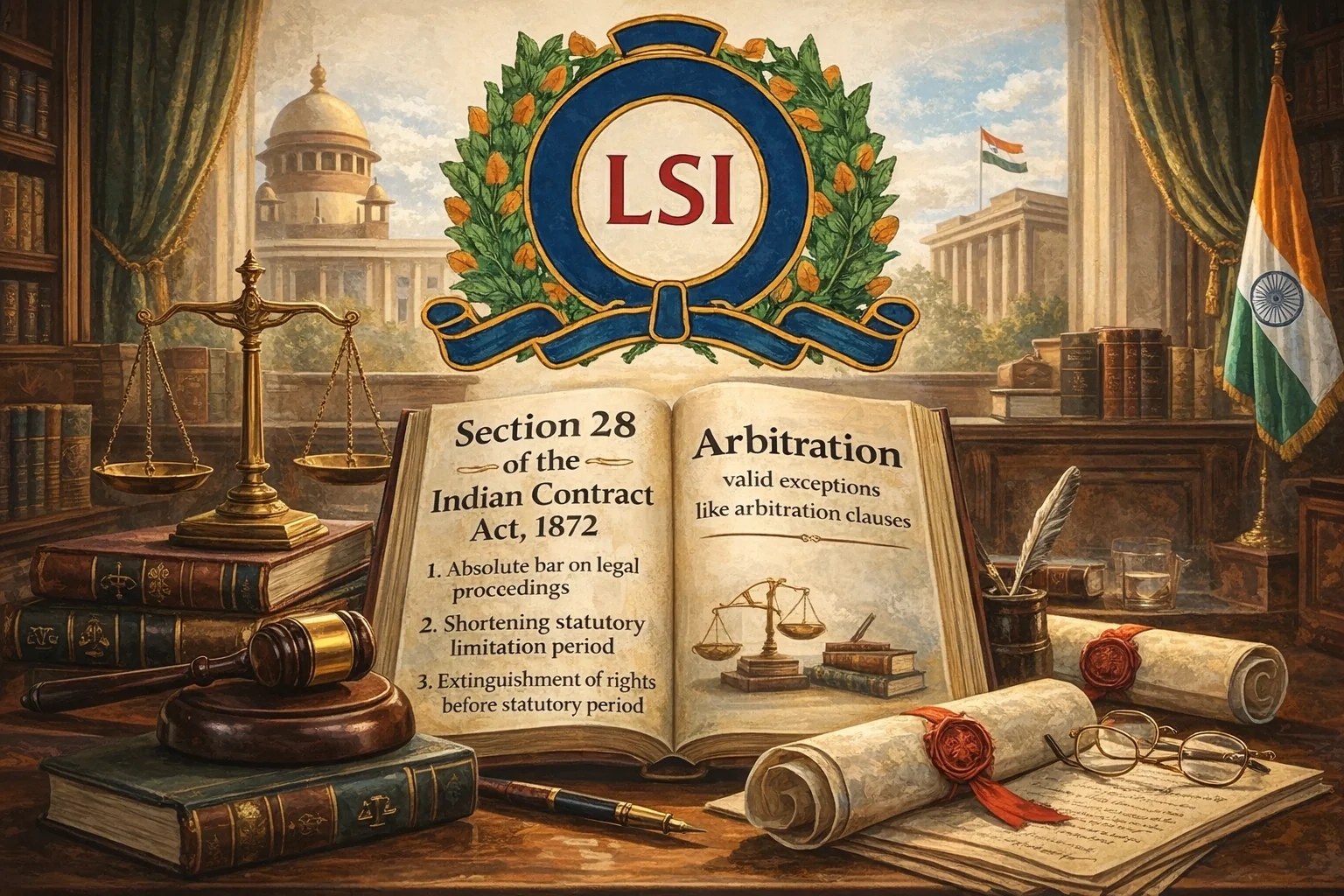
The foundation of the rule of law is access to courts and legal remedies. Any agreement that either completely prohibits someone from exercising their rights through court procedures in regular tribunals or limits the amount of time they have to do so, is held void under Section 28 of the Indian Contract Act, 1872. The rationale being clear that access to justice cannot be contracted away.
At the same time, the law recognises that parties may agree to resolve disputes outside court, most notably through arbitration. Arbitration, an alternative dispute resolution (ADR) mechanism, is acknowledged as a valid substitute to litigation, both domestically and internationally.
However, it has its own limitations where public interest or non-arbitrable matters are involved, such as those affecting the public at large, like cases about fraud, rights in rem, or issues tied to core public policy.
In contrast to UK and US laws and their pro-arbitration stance, India takes a more careful approach, upholding this forum as long as it does not entirely restraint accessibility to judicial recourse.
Research Objectives
- Critically examine the scope of Section 28 of the ICA and its judicial interpretation.
- Assess comparative approaches in the UK & USA.
Research Questions
| Aspect | Research Question |
|---|---|
| Section 28 (India) | What is the precise operational scope of Section 28’s exceptions in practice? |
| UK & USA | How do UK and USA laws regulate restraint clauses and arbitration agreements? |
Section 28 of the Indian Contract Act, 1872
Section 28 of the Indian Contract Act, 1872 renders void any contractual provision that:
1. Completely restrains a party from enforcing their rights through legal proceedings are held void.
Case Illustration: “K.K. Modi v. K.N. Modi (1998)” : The Supreme Court clarified that parties may agree to refer disputes to an expert or conciliator, but this cannot completely bar access to judicial remedies and any contractual provision attempting to prevent parties from approaching civil courts entirely is void under Section 28 of the Indian Contract Act, 1872 ; just like the existence of the MoU did not prevent the parties from approaching civil courts for redress. This judgment reinforces the principle that contractual arrangements must respect the parties’ fundamental right to seek judicial relief and cannot undermine statutory safeguards.
2. Limits the time for initiating legal proceedings to less than what is prescribed under law.
Case Illustration: “Food Corporation of India v. New India Assurance Co. Ltd.” (1994) involved an insurance clause that barred claims not made within six months of loss. At that time, the Supreme Court upheld the clause under the unamended Section 28, even though the Limitation Act allowed three years. Prior to the 1997 amendment, contractual shortening of limitation periods was permissible, however post-amendment, such clauses are void if they curtail statutory rights.
3. Extinguishes rights or discharges liability after a period shorter than the statutory limitation.
These clauses not only set a shorter deadline but also extinguish the right entirely if the deadline is missed, i.e., substantive rights are lost.
Case Illustration: In Chander Kant & Co. v. DDA (2009), a bank guarantee gave only 90 days to claim; if missed, the right was extinguished. This was addressed after the 1997 amendment of section 28 of ICA, 1872 , explicitly prohibiting premature extinguishment.
Historical Origin of Section 28 of the Indian Contract Act, 1872
Section 28 was first enacted in 1872, that time it only invalidated agreements that absolutely barred a party from enforcing their rights through court action. Though the Limitation Act, 1963 allowed three years for contract claims, the Supreme Court validated such a short-claim clause, in Food Corporation of India v. New India Assurance Co. Ltd. (1994) , leaving claimants with no remedy despite statutory time being available.
First Amendment, 1997
The Indian Contract (Amendment) Act, 1997 extended Section 28 to void clauses that extinguish rights after a fixed time shorter than the statutory period, or discharge liability after such a time. For example, an insurance policy saying “claims must be made within six months or forfeited” is void after 1997. This ensured statutory limitation periods could not be cut short by contract.
Second Amendment, 2013
The Second Amendment to Section 28 in 2013 introduced a narrow exception particularly for banking contracts involving Letters of Credit (LCs), which operate under strict timelines governed by international trade rules. The amendment permitted banks to enforce such shorter claim-expiry clauses without violating Section 28. This position was affirmed in “Union of India v. IndusInd Bank Ltd.” (2016), where the Court upheld the validity of reduced claim periods in LCs. Thus, while the 1997 amendment prioritised protecting claimants’ rights against premature termination of remedies, the 2013 amendment aligns Indian law with international practice for LCs.
Summary of Section 28 Provisions
| Provision | Effect Under Section 28 | Relevant Case |
|---|---|---|
| Absolute bar on legal proceedings | Void | K.K. Modi v. K.N. Modi (1998) |
| Shortening statutory limitation period | Void after 1997 amendment | Food Corporation of India v. New India Assurance Co. Ltd. (1994) |
| Extinguishment of rights before statutory period | Void after 1997 amendment | Chander Kant & Co. v. DDA (2009) |
| Short claim periods in Letters of Credit | Valid under 2013 amendment | Union of India v. IndusInd Bank Ltd. (2016) |
Legal Analysis in Modern Context with Case Laws
1. Absolute Ouster Clauses
Contractual freedom cannot be used to extinguish access to courts; where a clause makes litigative redress conditional on the other party’s discretion it strips an effective remedy and offends public policy. As established in K.K. Modi v. K.N. Modi (1998), the Supreme Court has repeatedly held that one-sided exclusion clauses are void because they are contrary to public policy and because they take away the fundamental right to seek judicial redress.
| Key Principle | Judicial Position |
|---|---|
| Ouster of courts | Not permitted if it denies effective judicial remedy |
| One-sided clauses | Void as against public policy |
2. Time-Limiting / Forfeiture Clauses and Arbitration
Historically, courts have occasionally upheld contracts with short-claims clauses, especially those pertaining to insurance and transportation. For example, contractual provisions restricted the period within which a party could enforce its rights, below the statutory limitation period, in National Insurance Co. Ltd. v. Sujir Ganesh Nayak & Co. (1997).
In order to rectify this, Parliament amended Section 28 in 1997, clarifying that any clause that forfeits a right after a shorter contractual period or shortens the time to enforce a right below the statutory limitation is void to that extent. This principle is upheld by courts, treating contractual clauses that result in the loss of rights below the period prescribed under the Limitation Act, 1963 as impermissible.
- Shortened limitation periods are void.
- Rights cannot be contractually forfeited earlier than statute allows.
- Section 28 amendment reinforces access to legal remedies.
3. Interaction of Arbitration and Limitation Periods
The Supreme Court in Bharat Sanchar Nigam Ltd. v. Nortel Networks India Pvt. Ltd. (2021) clarified the interaction between Section 11 of the Arbitration and Conciliation Act, 1996 and Article 137 of the Limitation Act.
If the parties are unable to agree themselves, Section 11 allows parties to request the court to appoint an arbitrator. However, if the claim is ex facie time-barred, clearly filed after the legal period, then Section 11 application may be refused.
Article 137 provides a residual three-year period, when no specific limitation is given. The Court reasoned that limitation periods cannot be bypassed through contractual clauses or delayed arbitration requests, ensuring arbitration remains a fair and timely forum.
| Provision | Effect |
|---|---|
| Section 11 | Court may appoint arbitrator |
| Article 137 | Three-year residual limitation |
| Ex facie time-bar | Application can be rejected |
4. Validity and Scope of Arbitration Clauses
Arbitration clauses are valid when they shift disputes from courts to a private tribunal without harming substantive rights or excluding judicial oversight in matters that law considers non-arbitrable.
In Booz-Allen & Hamilton Inc. v. SBI Home Finance Ltd. (2011), the Supreme Court clarified that arbitration is appropriate for disputes concerning individual rights (rights in personam), but not for matters that affect the public at large (rights in rem) or where special statutes provide exclusive remedies.
Later, in Vidya Drolia v. Durga Trading Corporation (2021), the Court held that many disputes, including tenancy and fraud issues, could be referred to arbitration. The guiding principle from these cases is that party autonomy in choosing arbitration must be respected, but it cannot override statutory mandates or compromise third-party rights.
According to Sundaram Finance v. NEPC India (1999), courts may provide interim protection under Section 9 in order to preserve the subject matter.
According to BSNL v. Nortel (2021), courts may choose arbitrators under Section 11; however, applications may be denied if they appear to be ex facie time-barred. Section 34 enables to set aside awards only on specific grounds like fraud, public policy, or patent violation.
- Rights in personam: Arbitrable
- Rights in rem: Not arbitrable
- Judicial oversight: Always preserved
5. Choice-of-Forum Clauses
Choice-of-forum clauses are valid as long as they select a court that already has jurisdiction under the Code of Civil Procedure (CPC).
Thereby, parties cannot provide jurisdiction to a court that does not have it otherwise, but they can agree to litigate only in one of multiple competent courts.
The Supreme Court in Hakam Singh v. Gammon (India) Ltd. (1971) clarified that such clauses are not to take away a legal remedy, but rather an election between legally competent forums.
However, if a clause tries to completely put unfair restrictions on access to a forum and denies a remedy, it will be void.
| Clause Type | Legal Status |
|---|---|
| Selecting competent court | Valid |
| Creating new jurisdiction | Invalid |
| Denying all remedies | Void |
Comparative Analysis: Section 28 (India) vs. UK and US Common Law
1. Arbitration-First Clauses (Scott v. Avery) and Court Access
Practice: In the UK, provisions requiring arbitration before litigation are upheld under the Arbitration Act 1996 and Scott v. Avery, they do not permanently bar courts but make arbitration the first step. Under the Federal Arbitration Act (FAA) and cases like AT&T Mobility v. Concepcion (2011), unless contrary to public policy, U.S. Law strongly enforces pre-dispute arbitration agreements.
Analysis: UK and U.S. law uphold arbitration-first clauses as expressions of party autonomy, while India imposes stricter safeguards to protect the right to judicial remedies.
| Jurisdiction | Approach to Arbitration-First Clauses |
|---|---|
| India | Stricter safeguards to ensure access to judicial remedies. |
| UK | Upheld under Arbitration Act 1996; courts are not barred permanently. |
| US | Strong enforcement under FAA unless against public policy. |
2. Judicial Oversight and Timing of Intervention
Practice: UK courts intervene mainly for public policy or procedural fairness. U.S. courts limit review to narrow FAA grounds, prioritising arbitral finality. However, India involves courts at structured stages: Section 9 (interim relief), Section 11 (appointment of arbitrators), and Section 34 (set-aside awards).
Analysis: The differences are in timing and intensity: India incorporates judicial checks into the arbitration process, but the US and UK interfere later and less frequently, reaffirming the finality of arbitration.
- India: Court involvement at multiple statutory stages.
- UK: Limited intervention, mainly on fairness or policy.
- US: Very narrow review under FAA.
3. Contractual Time-Bars and Forfeiture Clauses
Practice: According to the 1997 Amendment to Section 28, India voids contracts that restrict statutory limitation or curtail statutory rights. While UK law typically sustains them, subject to fairness requirements, and U.S. courts also enforce them unless inequitable.
Analysis: India adopts a statutory prohibition, while UK/US allow commercial freedom with softer checks like reasonableness and unconscionability.
| Jurisdiction | Position on Time-Bar Clauses |
|---|---|
| India | Statutorily void if they restrict limitation or rights. |
| UK | Generally valid, subject to fairness. |
| US | Enforced unless inequitable or unconscionable. |
Conclusion
Section 28 of the Indian Contract Act, 1872, is a critical public policy safeguard, which invalidates contractual provisions that restrain parties from accessing legal remedies or impose time bars shorter than statutory limitation periods. Indian law balances the principle of party autonomy with the constitutional guarantee of access to justice through a careful legislative evolution, including the 1997 and 2013 amendments. Landmark judicial decisions, such as K.K. Modi v. K.N. Modi and Booz-Allen & Hamilton Inc., have established that arbitration clauses are enforceable provided they do not bypass mandatory judicial oversight and only redirect the forum without extinguishing substantive rights.
Comparative analysis emphasises that, while common law jurisdictions such as the UK and US generally uphold arbitration-first clauses and emphasise party autonomy, India integrates statutory safeguards, making access to justice a core concern. Arbitration is confined to preserve fairness, substantive rights and neutrality. In essence, Section 28 exemplifies a nuanced legal framework where a complex legal system respects contractual flexibility without sacrificing statutory safeguards.
References:
Statutes
- Indian Contract Act, 1872, No. 9 of 1872.
https://www.indiacode.nic.in/bitstream/123456789/2187/2/A187209.pdf - Limitation Act, 1963, No. 36 of 1963.
https://www.indiacode.nic.in/bitstream/123456789/1565/5/A1963-36.pdf - Arbitration and Conciliation Act, 1996, No. 26 of 1996.
https://www.indiacode.nic.in/bitstream/123456789/1978/3/a1996-26.pdf
Web Resources
- https://blog.ipleaders.in/agreements-restraint-legal-proceedings/
- http://docs.manupatra.in/newsline/articles/Upload/968A00BF-EA62-4871-AF51-AE0DB6F096F1.pdf
- https://ijlsi.com/wp-content/uploads/Restraint-in-Legal-Proceedings.pdf
- https://www.scconline.com/

