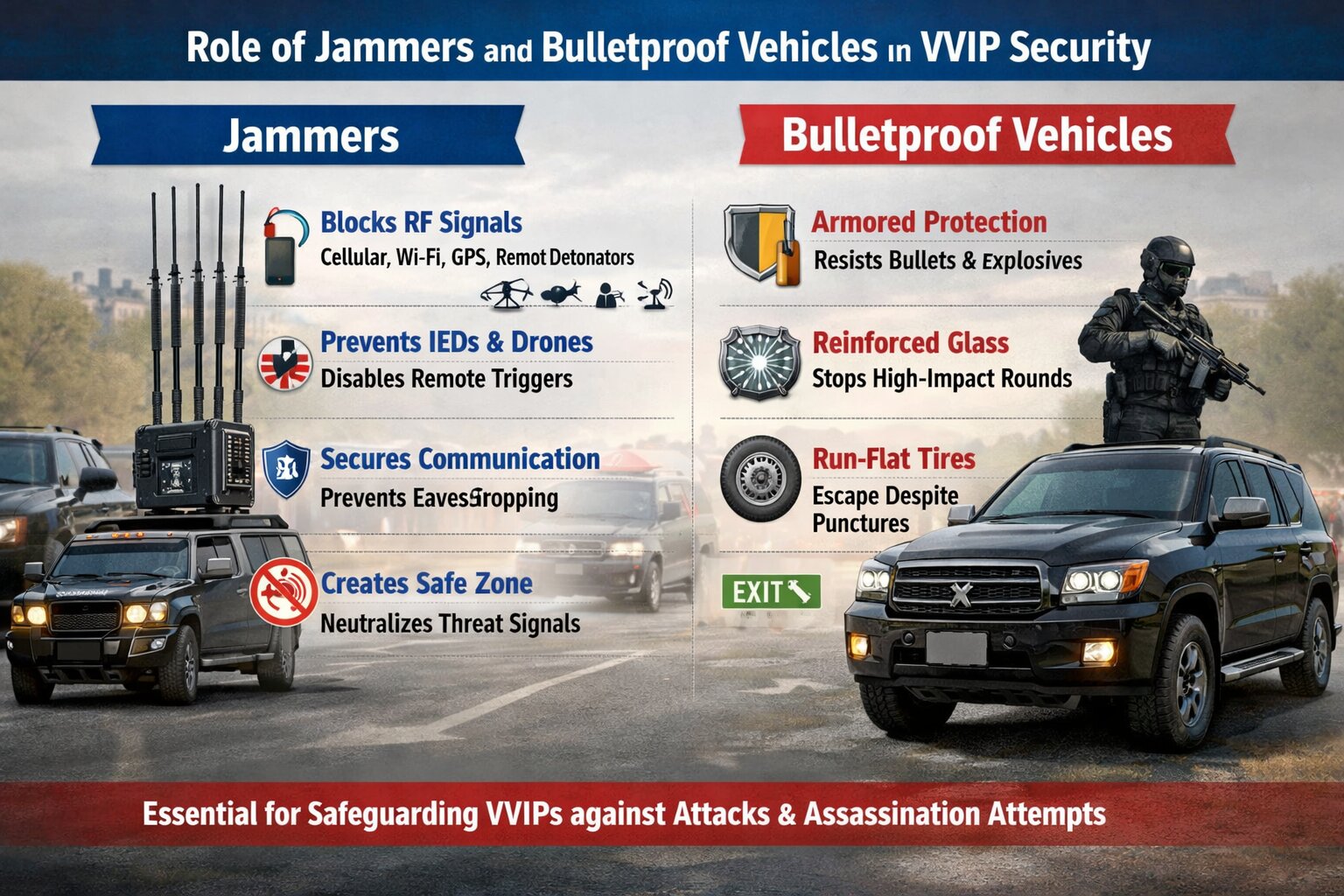
Ensuring the safety of VVIPs—such as heads of state, senior government officials, and dignitaries—requires a multi-layered security apparatus. Among the most critical components of this system are jammers and bulletproof vehicles, which serve complementary roles in neutralizing threats and safeguarding mobility.
- Importance of VVIP Security
- VVIPs are high-value targets for terrorist organizations, criminal groups, and hostile actors.
- Threats range from explosive devices and remote-controlled weapons to direct armed assaults.
- Security measures must therefore combine preventive technology with physical protection.
- Role of Jammers in VVIP Security
Jammers are electronic devices designed to block or disrupt communication signals. Their role in VVIP convoys is crucial for countering remote-triggered threats.
Functions:
- Neutralizing Remote-Controlled Explosives (RCIEDs):
- Prevent detonation of bombs triggered via mobile phones, radio frequencies, or remote controls.
- Blocking Unauthorized Communication:
- Disrupts hostile coordination attempts during convoy movement.
- Creating a Protective Electronic Bubble:
- Ensures that within a defined radius, no hostile signal can penetrate.
Operational Considerations:
- Jammers are mounted on escort vehicles in the convoy.
- They must cover multiple frequency bands (GSM, CDMA, 3G, 4G, satellite phones, Wi-Fi).
- Continuous monitoring is required to avoid interference with friendly communication systems.
- Role of Bulletproof Vehicles in VVIP Security
Bulletproof vehicles provide physical protection against direct armed attacks, ambushes, and sniper fire.
Features:
- Armoured Body: Reinforced steel and composite materials resist bullets and shrapnel.
- Ballistic Glass: Multi-layered glass prevents penetration from high-caliber rounds.
- Blast Resistance: Floors and sides are reinforced to withstand grenade or IED blasts.
- Run-Flat Tires: Allow escape even if tires are damaged.
- Secure Communication Systems: Encrypted radios and satellite phones ensure uninterrupted command.
Strategic Role:
- Serves as a mobile fortress, ensuring safe transit.
- Provides psychological assurance to the VVIP and security personnel.
- Enables rapid evacuation in case of attack.
- Integration of Jammers and Bulletproof Vehicles
- Complementary Protection: Jammers prevent remote-triggered attacks, while bulletproof vehicles shield against direct assaults.
- Convoy Security Protocols: Jammers are deployed in escort vehicles, while the VVIP travels in the bulletproof car.
- Layered Defense: Together, they form a dual shield—electronic disruption plus physical armor.
- Challenges and Limitations
- Signal Interference: Jammers may disrupt civilian communication networks.
- Mobility Constraints: Bulletproof vehicles are heavier and less maneuverable.
- Cost and Maintenance: Both systems require significant investment and specialized upkeep.
- Evolving Threats: Terrorists may adopt new triggering mechanisms beyond jammer coverage.
6. VVIP Security in the Indian Context
In India, the protection of is a matter of national priority, overseen by specialized agencies like the Special Protection Group (SPG) and state police units. Given the persistent threat of terrorism and the possibility of remote-controlled improvised explosive devices (RCIEDs), jammers play a vital role in convoys by neutralizing hostile communication signals and preventing remote-triggered attacks. Simultaneously, bulletproof vehicles—often custom-built to international standards—serve as mobile fortresses, shielding VVIPs from direct armed assaults, sniper fire, and explosive blasts. Together, these technologies form the backbone of India’s layered security strategy, ensuring safe mobility in high-risk environments while reinforcing public confidence in the state’s ability to protect its leaders.
7. Indigenous Manufacturing of Jammers and Bulletproof Vehicles in India
India’s growing self-reliance in defense and security equipment is exemplified by the indigenous production of advanced jammers and bulletproof vehicles. Public sector undertaking Electronics Corporation of India Limited (ECIL), under the Department of Atomic Energy, manufactures a range of sophisticated jammers—including vehicle-mounted, cellphone, portable RCIED, manpack, and emerging 5G variants—for supply to state police, paramilitary forces, defense organizations, and VVIP security applications, as confirmed by ECIL’s official portfolios and deployments in high-profile events.
Complementing this, private sector leader Bharat Forge (part of the Kalyani Group) produces indigenously designed armored and bulletproof vehicles, such as the Kalyani M4 mine-resistant ambush-protected vehicle and other protected platforms like light bullet-resistant and armored personnel carriers, meeting NATO standards and serving the Indian Army (including recent large deliveries and UN peacekeeping roles) while supporting high-security needs through partnerships and domestic manufacturing facilities. This blend of public and private sector capabilities underscores India’s advancing Atmanirbhar Bharat initiative in critical defense technologies.
8. Conclusion
The combination of jammers and bulletproof vehicles represents a cornerstone of modern VVIP security. While jammers safeguard against invisible electronic threats, bulletproof vehicles provide tangible physical protection. Together, they ensure that VVIPs can move securely through hostile environments, maintaining both operational continuity and national stability.