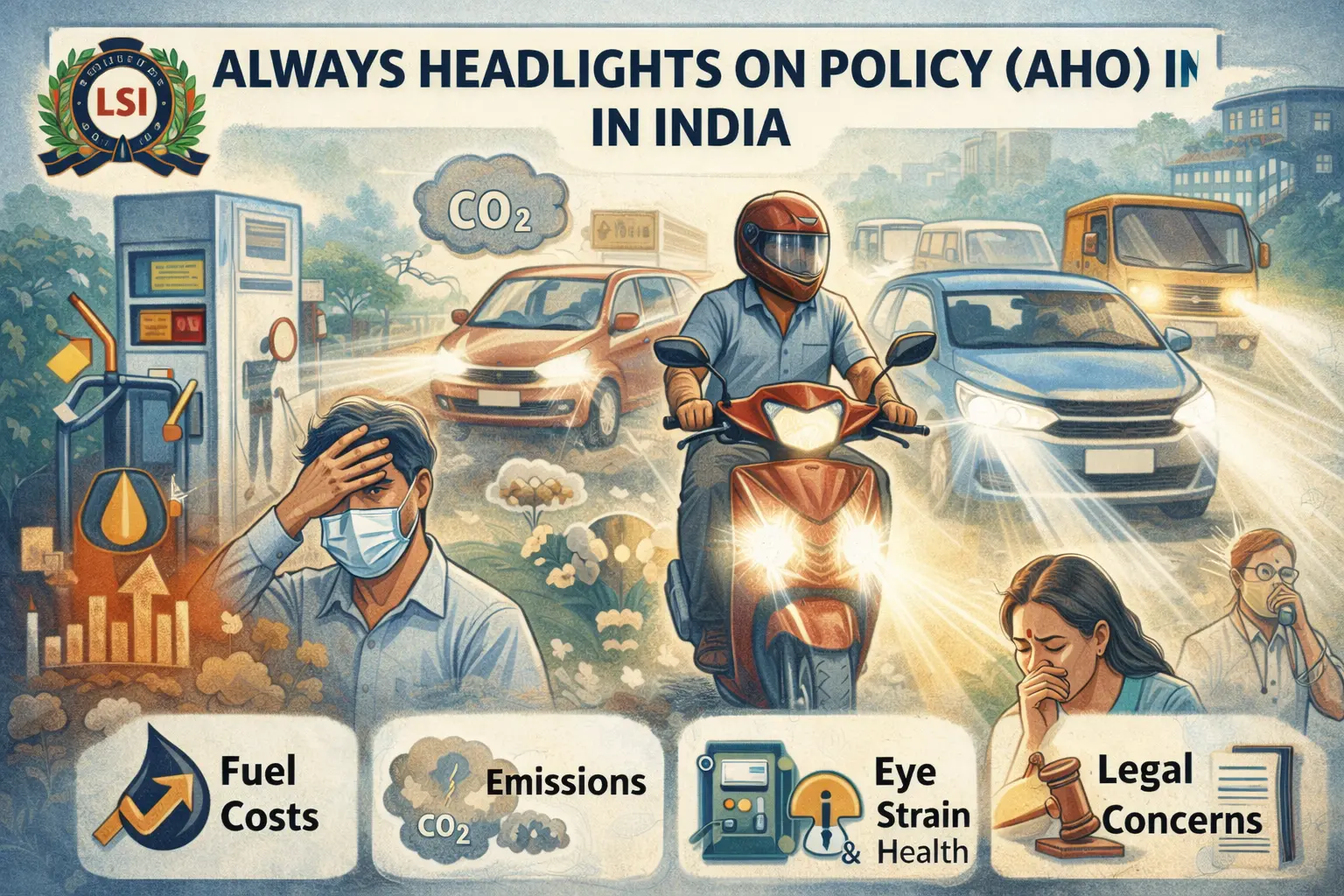
Traffic regulations impose continuous obligations on citizens and therefore must satisfy proportionality, reasonableness, and risk relevance. The Always Headlight On (AHO) policy was introduced as a road-safety measure to improve vehicle conspicuity. While safety is a legitimate objective, the policy mandates continuous operation of headlights or running lights regardless of daylight, regional climate, or actual visibility conditions.
India’s traffic ecosystem is characterized by wide climatic diversity, mixed road usage, dense congestion, and high livelihood dependence on fuel. In this context, a uniform, non-adaptive lighting mandate requires re-examination—especially when technology-available, less intrusive alternatives exist.
This article evaluates the AHO policy across five dimensions:
Fuel consumption
Environmental impact
Individual economy
Human health
Behavioural effects
The analysis is grounded in Motor Vehicle law and comparative regulatory practice.
Statutory, Regulatory and Emission-Norm Framework
2.1 Motor Vehicles Act, 1988
The parent statute does not mandate continuous headlamp usage. The obligation flows from delegated rule-making powers:
Section 110 – Power to prescribe vehicle safety standards
Section 111 – Power to regulate construction, equipment, and maintenance
AHO is therefore a policy choice, not a statutory inevitability.
2.2 Central Motor Vehicles Rules, 1989
Relevant rules include:
Rule 104 – Lighting and signaling devices
Rule 105 – Reflectors and visibility
Rule 108 – Safety standards for components
The CMVR does not require ambient-light sensors, automatic ON/OFF logic, or climate-specific calibration. Continuous AHO reflects static design, not legal compulsion.
2.3 Bharat Stage Emission Norms (What They Do Not Cover)
Framed under the Environment (Protection) Act, 1986, BS norms are emission-centric:
Norm
Scope
BS-III / BS-IV
Tailpipe limits
BS-VI
Advanced emission control, OBD
BS-VII (proposed)
Real Driving Emissions
None mandate lighting behavior. AHO is not an emission-compliance requirement.
2.4 Legal Implication
A traffic rule that indirectly increases fuel use and emissions—without being required by emission law and without adopting available adaptive alternatives—raises proportionality and reasonableness concerns.
Fuel Consumption Impact (Electrical Load and Sensor Savings)
3.1 Electrical Load and Current Usage
Headlamp systems draw continuous current under AHO, supplied by the alternator (engine-driven). Sustained electrical demand therefore translates into higher engine work and fuel burn.
Typical loads:
Halogen (pair): ~110–130 W
LED systems: ~20–40 W
Even with LEDs, continuous daytime draw creates a permanent energy load, amplified by Indian congestion and idling.
Automatic systems activate only when ambient light falls below thresholds (fog, dusk, night, tunnels) and switch off in high visibility.
System Type
Daytime Electrical Load
AHO
~100%
Automatic systems
~30–40%
This yields ~60–70% reduction in unnecessary daytime electrical load without compromising safety.
3.4 Overall Fuel Impact
Estimated fuel savings with automatic systems:
Two-wheelers: ~3–5%
Passenger cars: ~2–4%
Commercial vehicles: ~3–4%
National impact:
With 200+ million vehicles, avoidable fuel cost of ₹500–₹800 per vehicle per year aggregates to ₹100+ billion annually.
Environmental Impact (Emissions, Light Pollution, Health Exposure)
4.1 Emissions
Increased electrical load raises fuel combustion and emissions, including CO₂, NOx, and PM—especially relevant in urban idling conditions.
4.2 Daytime Light Pollution
Continuous daytime headlamps add avoidable glare and visual clutter, particularly in dense traffic and reflective urban environments. When lighting is not visibility-necessary, it becomes an avoidable environmental externality.
4.3 White / Blue-Rich Light and Human Health
Modern headlamps increasingly use high-intensity white/blue-rich LEDs. Contemporary studies and surveys associate excessive exposure with:
Discomfort for pedestrians, cyclists, and oncoming users
While effects are most studied at night, cumulative daytime exposure in congested settings—notably for traffic police, delivery workers, pedestrians, and two-wheeler riders—adds to visual and neurological load. Avoiding unnecessary exposure where visibility does not require illumination is therefore prudent.
For commercial vehicles, these are fixed, recurring operating costs, not variable or speculative—affecting margins and ultimately consumer prices.
Behavioural and Human-Factors Analysis
Headlights function as warning signals by contrast. Continuous presence reduces salience due to habituation:
Reduced sensitivity to light cues
Diminished signalling value
Possible over-confidence without proportional safety gain
Vulnerable users (pedestrians, cyclists, two-wheeler riders) face added glare and visual fatigue in dense traffic.
Regional Climatic Reality Within India
Fog incidence varies sharply:
Region
Fog Incidence
North India
Seasonal fog (20–35 days)
South India
Minimal fog (0–5 days)
Overall India
Minimal to Seasonal fog
Uniform AHO ignores rational classification based on actual risk.
Consolidated Comparative Table: Fog Incidence vs Lighting Regulation
Region / Country
Avg. Fog Days / Year
Daytime Headlamp Mandate
Automatic / Sensor-Based Lighting
Poland
60–80
No
Yes
Germany
30–50
No
Yes
United Kingdom
20–30
No
Yes
North India
20–35
Yes
No
South India
0–5
Yes
No
Core Finding
Despite higher fog incidence, Poland relies on automatic, sensor-based activation, while India mandates continuous AHO even in low-fog regions.
Policy Inconsistency
AHO coexists with fuel-saving advisories and anti-idling campaigns, creating internal inconsistency when avoidable energy consumption is mandated despite available alternatives.
Need for Reform
Available models:
Uniform AHO: Always ON; fuel waste, signal dilution
Sensor-based automatic: ON only when needed; safety with efficiency
Hybrid: DRL + auto headlights; optimal balance
Legal Justification
Under Article 14 (rational classification), Article 21 (livelihood and environmental facets), and the doctrine of proportionality, a regulation that imposes recurring burdens despite proven, less intrusive alternatives warrants reform.
Conclusion
The AHO policy pursued a legitimate safety aim, but its uniform, non-adaptive design has produced avoidable fuel consumption, environmental impact (including light pollution), economic burden, human health concerns from white/blue-rich light exposure, and behavioural desensitisation.
Comparative evidence demonstrates that automatic, sensor-based lighting preserves safety while reducing costs and impacts. Reforming AHO to adopt adaptive activation would align traffic regulation with proportionality, efficiency, and responsible governance—benefiting citizens, the environment, and the economy without compromising road safety.
Award-Winning Article Written By: Mr.Suryaprakash Kallakuri
🎖️ Recognition · Legal Author 📚
1 Published Articles
Surya is an LL.B student His academic interests include constitutional law, environmental regulation, and public policy analysis, with a focus on examining the legal implications of technology-driven regulations on public welfare and economic sustainability.