I. Introduction
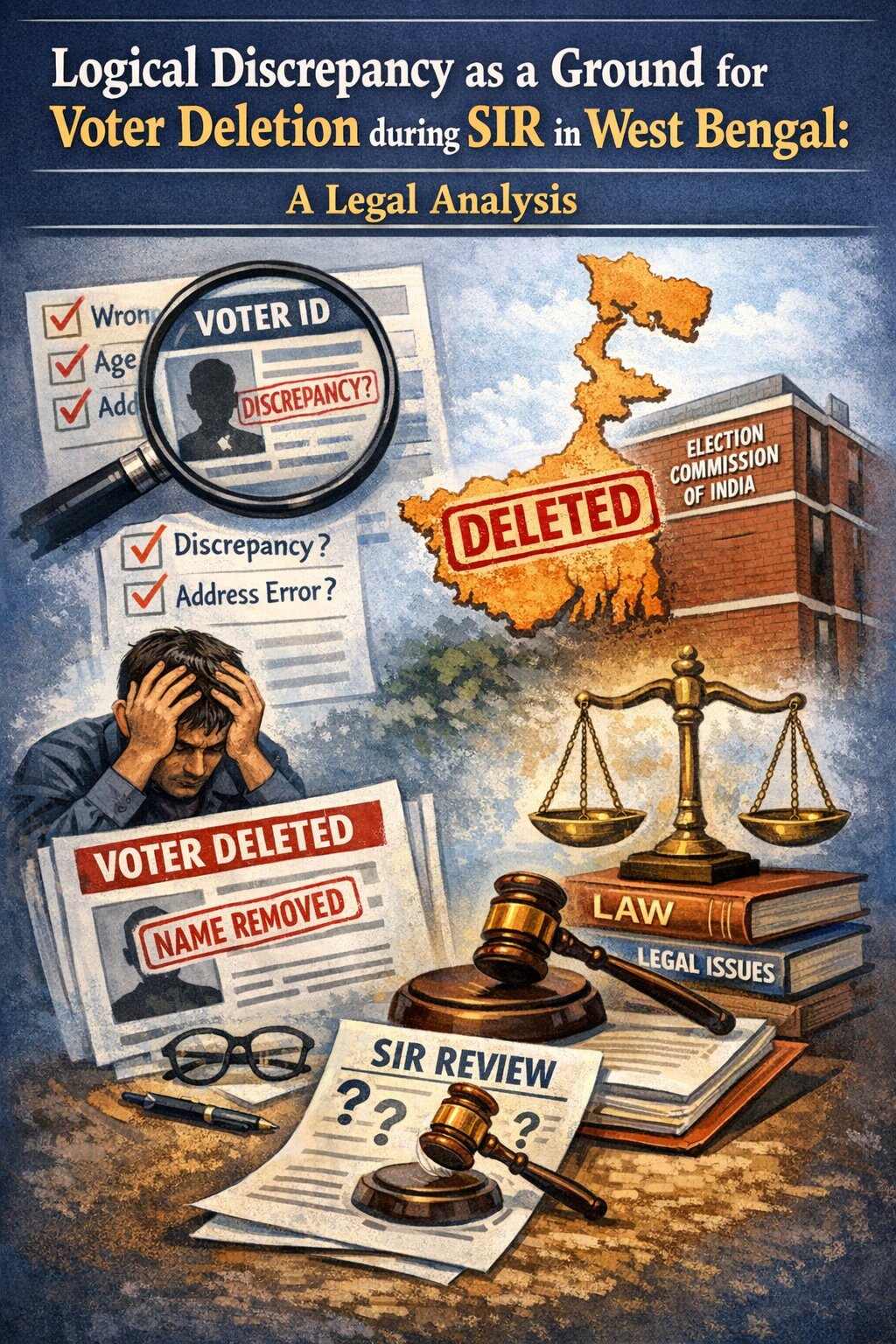
The Special Intensive Revision (SIR) of electoral rolls in West Bengal has foregrounded a critical constitutional concern that extends beyond questions of statutory compliance or administrative efficiency—namely, the problem of logical discrepancy in the reasoning employed by the ECI while exercising its powers of voter roll revision. The controversy surrounding large-scale deletions of names from the voters’ list does not merely raise issues of legality under the Representation of the People Act, 1950 (RPA, 1950), but strikes at the internal coherence, consistency, and democratic rationality of the Commission’s decision-making processes.
Logical discrepancy, in this context, refers to a condition where an authority advances mutually inconsistent premises or applies standards unevenly without a transparent or rational explanation. Unlike illegality, which involves a clear violation of law, logical discrepancy operates in the grey zone of administrative discretion—where actions may be formally lawful yet normatively indefensible. In the context of elections, such discrepancy is especially grave because it implicates the foundational democratic right to vote, which the Supreme Court has repeatedly described as integral to participatory democracy.
This article argues that the SIR in West Bengal exemplifies how logical discrepancy can function as an administrative technique—one that normalises exclusion while rhetorically affirming inclusion, and transforms voter eligibility from a constitutional presumption into a provisional status contingent on repeated verification. Through constitutional jurisprudence under Article 324, principles of administrative law, and comparative democratic practice, the article demonstrates that the official reasoning during the SIR reflects a shift from a rights-based electoral framework to a compliance-driven bureaucratic model, with serious implications for electoral legitimacy.
II. Constitutional Framework: Article 324 and the Logic of Electoral Governance
Article 324 of the Constitution vests the Election Commission of India with the “superintendence, direction and control” of elections to Parliament and State Legislatures. The Supreme Court, beginning with Mohinder Singh Gill v. Chief Election Commissioner (1978), has interpreted this provision as conferring plenary and residuary powers on the ECI to ensure free and fair elections, particularly where statutory law is silent or inadequate.
However, the Court has been equally emphatic that Article 324 is not a charter for unstructured discretion. In Mohinder Singh Gill itself, the Court cautioned that such power must operate within “the discipline of reason” and remain anchored in constitutional values such as fairness, equality, and non-arbitrariness. Later decisions, including A.C. Jose v. Sivan Pillai (1984) and Election Commission of India v. Ashok Kumar (2000), reiterated that while judicial interference in electoral processes should be limited, the Commission’s actions are not immune from constitutional scrutiny.
The jurisprudence thus establishes a crucial principle: the legitimacy of the ECI’s authority depends not merely on the breadth of its power, but on the coherence and transparency of its reasoning. Logical discrepancy arises precisely when this coherence is absent—when the Commission’s stated objectives and operational practices pull in opposite directions.
III. The Special Intensive Revision in West Bengal: Context and Contours
Special Intensive Revisions are not unknown to Indian electoral practice. Conducted periodically, they aim to cleanse electoral rolls of duplicate, fictitious, or otherwise ineligible entries. In principle, such exercises serve electoral integrity. However, the SIR in West Bengal has drawn attention because of the scale, timing, and manner of deletions, as well as the reasoning advanced to justify them.
The ECI has characterised the SIR as a neutral, routine administrative exercise, undertaken in accordance with statutory rules and established procedures. Yet, critics argue that the operational logic of the revision reflects a deeper inconsistency: while the Commission professes commitment to voter inclusion and universal adult suffrage, the verification mechanisms deployed during the SIR appear exclusionary in design and effect.
The controversy, therefore, is not about whether the ECI has the power to revise electoral rolls—it undoubtedly does—but whether the logic guiding the exercise of that power remains constitutionally coherent.
IV. Shifting Burden of Proof: From Presumptive Inclusion to Conditional Citizenship
A central logical discrepancy in the SIR lies in the shifting burden of proof imposed on electors. The ECI has consistently maintained that inclusion in the electoral roll is the norm, and deletion the exception, permissible only after due verification and notice. This position aligns with both constitutional principles and statutory design under the RPA, 1950.
However, during the SIR, the operational logic appears inverted. Voters whose names already exist on the rolls are required to re-establish eligibility, often through documentary proof, within compressed timelines. This effectively treats existing enrolment not as a settled status but as a tentative entry subject to periodic reconfirmation.
This approach conflicts with the Commission’s own settled position that an elector once validly enrolled carries a presumption of eligibility unless disqualified by law. The Supreme Court’s decision in Lal Babu Hussein v. Electoral Registration Officer (1995) is particularly instructive in this regard. The Court held that deletions from electoral rolls must be individualised, reasoned, and preceded by meaningful notice and opportunity to object. Wholesale or mechanical deletions undermine the democratic character of elections.
When the ECI asserts continuity of enrolment in principle but demands re-verification in practice, it reveals a logical inconsistency between principle and procedure. Even where statutory forms are complied with, the underlying reasoning departs from the constitutional presumption that the right to vote, once conferred, is not lightly withdrawn.
V. Selective Intensity of Scrutiny and Circular Reasoning
Another major logical discrepancy emerges from the selective intensity of scrutiny during the SIR. The Commission describes the revision as a general exercise to remove duplicates and ineligible names. However, when the effects on the ground appear geographically or demographically skewed, without publicly articulated, data-based justification, the claim of neutrality becomes strained.
The reasoning employed often appears circular: deletions are justified on the basis of suspected irregularities, while the existence of irregularities is inferred from the very deletions undertaken. This mode of reasoning lacks an independent evidentiary anchor and departs from basic principles of administrative rationality.
Such circularity is constitutionally problematic because it reverses the logic of justification. Instead of establishing clear criteria and evidence for deletion, the outcome itself becomes the justification. This directly conflicts with the requirement, emphasised in Lal Babu Hussein, that deletions must be based on specific grounds applicable to individual electors, not generalized suspicion.
VI. Administrative Necessity versus Democratic Cost
The ECI has frequently invoked administrative necessity to justify strict verification during the SIR, arguing that such measures are essential to prevent impersonation, duplication, and illegal voting. Electoral integrity is undoubtedly a legitimate objective. However, the manner in which this objective is balanced against the democratic cost of erroneous deletions reveals another logical discrepancy.
On one hand, the Commission treats the risk of wrongful inclusion as a serious threat to electoral purity. On the other hand, it downplays the risk of wrongful exclusion by pointing to post-deletion remedies such as claims, objections, and appeals. This reasoning is internally inconsistent. If the right to vote is foundational to democratic participation, then remedies after exclusion cannot logically justify a verification process that risks mass disenfranchisement before polling.
The Supreme Court’s caution in Mohinder Singh Gill—that Article 324 powers must be exercised to facilitate, not frustrate, democratic participation—directly challenges this form of instrumental reasoning. Administrative convenience cannot trump constitutional priority.
VII. Formal Equality and Substantive Inequality
A further discrepancy arises from the ECI’s reliance on uniform rules producing non-uniform outcomes. The Commission often defends SIR deletions by asserting that the same verification requirements apply to all electors. However, equality in form does not guarantee equality in effect.
Documentation-heavy verification regimes disproportionately impact migrant workers, the urban poor, women, and marginalised populations, whose access to formal records is uneven. When the ECI proclaims commitment to universal adult suffrage while administering processes that predictably exclude vulnerable groups, the inconsistency is not accidental but structural.
As recognised in A.C. Jose v. Sivan Pillai (1984), discretion under Article 324 cannot be exercised in a manner that defeats the substantive equality underlying electoral law. Treating unequal situations as equal can itself amount to arbitrariness.
VIII. Comparative Perspectives: Voter Roll Revisions in Other Democracies
A comparative examination of voter roll revision practices in other democracies reveals a striking contrast in underlying logic.
United States
Under the National Voter Registration Act, 1993 (NVRA), voter roll maintenance is permitted but is subject to stringent statutory safeguards. The Act regulates how electoral authorities may revise, clean, or purge voter rolls, proceeding on the foundational assumption that once a citizen is validly registered, enrolment is a continuing legal and constitutional status. Consequently, the burden lies squarely on the State to justify removal, and not on the voter to repeatedly re-establish eligibility.
The NVRA does not prohibit deletions altogether, but it constitutionalises restraint in deletion. Systematic purges are tightly regulated: voters cannot be removed solely on the basis of inactivity or non-participation, and any proposed removal must be preceded by individualised notice, meaningful opportunity to respond, and mandatory waiting periods. Roll maintenance, therefore, must be narrowly tailored, procedurally fair, and inclusion-oriented, ensuring that administrative efficiency does not override the fundamental right to vote.
This balance was judicially examined in Husted v. A. Philip Randolph Institute (2017), where the U.S. Supreme Court upheld Ohio’s voter-roll process as compliant with the NVRA, while simultaneously reaffirming that robust safeguards against wrongful purging remain essential to protect the constitutional franchise. Read together, the NVRA and its judicial interpretation recognise that electoral integrity is best preserved not through aggressive exclusion, but through transparency, due process, and a strong presumption in favour of voter inclusion.
United Kingdom
In the UK, deletion typically occurs only after repeated non-responses to canvass notices. The system accommodates electors without fixed addresses, prioritising inclusion over technical compliance.
Canada
Elections Canada maintains a continuously updated National Register of Electors, relying on system-level data matching rather than individual re-proof. Deletions are rare and overseen by an independent Commissioner to ensure procedural fairness.
Australia and Germany
Both jurisdictions treat enrolment as a civic status, not a conditional entitlement. The burden of maintaining accuracy lies primarily with the State, not the voter.
The common thread across these democracies is a strong presumption of continuity once enrolment is established. Deletion is a calibrated exception, not a routine reset.
IX. Lessons for India and the Need for Reform
Against this comparative backdrop, the ECI’s approach during the West Bengal SIR appears anomalous. The reliance on individual re-verification, compressed timelines, and post-facto remedies places India closer to a compliance-based model that other democracies have consciously moved away from.
The controversy underscores the need for institutional reform that addresses logical discrepancies rather than merely procedural compliance. Such reform could include:
- Statutorily mandated safeguards for deletions, akin to NVRA-style protections
- Mandatory, reasoned orders for deletions affecting existing electors
- Transparent, disaggregated data disclosure on revision outcomes
- Independent pre-election oversight mechanisms
X. Reported Deaths and Suicides during the Special Intensive Revision (SIR) in West Bengal
During the ongoing Special Intensive Revision (SIR) of electoral rolls in West Bengal, various deaths and suicides have been reported amid anxiety, stress and alleged work pressure related to the process. According to statements by the West Bengal Chief Minister, the state government has recorded at least 39 deaths, including cases of suicide and other causes, linked to panic and stress triggered by the SIR exercise, and financial assistance has been announced for their families. (Outlook India, December 2, 2025)
Political leaders in the state have claimed higher figures, with one allegation that up to 77 deaths, 4 suicide attempts and multiple hospitalisations are connected to the SIR process, attributing fear and disproportionate workload as contributing factors. (The Times of India, January 10, 2026)
Separately, multiple individual incidents of deaths and suicides allegedly related to anxiety over voter list revisions have been reported across West Bengal — including at least six deaths in a single 24-hour period, of which five were suicides and one a heart attack, with families linking the distress to SIR notices and fear of exclusion from the voter list. (The Times of India, January 20, 2026)
Note: These figures vary by source and include official claims, political statements, and individual incident reports; they are subject to verification and differing interpretations.
XI. Conclusion
The SIR in West Bengal exemplifies how logical discrepancy can operate as an administrative tool—not through overt illegality, but through inconsistent reasoning that normalises exclusion while rhetorically affirming inclusion. By treating voter inclusion as provisional, shifting the burden of proof onto citizens, and relying on post-deletion remedies to justify pre-emptive exclusion, the ECI risks undermining the constitutional promise of universal adult suffrage.
In a constitutional democracy, the legitimacy of electoral administration depends as much on the coherence of reasoning as on formal legality. Bridging the gap between principle and practice is essential to ensure that electoral roll revisions enhance integrity without sacrificing inclusion. Ultimately, the risk of wrongful exclusion is constitutionally graver than the risk of wrongful inclusion, and electoral governance must be structured accordingly.