





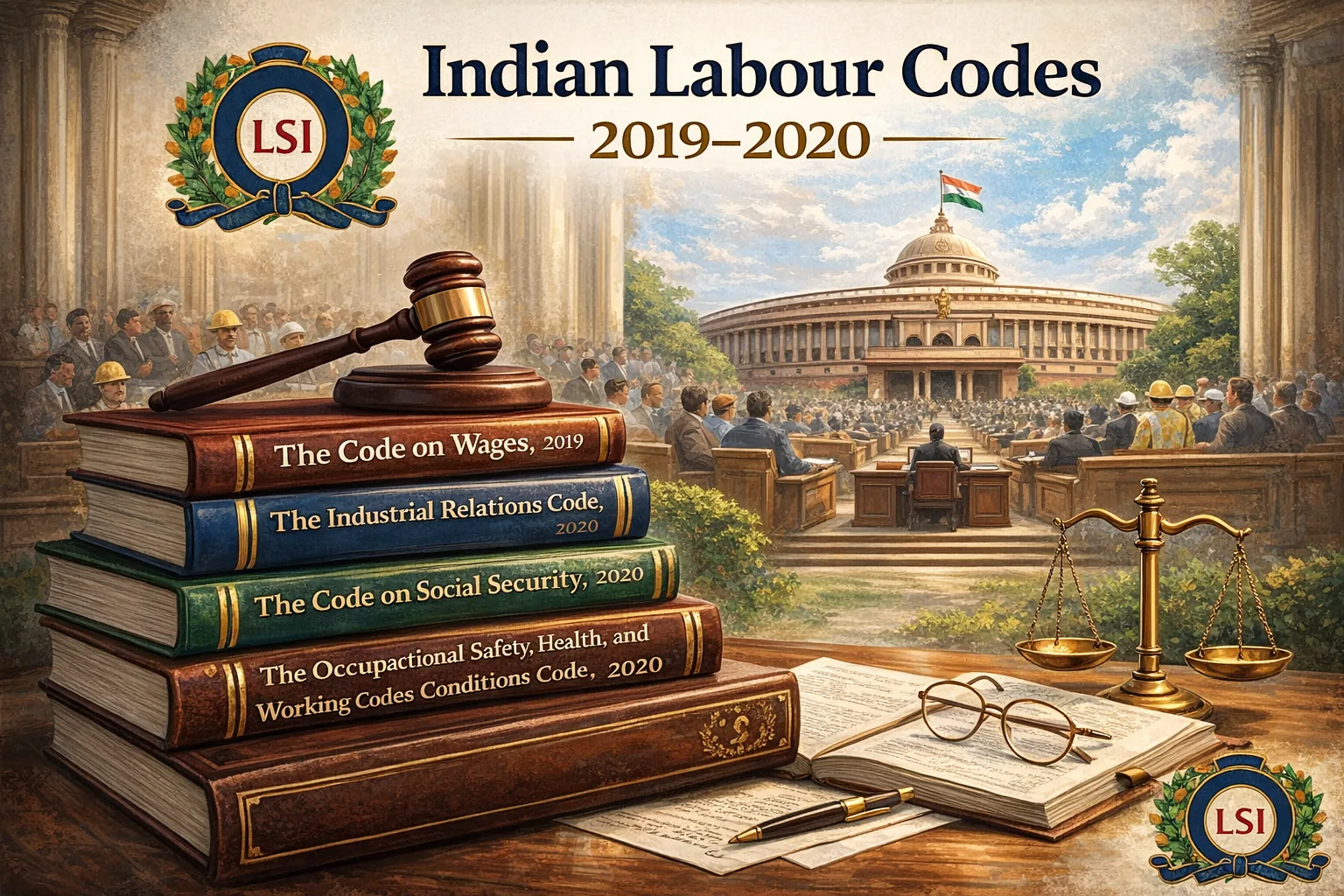
Introduction: A New Institutional Phase
The landscape of Indian labour law, prior to 2019, was a complex and fragmented tapestry woven from over forty central statutes and more than one hundred state-level laws.[1] This labyrinthine legal structure, a legacy of India’s post-colonial, welfare-state philosophy, was frequently criticised as a significant impediment to compliance, economic efficiency, and investment.[2]
While born from a noble intent to protect labour, this legislative profusion resulted in a stark dichotomy: a heavily regulated and rigid formal sector coexisting with a vast, largely unprotected informal sector where the majority of India’s workforce is employed. This system, characterized by a multiplicity of definitions, authorities, and compliance requirements, created what the Second National Commission on Labour (2002) identified as a need for rationalisation and simplification.
Imperative For Reform
The imperative for reform, gaining momentum in the context of a globalized economy and the emergence of novel work arrangements, culminated in a historic legislative overhaul. The declared objective was to simplify, rationalize, and modernize the legal architecture to enhance the ease of doing business while simultaneously expanding the umbrella of protection to a wider segment of the workforce.[3]
Four Labour Codes (2019–2020)
Between 2019 and 2020, the Indian Parliament enacted four comprehensive Labour Codes, heralding a new institutional phase in the country’s labour governance. These are The Code on Wages, 2019;[4] The Industrial Relations Code, 2020;[5] The Code on Social Security, 2020;[6] and The Occupational Safety, Health and Working Conditions Code, 2020.[7] These Codes consolidate twenty-nine central labour laws into four streamlined statutes, representing the most significant restructuring of labour legislation since India’s independence.
| Labour Code | Year |
|---|---|
| The Code on Wages | 2019 |
| The Industrial Relations Code | 2020 |
| The Code on Social Security | 2020 |
| The Occupational Safety, Health and Working Conditions Code | 2020 |
Core Argument Of This Paper
This paper argues that while the four Labour Codes successfully erect a modern legislative skeleton for labour governance, their transformative potential is fundamentally contingent upon overcoming significant challenges in regulatory implementation, enforcement capacity, sustainable funding for social security, and the preservation of meaningful social dialogue. The consolidation of statutes at the central level has, paradoxically, shifted complexity to the regulatory sphere, where a fragmentation of state-level rules threatens the very uniformity the Codes sought to achieve.
Structure Of The Paper
The success of this new architecture will not be determined by the legislative text alone, but by the ability of the state to build the institutional muscle required to give it life. This paper will proceed by first examining the constitutional bedrock of social justice that continues to guide Indian labour jurisprudence. It will then provide a substantive analysis of the structural changes introduced by each of the four Codes. Following this, it will focus on the Codes’ most novel contribution the inclusion of gig and platform workers and assess the practical working of the new regime up to 2025, highlighting implementation gaps and enforcement challenges. The paper concludes with recommendations aimed at bridging the gap between legislative ambition and on-the-ground reality.
The Constitutional Compass: Social Justice and Labour Rights
The edifice of Indian labour law, both in its historical form and under the new Codes, rests upon a profound constitutional philosophy of social and economic justice. This philosophical bedrock, enshrined in the Constitution of India, serves as a guiding compass for all legislative, executive, and judicial actions concerning labour. The Preamble itself sets the ultimate objective, promising to secure for all its citizens “Justice, social, economic and political.”[8] This vision is given substantive direction through the interplay of Fundamental Rights and the Directive Principles of State Policy (DPSP).
The Philosophical Bedrock: Directive Principles of State Policy
Part IV of the Constitution, containing the DPSP, has been described as the “soul of the Constitution” in the context of social welfare.[9] While these principles are not enforceable in any court of law, Article 37 declares them to be “fundamental in the governance of the country,” making it the duty of the State to apply them in making laws.
Several directives are of direct relevance to labour law, including:
- The State’s duty to secure a living wage for workers.[10]
- Provision for just and humane conditions of work and maternity relief.[11]
- Ensuring the participation of workers in the management of industries.[12]
These principles legitimize labour’s demands and provide a constitutional mandate for welfare-oriented legislation.
Judicial Alchemy: Weaving Directives into Fundamental Rights
The true potency of the DPSPs has been unlocked through the Indian judiciary’s innovative and activist jurisprudence, which has effectively woven these non-justiciable principles into the fabric of enforceable Fundamental Rights under Part III of the Constitution. The most crucial of these is Article 21, the Right to Life and Personal Liberty.
The Supreme Court’s interpretation of Article 21 has evolved dramatically:
| Case | Interpretation |
|---|---|
| A.K. Gopalan v. State of Madras | “Life” equated with mere “animal existence”.[13] |
| Maneka Gandhi v. Union of India | Right to live with human dignity.[14] |
| Olga Tellis v. Bombay Municipal Corporation | Right to livelihood as an essential component of life.[15] |
| People’s Union for Democratic Rights v. Union of India | Non-payment of minimum wages amounts to “forced labour” under Article 23 and violates dignity under Article 21.[16] |
Through this judicial alchemy, the welfare objectives of the DPSPs were transformed into enforceable fundamental rights.
Similarly, Article 19(1)(c) guarantees all citizens the fundamental right “to form associations or unions.”[17] This provides the constitutional foundation for the trade union movement. However, the judiciary has clarified that this right is not absolute; it does not automatically include a right to recognition by the employer or a guaranteed right to strike, both of which are subject to statutory regulation under industrial relations law.[18]
The Doctrine of Harmony: Balancing Rights and Welfare
The potential conflict between the individual freedoms in Part III and the collective welfare goals in Part IV was addressed by the Supreme Court through the “doctrine of harmonious construction.” In the landmark case of Minerva Mills Ltd. v. Union of India, the Court held that Fundamental Rights and Directive Principles are not mutually exclusive but are complementary, forming the “core of the Constitution.”[19]
The Court famously stated that the Indian Constitution is founded on the “bedrock of the balance between Part III and Part IV. To give absolute primacy to one over the other is to disturb the harmony of the Constitution.”[20]
This doctrine provides the constitutional justification for upholding labour laws that may place “reasonable restrictions” on the rights of employers (e.g., freedom of trade under Article 19(1)(g)) in pursuit of the social justice objectives articulated in the DPSPs.
Enduring Relevance of the Constitutional Framework
This constitutional framework remains unchanged and resilient. The new Labour Codes, despite being products of a policy environment emphasizing flexibility and ease of doing business, must operate within this established jurisprudential landscape. The enduring principles of social justice, judicially woven into the right to life and dignity, create an inherent tension with provisions that could be interpreted as diluting worker protections.
Consequently, the ultimate working of the Codes will not be determined by legislative intent alone, but by the dynamic and potentially conflictual interplay between the new statutory text and the judiciary’s role as the guardian of the Constitution’s core social-welfare ethos.
The New Architecture: An Analysis of the Four Labour Codes
The centrepiece of India’s new institutional phase in labour governance is the consolidation of 29 central laws into four comprehensive codes. This legislative exercise aimed to harmonize definitions, simplify compliance, and create a modern legal framework. Each Code addresses a distinct pillar of labour law, introducing significant structural changes.
The Code on Wages, 2019
This Code amalgamates and replaces four foundational statutes:
- The Payment of Wages Act, 1936
- The Minimum Wages Act, 1948
- The Payment of Bonus Act, 1965
- The Equal Remuneration Act, 1976[21]
Its most transformative feature is the universalization of the right to minimum wages. Previously, minimum wages were applicable only to workers in specified “scheduled employments,” leaving a large portion of the unorganized sector outside its purview.[22] The Code extends this right to all employees across all establishments, whether in the organized or unorganized sector.[23]
National Floor Wage
A novel concept introduced is the national ‘floor wage,’ which the Central Government is empowered to fix, taking into account the living standards of workers.[24] State governments are mandated to set their respective minimum wages at a level that is not below this national floor. This mechanism is designed to reduce regional disparities and establish a binding minimum standard of living across the country.
Standard Definition of Wages
Furthermore, the Code introduces a standardized definition of ‘wages,’ stipulating that allowances cannot exceed 50% of an employee’s total remuneration.[25] This seemingly technical change has profound implications.
- Impacts provident fund calculations
- Affects gratuity payments
- Changes bonus computation
While this may increase the financial liability for employers, it is intended to enhance the long-term savings and social security benefits for employees.[26]
The Industrial Relations Code, 2020
The Industrial Relations (IR) Code consolidates three of the most critical laws governing collective labour relations:
- The Trade Unions Act, 1926
- The Industrial Employment (Standing Orders) Act, 1946
- The Industrial Disputes Act, 1947[27]
The Code introduces significant changes aimed at increasing operational flexibility for employers.
Threshold for Lay-offs and Closures
A key amendment is the raising of the employee threshold for requiring prior government permission for lay-offs, retrenchment, and closure. This threshold has been increased from 100 to 300 workers,[28] effectively exempting a large number of medium-sized enterprises from this regulatory requirement and granting them greater autonomy in workforce management.
Similarly, the mandate for having certified ‘standing orders’ now applies only to establishments with 300 or more workers, up from the previous limit of 100.[29]
Collective Action Framework
The Code also restructures the framework for collective action. The definition of a ‘strike’ has been broadened to include “concerted casual leave” taken by 50% or more of the workers on a given day.[30]
Moreover, it mandates a 14-day notice period for all strikes and lock-outs in all establishments, making the process of undertaking a legal strike considerably more stringent.
Collective Bargaining
For collective bargaining, the Code introduces:
- Sole negotiating union: Requires at least 51% worker support
- Negotiating council: Formed by unions with at least 20% support[31]
This is intended to streamline negotiations but may also serve to marginalize smaller, minority unions.
Grievance Redressal Committee
To improve dispute resolution at the enterprise level, the Code mandates the formation of a Grievance Redressal Committee (GRC) in every establishment employing 20 or more workers.[32]
The Occupational Safety, Health and Working Conditions (OSH) Code, 2020
The OSH Code is the most ambitious of the four in terms of consolidation, subsuming 13 central laws related to workplace safety and working conditions, including:
- The Factories Act, 1948
- The Mines Act, 1952
- The Plantations Labour Act, 1951
- The Contract Labour (Regulation & Abolition) Act, 1970[33]
It aims to create a single, comprehensive legal framework for occupational safety and health standards applicable to a wide range of establishments.
Working Hours and Leave
The Code standardizes key working conditions:
- Maximum daily working hours fixed at eight hours per day[34]
- Overtime wages at twice the ordinary rate
- Eligibility for annual leave expanded by reducing minimum workdays from 240 to 180[35]
Employment of Women
One of the most significant social changes introduced by the OSH Code relates to the employment of women. It entitles women to be employed in all types of establishments and for all types of work.[36]
This includes night shifts (from 7 PM to 6 AM) and hazardous operations, provided:
- The woman worker gives consent
- The employer ensures safety safeguards
- Transportation and facilities are provided
This marks a paradigm shift from earlier protectionist laws to a model based on equality of opportunity and worker consent.
The Code on Social Security, 2020
The Social Security Code amalgamates nine central laws, including:
- The Employees’ Provident Fund and Miscellaneous Provisions Act, 1952
- The Employees’ State Insurance Act, 1948
- The Maternity Benefit Act, 1961
- The Payment of Gratuity Act, 1972[37]
Its primary objective is to extend social security benefits to all employees and workers, both in the organized and unorganized sectors.
Gig and Platform Workers
The Code’s most revolutionary feature is its explicit recognition of new forms of labour. For the first time in Indian law, it defines:
- Gig workers
- Platform workers[38]
These categories are brought within the ambit of social security.
National Social Security Fund
It envisages the creation of a national Social Security Fund for unorganized, gig, and platform workers.[39] This fund is to be financed through:
- Central government contributions
- State government contributions
- Employee contributions
- Aggregator contributions
Aggregator contribution is mandated to be between 1% and 2% of annual turnover, subject to a cap of 5% of the amount paid to workers.[40]
National Social Security Board
The Code also provides for the establishment of a National Social Security Board to advise the government and monitor schemes for these new categories of workers.[41]
Comparative Overview
The following table provides a comparative overview of the key structural changes introduced by the Labour Codes.
| Labour Code | Key Focus | Major Structural Change |
|---|---|---|
| Code on Wages | Income Protection | Universal minimum wage and floor wage |
| Industrial Relations Code | Employer Flexibility | Lay-off threshold raised to 300 workers |
| OSH Code | Workplace Safety | Uniform working hours and women employment |
| Social Security Code | Welfare Coverage | Inclusion of gig and platform workers |
Comparative Analysis of Key Provisions – Pre-Code Legislations vs. The New Labour Codes
Table 1: Comparative Analysis of Key Provisions
| Provision/Area of Regulation | Pre-Code Legal Framework (Relevant Acts) | New Labour Codes (Relevant Code & Section) | Key Change and Impact |
|---|---|---|---|
| Minimum Wage Applicability | Applicable only to “scheduled employments” under the Minimum Wages Act, 1948. | Applicable to all employees in all establishments. (Code on Wages, § 5) | Universalizes the right to minimum wage, significantly expanding coverage to the unorganized sector. |
| Definition of ‘Wages’ | Multiple, inconsistent definitions across various Acts (e.g., Payment of Wages Act, Minimum Wages Act). | A single, uniform definition with allowances capped at 50% of total remuneration. (Code on Wages, § 2(y)) | Standardizes calculation for PF, bonus, gratuity, etc., increasing employer costs but enhancing employee social security. |
| Retrenchment/Closure Permission | Prior government permission required for establishments with 100 or more workers. (Industrial Disputes Act, 1947, Ch. V-B) | Threshold raised to 300 or more workers. (Industrial Relations Code, § 83) | Grants significant operational flexibility to a larger number of enterprises, reducing regulatory oversight. |
| Standing Orders Applicability | Mandatory for industrial establishments with 100 or more workers. (Industrial Employment (Standing Orders) Act, 1946) | Threshold raised to 300 or more workers. (Industrial Relations Code, § 33) | Reduces compliance burden for medium-sized firms but also reduces formalization of employment terms for their workers. |
| Strike Notice Period | 14-day notice required only in public utility services. (Industrial Disputes Act, 1947) | 14-day notice mandatory for all strikes and lock-outs in all establishments. (Industrial Relations Code, § 62) | Makes legal strikes more difficult to organize across all sectors. |
| Trade Union Recognition | No central statutory provision for recognition; based on state laws or voluntary codes. | Introduces ‘Sole Negotiating Union’ (51% support) and ‘Negotiating Council’ (20% support). (Industrial Relations Code, § 14) | Formalizes the process for identifying a bargaining agent, potentially streamlining negotiations but marginalizing smaller unions. |
| Women’s Night Work | Prohibited in factories between 7 PM and 6 AM, with some exceptions. (Factories Act, 1948) | Permitted in all establishments with the worker’s consent and provision of adequate safeguards. (OSH Code, § 24) | Shifts from a protectionist to an equal opportunity approach, promoting gender equality in employment. |
| Social Security Coverage | Primarily for organized sector employees. No specific provision for gig/platform workers. | Explicitly extended to unorganized, gig, and platform workers through a dedicated fund. (Code on Social Security, § 114) | Revolutionary expansion of the social security net to cover the burgeoning informal and digital economy workforce. |
Key Observations
- The new labour codes significantly expand coverage to the unorganized and informal workforce.
- Thresholds for regulatory compliance have been raised, reducing obligations for medium-sized enterprises.
- Standardization of wage definitions enhances social security but increases employer liabilities.
- Trade union recognition is now more structured, though smaller unions may face marginalization.
- Gender equality is strengthened through relaxed restrictions on women’s night work.
The Platform Economy And The Evolving Labour Market
Perhaps the most forward-looking aspect of the new labour law framework is its attempt to grapple with the rise of the platform economy. The Code on Social Security, 2020, for the first time, provides legal recognition to a new class of workers who fall outside the traditional employer-employee binary. It defines a ‘gig worker’ as a person who earns from work arrangements outside of a traditional employment relationship, and a ‘platform worker’ as a subset who uses an online platform to connect with service users.[42] This legal acknowledgment is a crucial first step in addressing the regulatory vacuum in which millions of such workers operate.
The Central Framework For A New Social Security Net
The Social Security Code lays down a national-level framework to provide a welfare net for these workers. It mandates the creation of a ‘Social Security Fund’ to finance schemes for unorganized, gig, and platform workers.[43] The funding model is tripartite, drawing from contributions by the central government, state governments, and the workers themselves.
A pivotal component is the introduction of a mandatory contribution from ‘aggregators’ the digital platforms like Uber, Zomato, and others. This contribution is set at a rate between 1% and 2% of the aggregator’s annual turnover, though it is capped at 5% of the total amount paid or payable to its gig and platform workers.[44]
- Central government contribution
- State government contribution
- Worker contribution
- Mandatory aggregator contribution
The administration and monitoring of these schemes are entrusted to a National Social Security Board, which is tasked with advising the government on creating suitable welfare programs, which could include life and disability insurance, health and maternity benefits, and old-age protection.[45]
State-Led Innovations: Laboratories Of Policy
While the central framework awaits full implementation, the constitutional placement of ‘labour’ on the Concurrent List has allowed several states to act as policy laboratories, pioneering their own legislative solutions for gig workers. This state-level activism has, in effect, front-run the central government’s efforts.
Rajasthan Model
Rajasthan became the first state in India to pass a dedicated law, The Rajasthan Platform Based Gig Workers (Registration and Welfare) Act, 2023.[46] This landmark legislation establishes a tripartite Welfare Board with representation from workers, aggregators, and the government.
It introduces a ‘welfare cess’ to be levied on each transaction conducted on a platform, directly linking the funding of social security to the volume of platform activity.
- Tripartite Welfare Board
- Welfare cess on each transaction
- Central Transaction Information And Management System (CTIMS)
A key innovation is the creation of a Central Transaction Information and Management System (CTIMS) to maintain a database of all workers and track every transaction, ensuring transparency in cess collection and benefit disbursal.[47]
However, despite its passage in 2023, the Act’s on-ground implementation remains stalled as of 2025, pending the notification of specific rules by the state government.[48]
Other State Initiatives
Following Rajasthan’s lead, several other states moved to enact similar legislation in 2025. The Karnataka Platform-Based Gig Workers (Social Security and Welfare) Act, 2025, also established a welfare board and a fund financed by a cess on worker payouts.[49]
The Bihar Platform Based Gig Workers Act, 2025, went a step further by statutorily guaranteeing certain entitlements, such as accident compensation and maternity benefits, directly within the Act itself.[50]
Jharkhand also introduced a similar bill, though its funding model, based on a percentage of the platform’s gross revenue rather than worker payouts, drew criticism from industry bodies for being financially burdensome.[51]
| State | Key Feature | Funding Model |
|---|---|---|
| Rajasthan | CTIMS and Welfare Board | Cess per transaction |
| Karnataka | Welfare Board | Cess on payouts |
| Bihar | Statutory entitlements | Welfare fund |
| Jharkhand | Revenue-based model | Percentage of gross revenue |
These state-level initiatives, while varying in their specifics, demonstrate a growing political consensus on the need to provide a social safety net for platform workers. They also highlight the federal structure’s capacity to foster policy innovation in response to new economic realities.
The Unresolved Question: ‘Welfare Without Rights’
A critical analysis of both the central Social Security Code and the state-level Acts reveals a strategic and deliberate legal choice: they provide a framework for ‘welfare’ while carefully avoiding the conferral of employment ‘rights’.
By creating a distinct legal category for gig and platform workers and funding their social security through a cess-based system, the legislation acknowledges a degree of responsibility on the part of platforms and the state. However, it stops short of classifying these workers as ‘employees’ or ‘workmen’.
- No entitlement to national floor wage
- No statutory protection against unfair dismissal
- No recognized right to collective bargaining
- No coverage under working hours and leave provisions
This distinction is fundamental. It means that while gig workers may gain access to a social safety net (e.g., insurance, pensions), they remain outside the protective ambit of the other three Labour Codes.
This creates a novel legal paradigm in India: a third category of worker who receives a measure of welfare without the corresponding bundle of labour rights. This model represents a fundamental compromise, balancing the platform economy’s demand for flexibility against the state’s constitutional welfare obligations.
Global Perspective And Future Litigation
This ambiguity surrounding employment status is a global phenomenon. Courts in numerous jurisdictions have been asked to determine whether platform workers are genuinely self-employed contractors or de facto employees.
In the United Kingdom, the Supreme Court in Uber BV v. Aslam ruled that Uber drivers were ‘workers’ entitled to minimum wage and paid leave.[52] Similarly, France’s highest court, the Cour de Cassation, reclassified an Uber driver’s contract as an employment contract, finding a clear relationship of subordination.[53]
This global judicial trend towards reclassification suggests that despite the new legislative frameworks in India, the core question of employment status is likely to become a major battleground for future litigation, as worker collectives and unions challenge their classification as independent contractors.[54]
The Practical Working (2021–2025): Ambition Meets Reality
The period following the enactment of the Labour Codes has been a crucial test of their practical viability. While the legislative framework represents a significant structural shift, its translation into on-the-ground reality has been marked by a mixture of tangible progress, significant delays, and persistent institutional weaknesses. The ‘working’ of the new regime up to 2025 reveals a considerable gap between ambition and implementation.
Digital Enrolment: The e-Shram Portal
The most visible and impactful outcome of the new framework has been the creation of the e-Shram portal, a national database for unorganized workers, including construction workers, migrant workers, street vendors, and now, gig and platform workers. Launched in 2021, the portal has achieved remarkable scale. As of early 2025, over 309 million workers have been registered, each provided with a Universal Account Number (UAN).[55] This digital enrolment drive has created an unprecedented repository of data on the informal workforce, which constitutes nearly 90% of India’s labour force.
The stated objectives of the portal are to improve the delivery of social security schemes, enhance the portability of benefits for migrant workers, and provide a comprehensive database for future policymaking. However, its effectiveness has been hampered by several challenges.
- Widespread issues of low awareness, particularly in rural areas.
- Significant digital literacy barriers that prevent many workers from self-registering.[56]
- Mandatory linking with Aadhaar, which often excludes migrant workers whose current address does not match their official records.
- Largely static data, with no robust mechanism for real-time updates on employment status, location, or skills.
The portal is a powerful tool for registration, but it does not, by itself, guarantee the delivery of benefits, which often requires separate enrolment in specific schemes.[57]
The Implementation Stalemate: A Patchwork of Rules
A central promise of the Labour Codes was the simplification and unification of a fragmented legal system. However, the practical reality as of 2025 is one of stalled and uneven implementation. Because ‘labour’ is a subject on the Concurrent List of the Constitution, the nationwide rollout of the Codes is contingent upon both the Central and State governments notifying their respective rules. While the Central government has pre-published its draft rules, the response from the states has been slow and inconsistent.[58]
As of July 2025, while 32 states and Union Territories have drafted or pre-published rules for at least one of the four codes, many have not finalized them across the board.[59]
| Category | Status |
|---|---|
| West Bengal and Lakshadweep | Almost no progress |
| Maharashtra and Tamil Nadu | Draft rules for some, but not all codes |
| Other States/UTs | Partial or inconsistent progress |
This has created a state of legal limbo where employers and workers are uncertain about which set of laws the old statutes or the new codes is currently in force. This delay has undermined the primary objective of creating a uniform, simplified national labour law regime, instead creating a complex patchwork of old laws and new draft rules.
This reveals a fundamental tension in India’s federal structure: while it can enable policy innovation at the state level, as seen with the gig worker laws, it can also act as a significant bottleneck for implementing national-level reforms that require coordinated action.
Enforcement Deficits: From ‘Inspector’ to ‘Inspector-cum-Facilitator’
The Codes attempt to reform the enforcement machinery by re-designating the traditional ‘Inspector’ as an ‘Inspector-cum-Facilitator.’ This change is coupled with the introduction of a web-based, randomized, and transparent inspection scheme.[61] The stated intent is to shift the enforcement culture away from the “Inspector Raj” a system often associated with harassment and corruption towards one that prioritizes advising employers and workers on compliance over punitive action.
While this is a laudable goal, it raises serious questions about enforcement efficacy in a country with a history of weak state capacity and widespread non-compliance. Pre-code era studies consistently highlighted the ineffectiveness of the labour inspectorate and the “dynamics of delay” that plagued the industrial justice system, making it largely inaccessible to vulnerable workers.[62]
The concern is that a ‘facilitation’ model, without a significant enhancement of the inspectorate’s resources, training, and capacity, may further dilute enforcement power. In an environment where violations of even basic laws like minimum wages are rampant, it is uncertain whether a less punitive approach can succeed where a theoretically more stringent one has historically failed.
The success of the ‘facilitator’ model will depend entirely on whether it is backed by a credible threat of swift and certain penalties for non-compliance.
The State of Social Dialogue and Collective Bargaining
The Industrial Relations Code, with its higher thresholds for regulation and more stringent conditions for legal strikes, has been viewed with apprehension by trade unions, who see it as a legislative effort to curtail their power.[63]
This development can be understood within the broader historical context of industrial relations in India. Scholarly work, such as E.A. Ramaswamy’s seminal study Power and Justice, has long argued that the Indian state has played a dual role in simultaneously promoting but also controlling and fragmenting the trade union movement to align it with its developmental objectives.[64]
The emphasis in the new IR Code on enterprise-level flexibility, the formalization of a single bargaining agent, and the restrictions on industrial action can be interpreted as a continuation of this trend. It appears to favour a more unitarist, management-driven approach to industrial relations over the pluralist model of broad-based collective bargaining.[65]
In a labour market increasingly characterized by contractualization and fragmentation, the weakening of collective institutions poses a significant risk to the protection of workers’ rights and the maintenance of industrial democracy.[66]
Conclusion and Recommendations
The enactment of the four Labour Codes between 2019 and 2021 marks a watershed moment for labour governance in India. It represents a monumental and necessary structural overhaul, attempting to replace an archaic, fragmented legal system with a modernized, consolidated framework. The Codes successfully create a new legislative ‘skeleton’ designed for a 21st-century economy, shifting the paradigm towards greater operational flexibility for enterprises and, most notably, extending the promise of social security to the vast, unprotected workforce in the unorganized and platform economies. This legislative ambition, however, has been met with the harsh realities of implementation, revealing significant gaps that threaten to undermine its transformative potential.
The analysis in this paper has highlighted four critical deficits that define the practical working of the new regime:
- Implementation Deficit, where the federal structure, requiring state-level rule-making, has created a nationwide stalemate, defeating the primary objective of a uniform legal landscape.
- Enforcement Capacity Gap, where the well-intentioned shift from a punitive ‘Inspector’ to a collaborative ‘Inspector-cum-Facilitator’ risks becoming toothless without a commensurate investment in the capacity, resources, and authority of the enforcement machinery.
- Funding Gap, particularly concerning the ambitious goal of universal social security. The long-term financial viability of the new social security funds for unorganized and gig workers remains uncertain, contingent on the effective and consistent collection of contributions from multiple sources, including the novel aggregator cess.
- Collective Bargaining Gap, as the Industrial Relations Code’s provisions appear to prioritize enterprise flexibility at the potential cost of eroding the strength and influence of trade unions, which have historically been a cornerstone of industrial justice.
While the Codes provide a modern legislative foundation, their success will ultimately depend on bridging the chasm between law as written and law as experienced. To that end, the following recommendations are proposed to strengthen the new framework and realize its intended goals:
To Strengthen Enforcement
A hybrid enforcement model should be adopted. This would combine the efficiency of digital, risk-based, and randomized inspections with the necessity of empowered, on-the-ground action. The ‘Inspector-cum-Facilitator’ role must be clearly defined with a dual mandate: to guide and facilitate compliance for the willing, but to initiate swift, stringent, and punitive action against willful and egregious violators. This requires significant investment in training and capacity-building for the new inspectorate to equip them with both advisory and prosecutorial skills.
To Expand Meaningful Coverage
To overcome the implementation stalemate, the Central Government should establish a clear, time-bound roadmap for states to finalize and notify their rules, potentially linked to financial incentives. For social security to be meaningful, the funding mechanisms must be robust and transparent. Tripartite boards, with genuine representation from workers, employers, and the government, must be constituted to manage the social security funds, ensuring accountability and sustainable financial health. The data from the e-Shram portal must be leveraged effectively by integrating it with state-level welfare schemes to ensure last-mile delivery of benefits.
To Preserve Collective Bargaining
In an era of labour market fragmentation, the role of collective institutions is more critical than ever. The rules framed under the Industrial Relations Code should ensure that the ‘sole negotiating union’ framework does not completely disenfranchise minority unions, perhaps by providing them with rights to represent their members in individual grievances. Bipartite forums, such as the mandatory Grievance Redressal Committees and Works Committees, must be strengthened and monitored to ensure they function as genuine platforms for social dialogue, not mere procedural formalities. This is essential to maintain a semblance of industrial democracy in workplaces increasingly defined by individualized contracts and flexible employment arrangements.
Final Conclusion
In conclusion, the Labour Codes have set the stage for a new era in Indian labour law. However, the legislative act is merely the beginning of the journey. The true test lies ahead in the meticulous crafting of rules, the building of institutional capacity, the political will to fund social security, and the commitment to preserving the space for dialogue and dissent. Without these essential pillars, the modern skeleton of the Codes will remain just that, lacking the institutional muscle needed to protect workers and foster sustainable, inclusive growth. End Notes:
- Report Of The Second National Commission On Labour 1–15 (2002).
- Id. At 292.
- See Press Information Bureau, Govt. Of India, New Labour Code For New India (Sept. 29, 2020), https://labour.gov.in/sites/default/files/labour_code_eng.pdf (Describing The Reforms As Ensuring “Ease Of Doing Business” While Extending Benefits To All Workers).
- The Code On Wages, 2019, No. 29 Of 2019, India Code (2019).
- The Industrial Relations Code, 2020, No. 35 Of 2020, India Code (2020).
- The Code On Social Security, 2020, No. 36 Of 2020, India Code (2020).
- The Occupational Safety, Health And Working Conditions Code, 2020, No. 37 Of 2020, India Code (2020).
- India Const. Preamble.
- R. Dhavan, Introduction To Marc Galanter, Law And Society In Modern India Xxii (1989).
- India Const. Art. 43.
- India Const. Art. 42.
- India Const. Art. 43A.
- A.K. Gopalan v. State Of Madras, A.I.R. 1950 S.C. 27.
- Maneka Gandhi v. Union Of India, A.I.R. 1978 S.C. 597.
- Olga Tellis v. Bombay Mun. Corp., (1985) 3 S.C.C. 545.
- People’s Union For Democratic Rights v. Union Of India, (1982) 3 S.C.C. 235.
- India Const. Art. 19, Cl. 1(C).
- See D. Amalan, Fundamental Freedoms Under Article 19 Of The Constitution Of India, MCR HRD Institute Of Telangana 221, https://www.mcrhrdi.gov.in/91fc/coursematerial/pcci/Part3.pdf (Last Visited Oct. 27, 2025).
- Minerva Mills Ltd. v. Union Of India, A.I.R. 1980 S.C. 1789.
- Id.
- The Code On Wages, 2019, No. 29 Of 2019, India Code (2019); See Also Khaitan & Co, Ushering In A New Framework For Wages, https://www.khaitanco.com/thought-leadership/ushering-in-a-new-framework-for-wages-president-gives-assent-to-the-code-on-wages-2019.
- See The Minimum Wages Act, 1948, No. 11 Of 1948, India Code (1948).
- The Code On Wages, 2019, § 5.
- Id. § 9.
- Id. § 2(Y).
- See Code On Wages Bill 2019, Testbook, https://testbook.com/ias-preparation/code-on-wages-bill-2019.
- The Industrial Relations Code, 2020, No. 35 Of 2020, India Code (2020); See Also Gyani IAS, Industrial Relations Code, 2020: A Comparative Analysis Of Old And New Laws, https://gyanias.in/industrial-relations-code-2020-a-comparative-analysis-of-old-and-new-laws/.
- The Industrial Relations Code, 2020, § 83.
- Id. § 33.
- Id. § 2(Zk).
- Id. § 14.
- Id. § 4.
- The Occupational Safety, Health And Working Conditions Code, 2020, No. 37 Of 2020, India Code (2020); See Also Ahlawat & Associates, Code On The Occupational Safety, Health And Working Conditions, 2020, https://www.ahlawatassociates.com/blog/code-on-occupational-safety-health-and-working-conditions/.
- The Occupational Safety, Health And Working Conditions Code, 2020, § 25(1)(A).
- Id. § 32.
- Id. § 24.
- The Code On Social Security, 2020, No. 36 Of 2020, India Code (2020); See Also PRS Legislative Research, The Code On Social Security, 2020, https://prsindia.org/billtrack/the-code-on-social-security-2020.
- The Code On Social Security, 2020, § 2(35), § 2(61).
- Id. § 114.
- Id. § 114(4).
- Id. § 6(7).
- See Supra Note 38.
- See Supra Note 39.
- See Supra Note 40.
- See Supra Note 41.
- The Rajasthan Platform Based Gig Workers (Registration And Welfare) Act, 2023, No. 30 Of 2023 (Raj.).
- See Saurabh Bhattacharjee & Madhulika T, Beyond Welfare In India’s Gig Sector, The Labour Review (Aug. 26, 2025), https://labourreview.org/beyond-welfare/.
- Id.
- The Karnataka Platform-Based Gig Workers (Social Security And Welfare) Act, 2025 (Kar.).
- The Bihar Platform Based Gig Workers (Registration, Social Security And Welfare) Act, 2025 (Bih.).
- See Aroon Deep, Platforms Decry Jharkhand Gig Worker Bill’s ‘Gross Revenue’ Benchmark For Welfare Contributions, The Hindu (Aug. 29, 2025), https://www.thehindu.com/incoming/platforms-decry-jharkhand-gig-worker-bills-gross-revenue-benchmark-for-welfare-contributions/article69988836.ece.
- Uber BV v. Aslam, UKSC 5.
- Cour De Cassation [Cass.] Soc., Mar. 4, 2020, Bull. Civ. V, No. 374 (Fr.).
- See Brishen Rogers, The Social Costs Of Uber, 83 U. Chi. L. Rev. Dialogue 85 (2016).
- Press Information Bureau, Govt. Of India, Nearly 31 Crore Unorganised Workers Registered On E-Shram Portal (Aug. 11, 2025), https://www.pib.gov.in/PressReleseDetailm.aspx?PRID=2155172.
- Digitizing Informality: A Policy Update On The E-Shram Portal, IMPRI (2025), https://www.impriindia.com/insights/digitizing-on-e-shram-portal-2021/.
- Id.
- Press Information Bureau, Govt. Of India, Implementation Of Labour Codes (July 24, 2025), https://www.pib.gov.in/PressReleasePage.aspx?PRID=2147926.
- Id.
- Id.; See Also The Code On Wages (Maharashtra) Rules, 2021 (Draft); Industrial Relations (Tamil Nadu) Rules, 2022.
- See The Occupational Safety, Health And Working Conditions Code, 2020, § 34; See Also CHRMP, Comparative Analysis Between Labour Codes And Labour Laws, https://www.chrmp.com/comparative-analysis-between-labour-codes-and-labour-laws/.
- Upendra Baxi, Industrial Justice Dispensation: The Dynamics Of Delay, In Labour Judiciary, Adjudication And Industrial Justice 48 (Debi S. Saini Ed., 1994).
- See W.R. Varada Rajan, Second National Commission On Labour: An Affront To The Working Class, Labour File, http://www.labourfile.com/section-detail.php?aid=36.
- E.A. Ramaswamy, Power And Justice: The State In Industrial Relations (1984).
- E.A. Ramaswamy, The Worker And His Union: A Study In South India (1977).
- See K. Shyam Sundar, Trade Unions And The New Challenges: One Step Forward And Two Steps Backward?, 42 Indian J. Indus. Rel. 899 (2007).

