Introduction
In democratic societies, VVIPs—including heads of government, senior ministers, chief ministers, political party leaders, and other high-profile constitutional functionaries—wield speech as an extension of power. Their words shape public sentiment, political discourse, social harmony, and—critically—the security environment surrounding them.
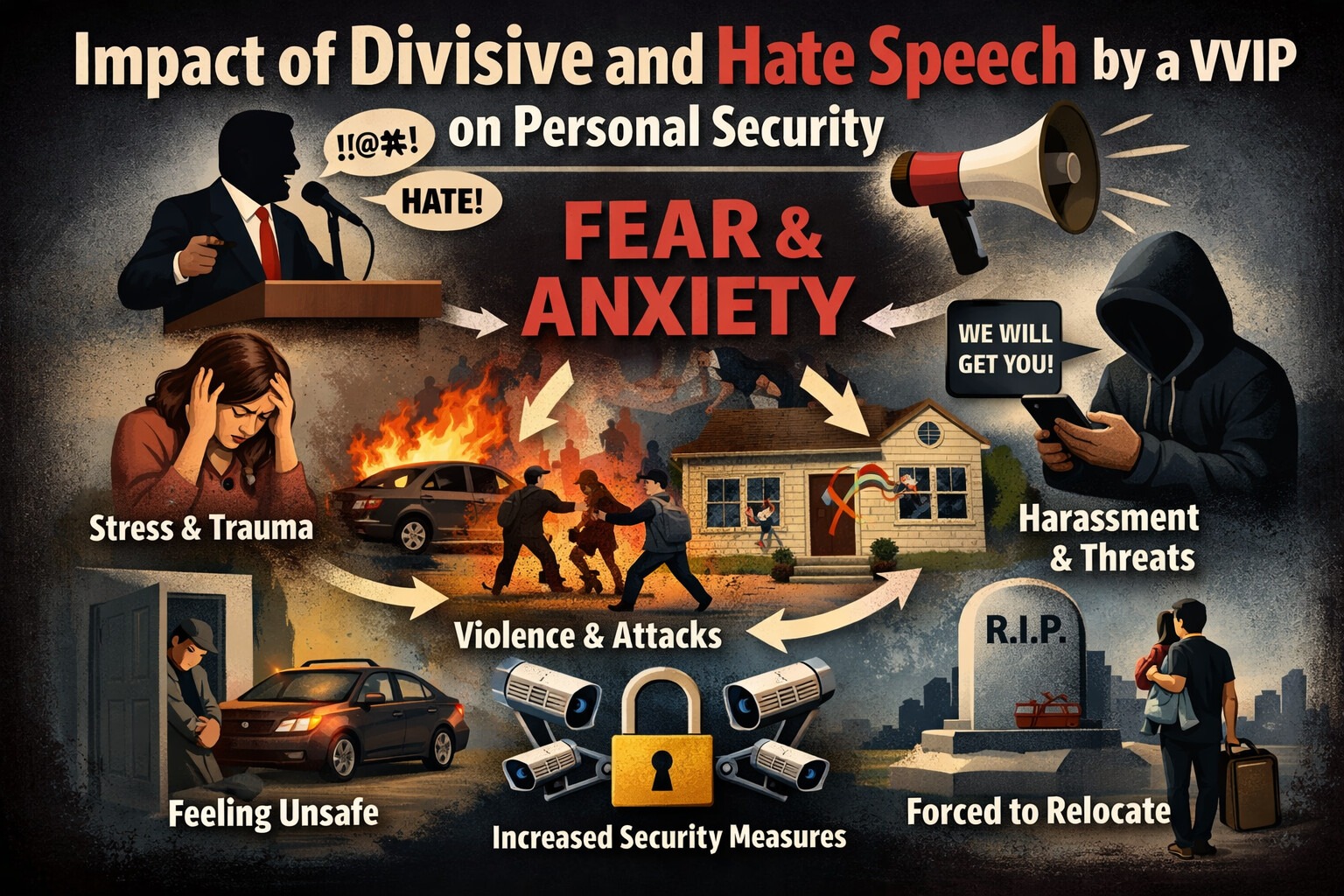
When a VVIP engages in divisive or hate speech, the fallout transcends ethical, moral, or legal debates. Such rhetoric directly reshapes the threat landscape, complicates protection protocols, and elevates risks of targeted attacks, spontaneous violence, and insider vulnerabilities. From a security viewpoint, hate speech is not abstract ideology—it is a self-generated operational risk that narrows the margin for error.
VVIP security is dynamic, responding to intelligence, public mood, political context, and social divisions. Divisive rhetoric—centered on religion, caste, ethnicity, region, language, ideology, or nationalism—acts as a potent threat multiplier: it polarizes populations, radicalizes fringes, emboldens extremists, and destabilizes crowd behavior.
Understanding Divisive and Hate Speech in the VVIP Context
Divisive or hate speech may be understood as public expression that:
- Targets individuals or groups based on identity
- Dehumanizes, vilifies, or portrays a community as an existential threat
- Encourages exclusion, hostility, or discrimination
- Normalizes or indirectly legitimizes violence
When such speech originates from a VVIP, its impact is magnified exponentially due to three interlinked factors.
First, the Authority Effect. Audiences often treat statements by VVIPs as morally or politically legitimate, regardless of their legality or accuracy.
Second, Amplification. Traditional media, social media platforms, and partisan networks rapidly disseminate such statements, often stripping them of nuance and heightening emotional impact.
Third, Symbolism. The VVIP ceases to be merely an individual and becomes a living symbol of an ideology, grievance, or perceived injustice.
From a protection standpoint, this symbolic transformation is crucial. Security threats are rarely personal alone; they are ideological. Divisive rhetoric converts a political leader into a lightning rod for resentment, retaliation, and radical action.
Polarization and the Expansion of the Threat Spectrum
Creation of Motivated Adversaries Divisive speech sharpens “us vs. them” divides, expanding the pool of potential threats. Affected individuals may develop deep grievances, collective resentment, or moral justifications for violence—fuelling lone-actor radicalization or extremist manipulation.
From Political Rival to Existential Enemy Healthy opposition views leaders as legitimate adversaries within constitutional bounds. Hate speech reframes them as oppressors or existential threats, lowering psychological barriers to violence and forcing security to prepare for spontaneous, ideologically driven acts.
Impact on Crowd Dynamics and Public Events
Volatility of Public Gatherings
VVIP movements frequently involve rallies, roadshows, inaugurations, and public interactions. Divisive rhetoric fundamentally alters the character of such gatherings:
- Supporters become emotionally charged and aggressive
- Opponents attempt infiltration with hostile intent
- Neutral participants are drawn into confrontations
This volatility heightens the risk of stampedes, clashes, and sudden attacks using improvised or opportunistic weapons. Crowd psychology becomes unpredictable, compressing reaction time for security personnel.
Erosion of Security Buffers
Divisive speech often triggers counter-mobilization. Protesters and rival groups may deliberately approach venues or routes, seeking confrontation. This reduces spatial buffers, strains crowd-segregation plans, and increases the likelihood of breaches.
From a protection standpoint, managing a polarized crowd is exponentially more dangerous than securing a celebratory or politically neutral gathering.
Lone-Wolf and Insider Threats
Lone-Actor Violence
Modern protective doctrines recognize lone-wolf attackers as among the most dangerous threats. Such individuals:
- Operate without formal organizational links
- Evade traditional intelligence detection
- Are driven by ideology, grievance, or identity
Divisive speech can act as a catalytic trigger. Violence is framed by the attacker as retaliation, justice, or sacrifice. Even low-capability attackers can inflict serious harm in close-contact environments.
Insider Vulnerabilities
Security systems rely heavily on human integrity—drivers, escorts, police personnel, event staff, and volunteers. Divisive rhetoric can generate silent resentment within these layers.
Insider risk does not always manifest as overt hostility. It may appear as:
- Deliberate negligence
- Information leakage
- Reduced vigilance at critical moments
Thus, a VVIP’s rhetoric can indirectly corrode the human reliability of the security chain.
Strain on Intelligence and Threat Assessment
Intelligence Overload
Following divisive speeches, intelligence agencies typically observe:
- Spikes in online threats
- Intensified social media chatter
- Increased extremist propaganda
Distinguishing credible threats from emotional noise becomes increasingly difficult. Analysts must parse sarcasm, hyperbole, and genuine intent under severe time pressure, increasing the likelihood of misjudgement.
Rapidly Shifting Threat Profiles
A single speech can instantaneously alter threat perceptions across regions or communities. Areas previously assessed as low-risk may become sensitive overnight, necessitating:
- Rapid revision of threat matrices
- Reallocation of forces
- Changes in route planning and venue selection
Such accelerated adjustments increase operational stress and the probability of oversight.
Legal Fallout as a Security Multiplier
Legal Scrutiny and Public Backlash
Divisive speech may invite court proceedings, election commission action, or regulatory scrutiny. These developments intensify media focus and public debate, further inflaming emotions.
For security planners, legal controversy translates into:
- Larger protests
- Denser media presence
- Unpredictable crowd behaviour
Erosion of Moral Authority
A VVIP perceived as divisive often loses moral legitimacy among segments of society. This erosion has indirect security implications:
- Reduced public cooperation
- Lower compliance with security advisories
- Increased hostility toward protective personnel
Public goodwill remains an intangible yet critical layer of security.
Inter-Agency Coordination Under Stress
Security agencies are expected to operate professionally and impartially. Polarizing rhetoric places them under strain, leading to:
- Political pressure
- Conflicting perceptions among personnel
- Fear of being labelled partisan
In federal systems, this can complicate coordination between central and state agencies, subtly affecting morale, trust, and decision-making.
Additionally, enhanced deployments and monitoring divert resources from other priorities, leading to fatigue and reduced systemic resilience.
Indian Experience: Speech, Polarization, and Security Risk
India’s diverse, communally sensitive landscape and intense electoral cycles make it especially vulnerable. Polarizing rhetoric has repeatedly triggered:
- Immediate violence near venues
- Large protests/counter-protests
- Assassination intelligence alerts
- Emergency SPG/NSG/state police recalibrations
Threat intensity frequently spikes in the immediate post-speech window, especially during VVIP transit phases and unscheduled or semi-public movements. The February 2020 Delhi riots, which resulted in over 50 fatalities, exemplify this dynamic: inflammatory statements delivered during the anti-CAA protests were subsequently referenced in police investigations, court filings, and Supreme Court proceedings—including bail orders and arguments in 2025–2026—as contributing to large-scale mobilization, obstruction of critical supply chains, and a sustained atmosphere of fear. These conditions compelled the imposition of extraordinary, multi-layered security and protective deployments.
Global Comparative Perspective
Cross-nationally, divisive rhetoric correlates with heightened political violence:
- United States: US Capitol Police investigated 9,474 concerning statements and direct threats in 2024 (a near-record high, with trends indicating sustained elevation into 2025). This surge aligns with the January 6, 2021, Capitol attack and ongoing plots against lawmakers, overburdening protective resources.
- Europe: The May 2024 assassination attempt on Slovak Prime Minister Robert Fico unfolded amid deep polarization and toxic discourse, illustrating how charged rhetoric fosters environments ripe for lone-actor attacks.
- Broader patterns (from Africa, Asia, and elsewhere) show inflammatory speech rebounding as inward risk to the speaker.
Mitigation Strategies for Security Agencies
To manage these self-generated risks, security frameworks must adapt:
- Integrating Rhetorical Analysis into threat assessment
- Training personnel to manage polarized crowds and insider biases
- Advising restraint and de-escalation, even in adversarial political contexts
- Strengthening inter-agency neutrality and trust
- Balancing legal safeguards with democratic freedoms
Ultimately, disciplined rhetoric is not political weakness—it is a security asset.
Divisive Rhetoric by Leaders: From Words to Concrete Security Threats
Real-world experience across democracies shows that inflammatory, divisive, or hate-filled rhetoric by high-profile leaders repeatedly generates tangible security risks, escalating beyond political debate into threats, violence, and strain on protective systems.
In India, provocative speeches during election campaigns or communal tensions have frequently triggered immediate violent fallout—such as protests, stone-pelting near venues, convoy attacks, and urgent intelligence alerts. These incidents have forced enhanced Special Protection Group (SPG) and state police deployments, last-minute programme cancellations, or route alterations. The February 2020 Delhi communal riots, which claimed over 50 lives, remain a stark example: inflammatory political statements (including ultimatums and calls at protest sites) were cited in media reports, police investigations, court proceedings, and judicial analyses as factors that inflamed tensions and fostered an environment of fear. This necessitated massive, extraordinary security arrangements for leaders, public figures, and sensitive sites amid widespread unrest.
In the United States, polarizing political language has aligned with a documented surge in threats against elected officials and institutions. United States Capitol Police Threat Assessment Section data reveal a sharp rise: investigations reached approximately 9,474 concerning statements and direct threats in 2024 alone (with projections indicating even higher numbers in subsequent years), a marked increase from pre-2021 levels. This escalation has coincided with major incidents, including the January 6, 2021, U.S. Capitol attack (linked in bipartisan investigations and reports to inflammatory rhetoric) and repeated plots or attempts against lawmakers. The result is persistent overload on protective details, intelligence monitoring, and law enforcement resources.
In Europe, extreme or divisive rhetoric from political leaders has historically preceded targeted violence during periods of ideological polarization. A recent illustration is the May 2024 assassination attempt on Slovak Prime Minister Robert Fico, which occurred amid months of intense political division, toxic discourse, and mutual accusations of hatred. Analyses (including from international outlets and domestic observers) highlight how such charged rhetoric contributed to a climate conducive to lone-actor or ideologically driven attacks on high-profile figures, underscoring risks to personal security and democratic stability.
These cross-country patterns demonstrate that when VVIP rhetoric deepens social fault lines, it ceases to be abstract controversy and instead manifests as heightened personal dangers for leaders: volatile crowds, elevated lone-actor threats, frequent intelligence-triggered security upgrades, and ongoing burdens on protective apparatuses. Recognizing inflammatory speech as a potential security catalyst—not merely protected expression—is essential for proactive risk mitigation.
Conclusion
Divisive and hate speech by a VVIP is a double-edged sword. While it may energize political bases, it simultaneously magnifies personal security vulnerabilities. In India and across the world, evidence consistently shows that such rhetoric expands threat pools, strains protective systems, and invites violence.
Security is not built solely through weapons, convoys, or commandos. It is sustained by social cohesion and public legitimacy—both of which leaders themselves shape. In an era of amplified voices and instant outrage, restraint is not silence; it is strategic wisdom.