





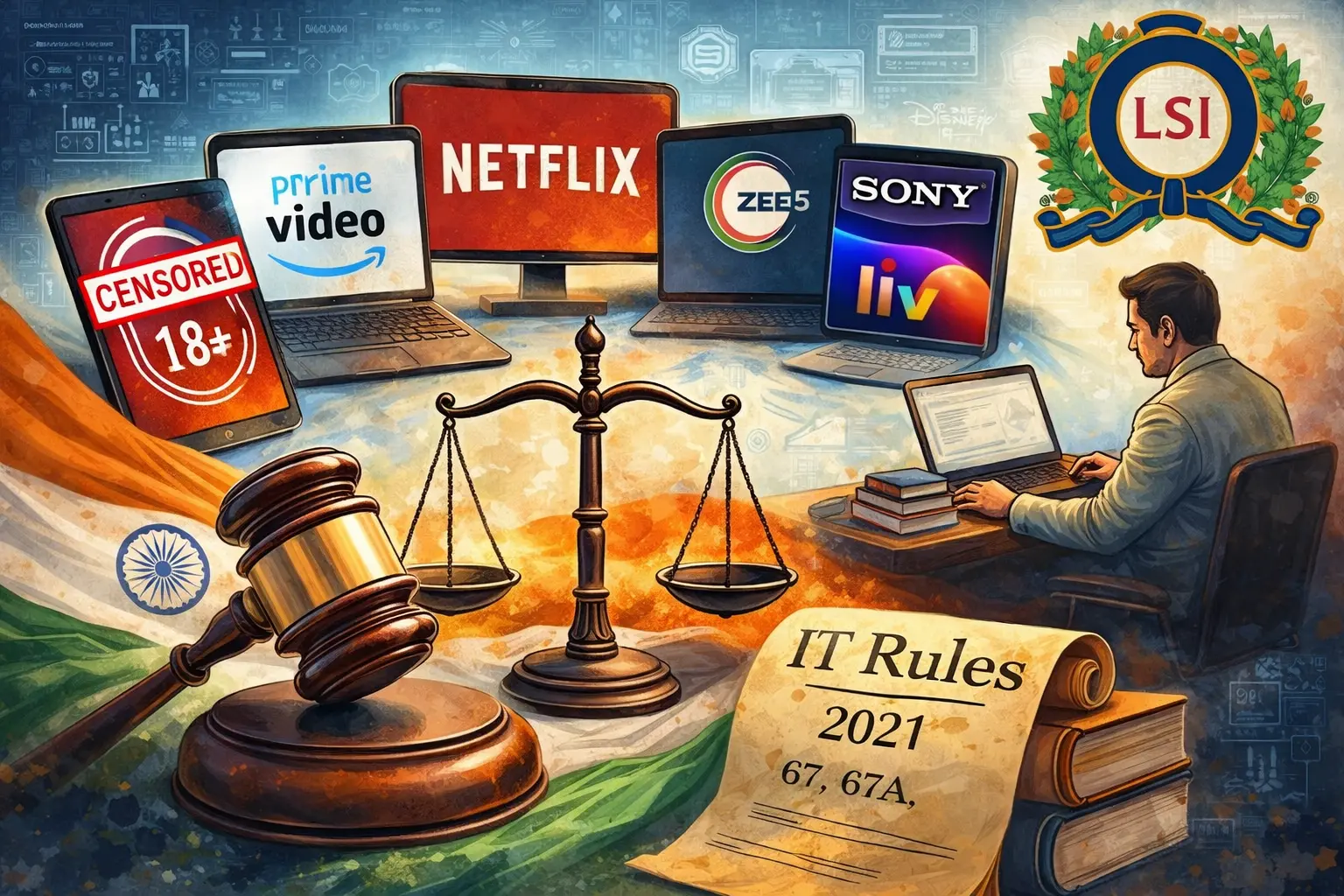
Introduction: Rise of OTT Platforms in India
Over the past decade, the utilisation of Over-The-Top (OTT) platforms has significantly witnessed a rise in India, establishing themselves as popular mediums for entertainment, news, and information among millions of Indians. However, this rise in usage has sparked concerns regarding the regulatory framework governing these platforms. This article endeavours to furnish an overview of the legal framework overseeing OTT platforms in India, encompassing the laws, regulations, and guidelines instituted by the Indian government.
Over-the-top (OTT) services deliver media directly to consumers via the internet. Accessing them on computers, desktop software, mobile devices, and tablets remains straightforward. As of late 2025, India boasts approximately 900 million active internet users and over 1.17 billion wireless mobile connections, fueling a surge in OTT adoption with paid subscribers exceeding 100 million across major platforms.
Growth Projections and Digital Infrastructure
India’s OTT customer base is poised for explosive growth, potentially reaching 250-300 million paid subscribers by 2028, driven by affordable data, 5G expansion to 770 million users, and rising smartphone penetration nearing 1 billion devices. Total internet users are expected to surpass 1 billion, while mobile connections could hit 1.2 billion, amplifying OTT consumption through enhanced streaming quality and regional content.
Market Landscape and Key Players
Global platforms like Amazon Prime Video and Netflix are steadily capturing greater market share, even as regional video-on-demand services such as Jio Hotstar, Zee5 and SonyLIV gain widespread popularity. The Digital India program plays a pivotal role in promoting OTT adoption by enabling access to a vast library of international content. OTT services have evolved dramatically from their humble origins, with the global pandemic accelerating their rise by fundamentally shifting consumer entertainment habits across all media formats.
Meaning and Scope of OTT Platforms
What Is OTT
Over-The-Top (OTT) platforms are digital services that deliver audio, video, and other media content directly to users over the internet, bypassing traditional distribution channels such as cable television, satellite networks, or cinema halls. Unlike conventional broadcasting services, OTT platforms do not require dedicated transmission infrastructure and rely entirely on internet connectivity to deliver content.
In the Indian context, OTT platforms primarily function as internet-based content providers offering on-demand access to films, web series, documentaries, short films, and live-streamed events. Popular examples include Netflix, Amazon Prime Video, Zee5, SonyLIV, and MX Player. These platforms operate on subscription-based, advertisement-supported, or hybrid revenue models.
Legally, OTT platforms fall within the broader category of “digital media” and are governed largely by the Information Technology Act, 2000, and the Information Technology (Intermediary Guidelines and Digital Media Ethics Code) Rules, 2021. Unlike films certified under the Cinematograph Act, 1952 or television programmes regulated under the Cable Television Networks (Regulation) Act, 1995, OTT content is not subject to pre-censorship, which has been a central point of regulatory debate.
Scope of OTT
Reach and Accessibility
OTT platforms possess a far wider geographical reach compared to traditional media. Content hosted on such platforms is accessible across national boundaries, subject only to internet availability. This transnational nature raises complex jurisdictional issues concerning content regulation, censorship, and enforcement of domestic laws.
In India, the affordability of mobile data and increased smartphone penetration have significantly expanded the consumer base of OTT platforms, making them a dominant medium of entertainment.
Creative Freedom and Content Diversity
One of the defining aspects of OTT platforms is the relative creative autonomy they offer to content creators. Freed from rigid broadcast schedules and conventional censorship norms, OTT platforms have facilitated experimentation with themes such as sexuality, politics, religion, caste, and gender identity. This has contributed to more nuanced and diverse storytelling but has simultaneously triggered concerns regarding obscenity, cultural sensitivity, and public morality.
Legal Framework Governing OTT Platforms in India
The regulatory framework governing Over-The-Top (OTT) platforms in India is fragmented and evolving. Unlike traditional media such as cinema and television, OTT platforms were initially unregulated, operating in a legal vacuum. However, with the rapid growth of digital streaming services and their increasing influence on public discourse, the Indian legal system has gradually extended existing statutory and constitutional principles to govern OTT content.
The primary legal instruments applicable to OTT platforms include the Information Technology Act, 2000, the Cinematograph Act, 1952 (with limited relevance), and the constitutional guarantees of freedom of speech and expression under Article 19 of the Constitution of India.
Information Technology Act, 2000
The Information Technology Act, 2000 (IT Act) serves as the principal legislation governing digital and online content in India. Although the Act does not explicitly mention OTT platforms, its broad definitions and regulatory scope bring such platforms within its ambit.
Under Section 2(1)(w) of the IT Act, OTT platforms may qualify as “intermediaries” insofar as they host, transmit, or provide access to content through their digital infrastructure. Consequently, OTT platforms are subject to intermediary liability provisions under Section 79 of the Act, which grants conditional “safe harbour” protection, provided the intermediary observes due diligence and complies with statutory obligations.
Further, Sections 67, 67A, and 67B of the IT Act penalise the publication or transmission of obscene, sexually explicit, and child sexual abuse material in electronic form. These provisions are often invoked in complaints against OTT content alleged to violate public morality or decency standards.
Strengthening of the Regulatory Framework: IT Rules, 2021
The regulatory framework under the IT Act was substantially strengthened with the introduction of the Information Technology (Intermediary Guidelines and Digital Media Ethics Code) Rules, 2021. These Rules explicitly brought publishers of online curated content, including OTT platforms, under a three-tier regulatory mechanism consisting of:
- Self-regulation by the platform
- Self-regulation by an industry-level body
- Oversight by the Central Government
The Rules mandate adherence to a Code of Ethics, age-based content classification, parental controls, and a structured grievance redressal mechanism. Thus, the IT Act forms the statutory foundation for OTT regulation in India.
Cinematograph Act, 1952 and Its Limited Applicability
The Cinematograph Act, 1952 governs the certification and public exhibition of films in India through the Central Board of Film Certification (CBFC). The Act mandates prior certification of films before their public exhibition in cinema halls.
However, the applicability of the Cinematograph Act to OTT platforms remains limited. OTT content is disseminated via private digital platforms and is accessed on-demand by individual users rather than being exhibited publicly in a physical space. As a result, OTT platforms are not subject to mandatory pre-censorship or CBFC certification.
While certain judicial observations have drawn parallels between films released in theatres and films streamed online, no statutory amendment has explicitly extended the CBFC’s jurisdiction to OTT platforms. Consequently, OTT content remains outside the purview of the Cinematograph Act, reinforcing the distinction between traditional film exhibition and digital content delivery.
This regulatory gap has been a key factor in debates surrounding the need for censorship or alternative regulatory models for OTT platforms.
Constitutional Provisions: Article 19(1)(a) and Article 19(2)
The constitutional framework plays a crucial role in shaping the regulation of OTT platforms in India. Article 19(1)(a) of the Constitution guarantees the fundamental right to freedom of speech and expression, which extends to all forms of media, including digital and online platforms.
OTT platforms and content creators rely on this constitutional protection to assert creative freedom and autonomy in content creation. However, this right is not absolute. Article 19(2) permits the State to impose reasonable restrictions on the exercise of free speech in the interests of sovereignty and integrity of India, security of the State, public order, decency or morality, and other specified grounds.
Balancing Free Speech and Regulatory Concerns
In the context of OTT platforms, the challenge lies in ensuring that regulatory measures do not have a chilling effect on free expression while simultaneously addressing legitimate concerns relating to obscenity, hate speech, misinformation, and public order. Courts have consistently emphasised the principle of proportionality, requiring restrictions on speech to be reasonable, narrowly tailored, and backed by statutory authority.
Thus, the regulation of OTT platforms must strike a constitutional balance between safeguarding freedom of expression and enforcing reasonable restrictions in the public interest.
Regulation and Content Management Policies
With the rapid expansion of OTT platforms and the absence of traditional pre-censorship mechanisms, content regulation in the digital space has largely evolved around principles of self-regulation, post-publication oversight, and governmental supervision. India has adopted a hybrid regulatory framework that seeks to balance creative freedom with accountability through structured content management policies under the Information Technology (Intermediary Guidelines and Digital Media Ethics Code) Rules, 2021.
Self-Regulation and Grievance Redressal Mechanism
Self-regulation constitutes the first and foundational tier of OTT content governance in India. Under the IT Rules, 2021, OTT platforms are required to establish internal mechanisms to ensure compliance with the prescribed Code of Ethics.
Each OTT platform must appoint a Grievance Officer, who is responsible for addressing user complaints relating to content hosted on the platform. Complaints may pertain to issues such as obscenity, religious sensitivity, misinformation, or age-inappropriate material. The Grievance Officer is mandated to acknowledge complaints within twenty-four hours and dispose of them within fifteen days.
- Acknowledge complaints within twenty-four hours
- Dispose of complaints within fifteen days
- Address concerns related to content standards and viewer sensitivity
At the second tier, OTT platforms may be members of a self-regulatory body headed by a retired judge or an independent eminent person. These bodies are entrusted with monitoring adherence to the Code of Ethics, hearing unresolved grievances, and issuing guidance or advisories to member platforms.
This layered self-regulatory approach reflects a shift away from direct censorship towards industry-led accountability. However, critics argue that self-regulation may lack uniformity and enforceability, particularly in cases involving politically or socially sensitive content.
Role of the Ministry of Information and Broadcasting
The Ministry of Information and Broadcasting (MIB) plays a supervisory role in the regulation of OTT platforms under the third tier of the regulatory mechanism. Although OTT platforms are not subject to prior approval or certification by the government, the MIB acts as the oversight authority to ensure compliance with the IT Rules, 2021.
The Ministry has the power to issue directions to OTT platforms in cases involving violations of the Code of Ethics or where content poses risks to public order, national security, or sovereignty. An Inter-Departmental Committee (IDC), constituted by the MIB, examines complaints referred by self-regulatory bodies and may recommend appropriate action, including content modification, access restriction, or removal.
| Authority | Function |
|---|---|
| Ministry of Information and Broadcasting | Supervisory oversight and enforcement of IT Rules, 2021 |
| Inter-Departmental Committee | Examination of complaints and recommendation of corrective measures |
While governmental oversight is justified on grounds of public interest, concerns have been raised regarding executive overreach and the potential chilling effect on freedom of expression. The absence of judicial involvement at the oversight stage has been a focal point of constitutional challenges to the IT Rules.
Thus, the role of the MIB highlights the tension between regulatory supervision and the preservation of editorial independence in the OTT ecosystem.
Age Classification and Content Descriptors
Age classification and content descriptors form an essential component of content management policies for OTT platforms. Unlike traditional cinema certification, which relies on a uniform certification process, OTT platforms follow a self-classification model based on age suitability.
Under the IT Rules, OTT platforms are required to classify content into categories such as:
- U (Universal)
- U/A 7+
- U/A 13+
- U/A 16+
- A (Adult)
Additionally, platforms must provide clear content descriptors, including information related to violence, nudity, sexual content, substance abuse, or strong language. These descriptors enable viewers to make informed choices and align content consumption with personal or parental discretion.
Role Of Third-Party Platforms: Understanding IMDb
Internet Movie Database (IMDb) is a globally recognised online database that provides information relating to films, television series, web shows, cast, crew, ratings, and user-generated reviews. Owned by Amazon, IMDb has become an influential third-party platform that significantly shapes public perception of audiovisual content, including productions released on OTT platforms.
IMDb As A Third-Party Platform In The OTT Ecosystem
In the OTT ecosystem, IMDb functions as a content aggregator and feedback forum rather than a content publisher. Viewers frequently rely on IMDb ratings and reviews to determine whether to watch a particular film or series. Consequently, IMDb plays an indirect yet powerful role in the commercial success, audience reception, and reputational standing of OTT content.
Key Functions Of IMDb
- Provides information on films, television series, and web shows
- Hosts ratings and user-generated reviews
- Influences viewer choices and audience reception
- Impacts the commercial success of OTT content
| Aspect | Role Of IMDb |
|---|---|
| Nature Of Platform | Content aggregator and feedback forum |
| Ownership | Owned by Amazon |
| Impact | Shapes public perception and reputational standing of OTT content |
OTT Censorship: Necessity Or Excessive Control?
The censorship of content on Over-the-Top (OTT) platforms has become a prominent subject of public and legal debate, centring on concerns regarding creative expression within the entertainment industry. Opinions are sharply divided on whether pre-release censorship is necessary. Proponents argue that it is essential to protect viewers and maintain societal standards, while opponents contend that it undermines artistic integrity and raises significant questions about freedom of speech and expression for creators.
Complexity Of The OTT Censorship Debate
The debate is further complicated by the profound influence that film and series content can have on public opinion, making the issue particularly complex. Indian jurisprudence has addressed aspects of this dilemma in notable cases.
Judicial Perspectives On OTT Regulation
In Padmanabh Shankar v. Union of India, the court observed that content on OTT platforms cannot be equated with public exhibitions and therefore should not be subject to traditional censorship models. The ruling suggested that prioritising broad societal interests at the cost of individual creative freedom is a problematic approach for regulating OTT material.
Conversely, it is argued that a measured regulatory framework safeguards the rights of service providers and maintains a baseline of content quality, making it a necessary measure in the public interest. This perspective finds some balance in rulings like Shreya Singhal v. Union of India, where the Supreme Court held that online content cannot be restricted without evidence of direct incitement to offence or violence.
| Case | Key Observation |
|---|---|
| Padmanabh Shankar v. Union of India | OTT content should not be equated with public exhibitions or traditional censorship models |
| Shreya Singhal v. Union of India | Online content cannot be restricted without direct incitement to offence or violence |
Need For A Balanced And Nuanced Approach
Overall, the discussion around OTT censorship underscores the need for preventive measures that are both nuanced and adaptable to evolving digital landscapes, protecting fundamental freedoms while addressing legitimate societal concerns.
Judicial Precedents
Judicial intervention has played a pivotal role in shaping the regulatory discourse surrounding OTT platforms in India. While courts have largely refrained from imposing blanket censorship, they have consistently emphasised constitutional safeguards, proportionality, and the need for a balanced regulatory approach. The following judicial precedents provide critical insight into the evolving legal position on OTT regulation and digital content governance.
Justice for Rights Foundation v. Union of India
In Justice for Rights Foundation v. Union of India, a public interest litigation was filed seeking the regulation and certification of content published on OTT platforms, alleging that unregulated digital content violated societal morals and posed risks to children and public order.
The Supreme Court declined to issue directions mandating censorship of OTT platforms, observing that the absence of a specific statutory framework at the time limited judicial intervention. The Court emphasised that policy formulation and regulatory structuring fall within the domain of the legislature and executive, not the judiciary.
This decision is significant as it reaffirmed the principle of separation of powers and indicated judicial reluctance to impose content regulation without statutory backing. The case indirectly paved the way for executive action, culminating in the introduction of the IT Rules, 2021, thereby formalising OTT regulation through delegated legislation.
Key Takeaways
- Judicial restraint in the absence of a statutory framework
- Reaffirmation of the principle of separation of powers
- Recognition of the legislature and executive as the appropriate policy-making authorities
Amazon Prime Video India Cases
Several legal challenges have been instituted against content hosted on Amazon Prime Video, particularly concerning web series alleged to hurt religious sentiments or promote obscenity. A prominent example includes litigation arising from the series Tandav, which faced multiple FIRs across different States for allegedly offending religious beliefs.
In response, the Supreme Court and various High Courts examined the constitutional implications of imposing criminal liability for creative expression. Courts underscored the importance of protecting artistic freedom under Article 19(1)(a) while cautioning OTT platforms to exercise due diligence in content dissemination.
Judicial Approach
| Aspect | Judicial Emphasis |
|---|---|
| Creative Expression | Protection of artistic freedom under Article 19(1)(a) |
| Criminal Liability | Cautious approach toward imposing criminal sanctions |
| Platform Responsibility | Due diligence in content dissemination |
Conclusion
The rise of OTT platforms has fundamentally transformed the media and entertainment landscape in India, offering unprecedented creative freedom and access to diverse narratives. At the same time, the reach and influence of digital content necessitate a regulatory framework that addresses legitimate concerns relating to public order, decency, and social responsibility.
Any attempt to regulate OTT platforms must carefully balance the constitutional guarantee of freedom of speech and expression under Article 19(1)(a) with the reasonable restrictions permitted under Article 19(2). Excessive state control or blanket censorship risks stifling artistic expression and creating a chilling effect on digital creativity, while a complete absence of regulation may undermine public interest and accountability.
The way forward lies in a transparent, proportionate, and rights-oriented regulatory model that prioritises self-regulation, effective grievance redressal, and limited governmental oversight. Strengthening content classification mechanisms, enhancing digital literacy, and ensuring judicial scrutiny of executive action can collectively contribute to responsible OTT governance. If implemented with constitutional sensitivity, such a framework can preserve creative autonomy while fostering a mature and accountable digital media ecosystem in India.

