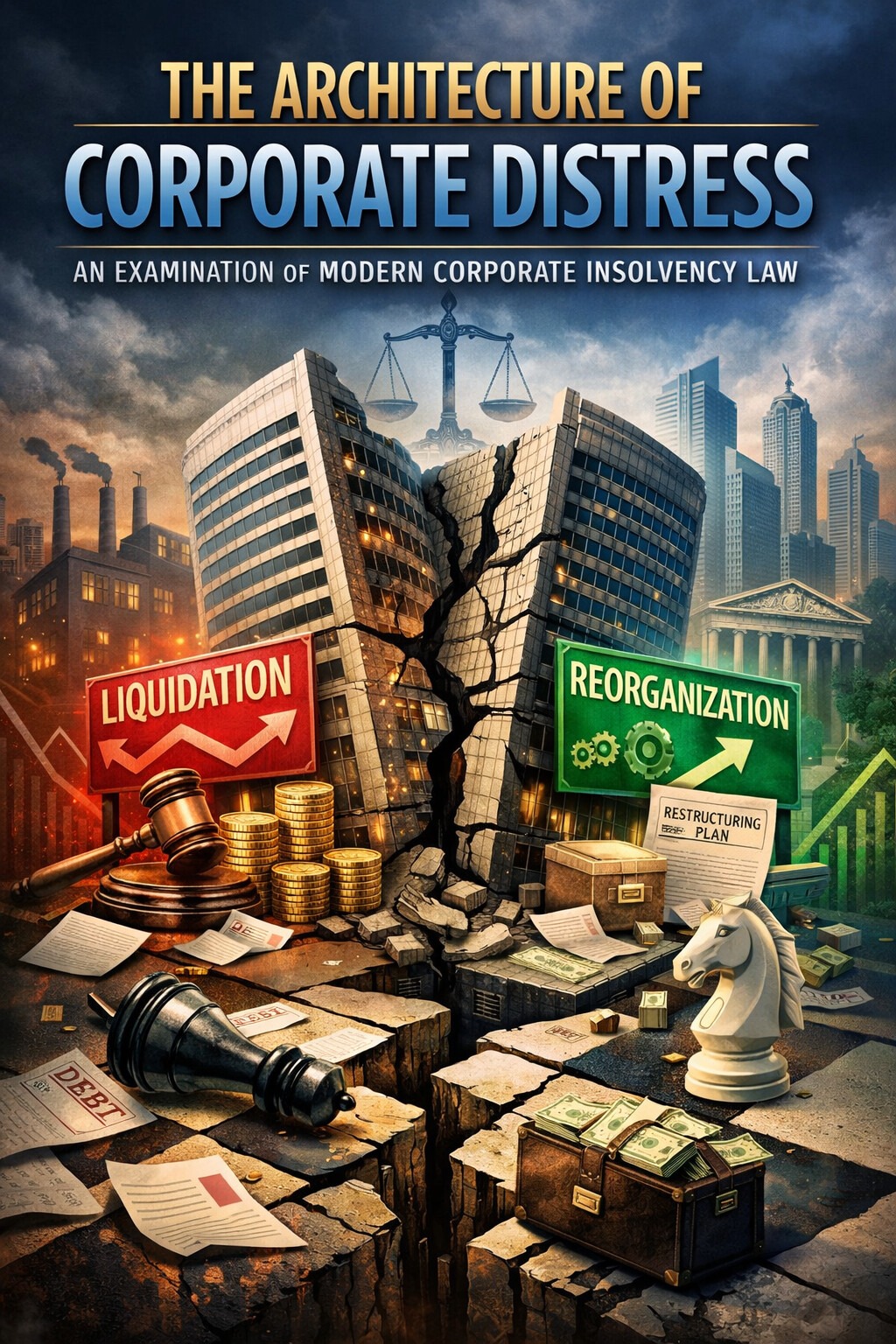
Introduction: The Necessity of a Robust Insolvency Framework
Corporate insolvency law, often perceived as the final chapter in a company’s lifecycle, is in fact one of the most vital pillars of a modern market economy. It provides the legal architecture for addressing financial failure while balancing the competing interests of creditors, employees, shareholders, and the broader economy. At its core, insolvency law pursues two fundamental objectives: efficient resolution of distress and maximisation of economic value.
Historically, insolvency regimes were punitive in nature and oriented primarily toward liquidation. Contemporary insolvency laws, however, emphasise the preservation and revival of viable enterprises through structured reorganisation. A well-designed insolvency framework mitigates systemic risk, improves access to credit, and ensures the swift reallocation of capital from inefficient to productive uses. This global evolution is exemplified by India’s Insolvency and Bankruptcy Code, 2016 (IBC), which marked a decisive shift from a “debtor-in-possession” regime to a “creditor-in-control” model.
- Defining Corporate Insolvency and Its Objectives
1.1 Meaning of Corporate Insolvency
Corporate insolvency arises when a company is unable to meet its financial obligations as they fall due (cash-flow insolvency) or when its liabilities exceed its assets (balance-sheet insolvency). It represents a state of financial distress requiring legal intervention either to restructure debts or to liquidate assets in an orderly manner.
1.2 Core Objectives of Modern Insolvency Law
Modern insolvency statutes are structured around three central objectives:
- Value Maximisation: Ensuring that the company’s assets are deployed or restructured in a manner that yields the highest possible returns for stakeholders, particularly creditors.
- Reorganisation and Rescue: Providing viable businesses with an opportunity to continue as going concerns, thereby preserving employment, enterprise value, and economic stability.
- Timely Resolution: Establishing predictable, time-bound processes to minimise delay, prevent erosion of asset value, and enhance the ease of doing business.
- Global Insolvency Models: Liquidation and Reorganisation
Insolvency systems worldwide generally operate through two broad, often complementary, paradigms.
2.1 Liquidation (Winding Up)
Liquidation involves the closure of the company, sale of its assets, and distribution of proceeds to creditors according to a statutory priority framework.
- Voluntary Liquidation: Initiated by shareholders of a solvent company or creditors of an insolvent one.
- Compulsory Liquidation: Ordered by a court, typically upon a creditor’s petition for non-payment of debts.
2.2 Reorganisation (Corporate Rescue)
Reorganisation aims to preserve the company as a going concern by imposing a temporary moratorium on creditor actions, allowing time for the formulation and implementation of a viable restructuring plan.
- United States – Chapter 11: Allows existing management to retain control as “debtor in possession,” subject to court and creditor oversight, with a strong emphasis on future value maximisation.
- India – Corporate Insolvency Resolution Process (CIRP): Suspends management control and transfers authority to an independent Resolution Professional and the Committee of Creditors (CoC), ensuring a creditor-driven and time-bound process.
- The Insolvency and Bankruptcy Code, 2016: A Paradigm Shift
Before the enactment of the IBC, India’s insolvency regime was fragmented, slow, and largely debtor-friendly, resulting in mounting non-performing assets and low recovery rates. The IBC introduced a unified, market-oriented framework designed to resolve corporate distress efficiently.
3.1 Key Pillars of the IBC
- Unified Legal Framework: Consolidated multiple overlapping statutes into a single comprehensive law.
- Strict Timelines: Mandated completion of the CIRP within a maximum of 330 days, significantly reducing procedural delays.
- Creditor Control: Vested decision-making authority in the CoC, composed primarily of financial creditors.
- Professional Administration: Established a regulated ecosystem of Insolvency Professionals under the supervision of the Insolvency and Bankruptcy Board of India (IBBI).
3.2 The Corporate Insolvency Resolution Process (CIRP)
The CIRP follows a structured sequence:
- Initiation: Triggered by financial creditors, operational creditors, or the corporate debtor upon default of ₹1 crore or more.
- Moratorium: Upon admission by the NCLT, all legal actions against the debtor are stayed.
- Management Takeover: An Interim Resolution Professional assumes control of the company’s operations.
- CoC Formation: The CoC appoints a Resolution Professional and evaluates resolution plans.
- Approval of Resolution Plan: A plan must receive at least 66% CoC approval and NCLT confirmation.
- Liquidation: If resolution fails within the prescribed timeline, liquidation follows.
3.3 Section 29A and the Clean Slate Principle
Section 29A, introduced in 2017, disqualifies certain categories of persons—including wilful defaulters and defaulting promoters—from submitting resolution plans. This provision prevents those responsible for corporate failure from regaining control and ensures a genuine transfer of ownership, reinforcing the clean slate principle for new investors.
- Cross-Border Insolvency and International Harmonisation
4.1 The Need for Harmonisation
Globalised business operations often involve assets and creditors across multiple jurisdictions. In the absence of harmonised rules, parallel proceedings can lead to inefficiency, inconsistent outcomes, and diminished recoveries.
4.2 The UNCITRAL Model Law
The UNCITRAL Model Law on Cross-Border Insolvency (1997) offers a harmonised framework enabling cooperation between courts and insolvency authorities. It rests on four foundational principles:
- Access for foreign representatives to domestic courts
- Recognition of foreign insolvency proceedings
- Cooperation between courts and administrators
- Coordination of concurrent proceedings
India has proposed a framework to adopt the Model Law, signalling its commitment to align domestic insolvency practice with global standards, particularly for multinational corporate debtors.
- Challenges and Evolving Jurisprudence
5.1 Judicial Interpretation
The Supreme Court and the NCLAT have played a decisive role in shaping the IBC. Judicial decisions have upheld the primacy of the CoC’s commercial wisdom, clarified the scope of moratorium protections, and consistently reinforced the intent behind Section 29A.
5.2 Practical Challenges
Despite its success, the IBC faces continuing challenges:
- Judicial Delays: Case backlogs and limited NCLT capacity often extend proceedings beyond statutory timelines.
- Valuation Disputes: Divergent assessments of enterprise value frequently delay resolutions.
- MSME Constraints: The standard CIRP is often costly for small businesses, prompting the introduction of the Pre-Packaged Insolvency Resolution Process (PPIRP).
- Conclusion: Insolvency Law as an Economic Instrument
Modern insolvency law has evolved from a mechanism of punishment into a strategic economic tool. Statutes like the IBC promote discipline, expedite resolution of financial distress, and facilitate the redeployment of capital to productive sectors. By enabling viable enterprises to restart under new ownership, insolvency regimes strengthen investor confidence and support sustainable economic growth. Their continued success depends on judicial efficiency, regulatory capacity, and the ability to address increasingly complex and cross-border corporate failures.